
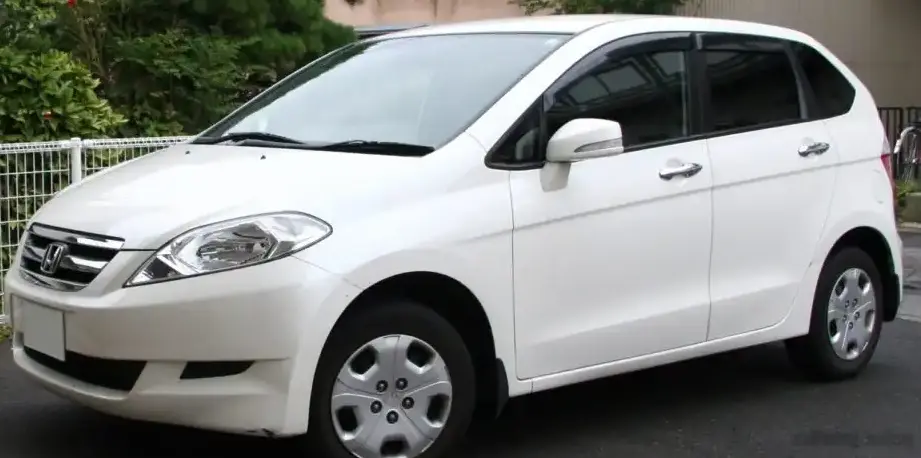
The Honda Edix 1.7, produced between 2004 and 2009, was a unique offering from Honda, primarily aimed at the Japanese domestic market (JDM) and select export markets. Positioned as a compact minivan, the Edix sought to blend the practicality of a multi-purpose vehicle with a somewhat sporty aesthetic. This particular variant, equipped with the 1.7-liter engine producing 130 horsepower and paired with a four-speed automatic transmission, represented a mid-range option within the Edix lineup, offering a balance between affordability and usability. It was a key model in Honda’s strategy to cater to families seeking a versatile vehicle in a relatively small footprint.
Technical Specifications
| Brand | Honda |
| Model | Edix |
| Generation | Edix |
| Type (Engine) | 1.7 (130 Hp) |
| Start of production | 2004 |
| End of production | 2009 |
| Powertrain Architecture | Internal Combustion engine |
| Body type | Minivan |
| Seats | 6 |
| Doors | 4 |
| Fuel Type | Petrol (Gasoline) |
| Weight-to-power ratio | 10.5 kg/Hp, 95.6 Hp/tonne |
| Weight-to-torque ratio | 8.8 kg/Nm, 114 Nm/tonne |
| Power | 130 Hp @ 6300 rpm |
| Power per litre | 77.9 Hp/l |
| Torque | 155 Nm @ 4800 rpm (114.32 lb.-ft. @ 4800 rpm) |
| Engine layout | Front, Transverse |
| Engine displacement | 1668 cm3 (101.79 cu. in.) |
| Number of cylinders | 4 |
| Engine configuration | Inline |
| Number of valves per cylinder | 4 |
| Fuel injection system | Multi-port manifold injection |
| Engine aspiration | Naturally aspirated engine |
| Valvetrain | SOHC |
| Engine oil capacity | 3.5 l (3.7 US qt | 3.08 UK qt) |
| Coolant | 5.5 l (5.81 US qt | 4.84 UK qt) |
| Kerb Weight | 1360 kg (2998.29 lbs) |
| Fuel tank capacity | 58 l (15.32 US gal | 12.76 UK gal) |
| Length | 4285 mm (168.7 in) |
| Width | 1795 mm (70.67 in) |
| Height | 1610 mm (63.39 in) |
| Wheelbase | 2680 mm (105.51 in) |
| Front track | 1550 mm (61.02 in) |
| Rear (Back) track | 1560 mm (61.42 in) |
| Drivetrain Architecture | The Internal combustion engine (ICE) drives the front wheels of the vehicle. |
| Drive wheel | Front wheel drive |
| Number of gears and type of gearbox | 4 gears, automatic transmission |
| Front brakes | Ventilated discs |
| Rear brakes | Drum |
| Tires size | 195/65 R15 |
| Wheel rims size | 15 |
Powertrain & Engine Architecture
The heart of the Edix 1.7 is the Honda D17A engine, a 1.7-liter inline-four cylinder powerplant. This engine utilizes a single overhead camshaft (SOHC) valvetrain and a multi-point fuel injection system. While not a particularly high-performance engine, the D17A is known for its reliability and fuel efficiency. The 130 horsepower output is achieved at 6300 rpm, while peak torque of 155 Nm (114 lb-ft) arrives at 4800 rpm. The engine’s design prioritizes smooth operation and everyday drivability over outright speed. The four-speed automatic transmission, while adequate for the vehicle’s intended purpose, is a relatively conventional unit and lacks the sophistication of more modern transmissions. It features typical torque converter lock-up for improved highway fuel economy.
Driving Characteristics
The Edix 1.7 Automatic delivers a comfortable, if not particularly exciting, driving experience. Acceleration is adequate for merging onto highways and navigating city streets, but it won’t win any drag races. The automatic transmission’s gear ratios are tuned for fuel economy and smooth shifts, rather than aggressive performance. Compared to the manual transmission versions of the Edix, the automatic feels noticeably slower, especially during overtaking maneuvers. The relatively low horsepower and torque figures mean the engine needs to be revved to extract maximum performance. The suspension is tuned for comfort, providing a reasonably smooth ride over most road surfaces. However, it’s not particularly sporty, and body roll is noticeable in corners.
Equipment & Trim Levels
The Edix 1.7 typically came equipped with a reasonable level of standard features, including air conditioning, power windows, power locks, and a basic audio system. Higher trim levels offered upgrades such as alloy wheels, a sunroof, and more advanced audio systems. Interior upholstery was typically cloth, with options for upgraded materials on higher trims. The dashboard layout is functional and straightforward, with easy-to-read gauges and controls. The six-seat configuration, with its unique arrangement of second and third-row seating, was a defining feature of the Edix.
Chassis & Braking
The Edix 1.7 utilizes a front-wheel-drive layout with a MacPherson strut suspension in the front and a torsion beam suspension in the rear. The front brakes are ventilated discs, providing adequate stopping power, while the rear brakes are drums, a cost-saving measure common in this class of vehicle. The 15-inch wheels are fitted with 195/65 R15 tires. The chassis is designed to prioritize comfort and practicality over sporty handling. Stabilizer bars are present, but their effectiveness is limited by the relatively soft suspension tuning.
Market Reception & Comparison
The Honda Edix 1.7 received mixed reviews from automotive critics. While praised for its spacious interior and unique seating configuration, it was often criticized for its uninspired styling and lackluster performance, particularly with the automatic transmission. Compared to other compact minivans available at the time, such as the Toyota Wish, the Edix offered a slightly more affordable price point but lacked the same level of refinement. Fuel economy was generally considered to be average for its class. Reliability was a strong point, as is typical for Honda vehicles.
Legacy
The Honda Edix, while not a mainstream success in many markets, remains a popular choice among enthusiasts seeking a unique and practical vehicle. The 1.7-liter engine and four-speed automatic transmission combination is generally considered to be reliable, although regular maintenance is essential. Parts availability can be a challenge in some regions, as the Edix was not widely sold outside of Japan and select export markets. Today, the Edix 1.7 can be found on the used car market at relatively affordable prices, making it an attractive option for budget-conscious buyers seeking a versatile and dependable vehicle.
