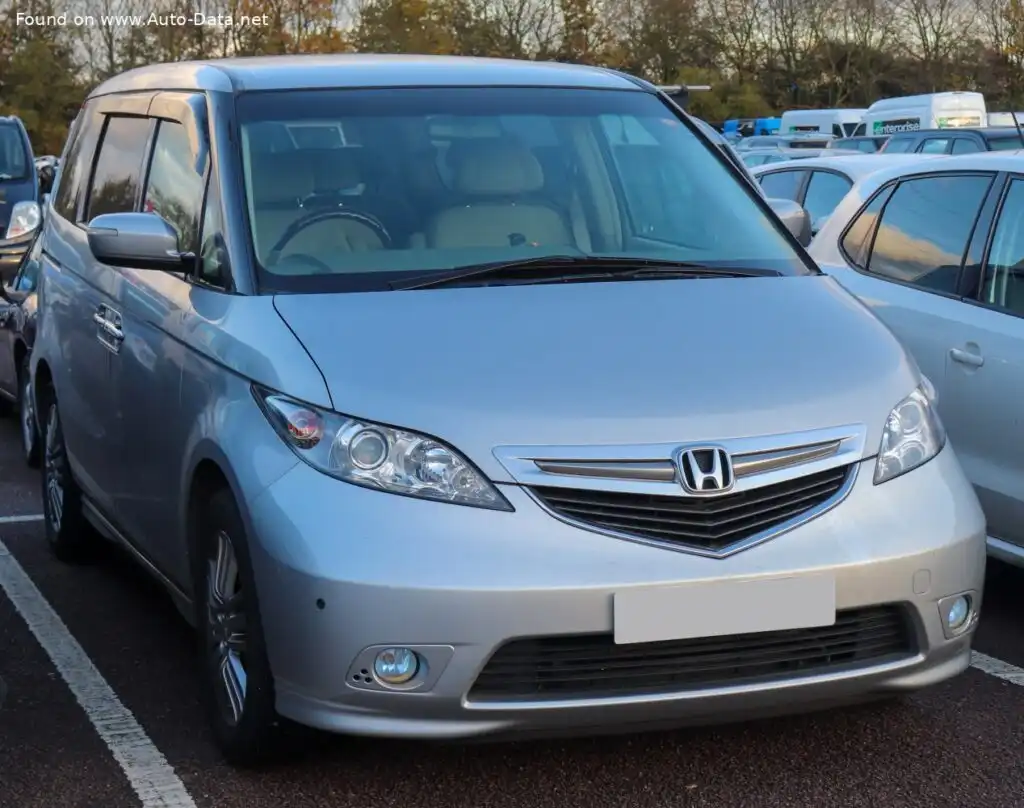
The Honda Elysion is a minivan that was produced by Honda from 2004 to 2015. Primarily aimed at the Japanese domestic market (JDM), the Elysion offered a spacious and comfortable interior, focusing on family transportation. The first generation, known as the Elysion I, was based on a dedicated platform and distinguished itself with a focus on interior flexibility and a relatively upscale feel for its class. This article will focus specifically on the 3.0 i V6 24V variant, produced throughout the Elysion I’s lifespan, representing the top-tier engine option for the model.
Technical Specifications
| Brand | Honda |
| Model | Elysion |
| Generation | Elysion I |
| Type (Engine) | 3.0 i V6 24V (200 Hp) |
| Start of production | 2004 |
| End of production | 2015 |
| Powertrain Architecture | Internal Combustion engine |
| Body type | Minivan |
| Seats | 8 |
| Doors | 5 |
| Fuel Type | Petrol (Gasoline) |
| Weight-to-power ratio | 10.1 kg/Hp, 99 Hp/tonne |
| Weight-to-torque ratio | 7.6 kg/Nm, 131.2 Nm/tonne |
| Power | 200 Hp @ 5500 rpm |
| Power per litre | 66.7 Hp/l |
| Torque | 265 Nm @ 4800 rpm (195.45 lb.-ft. @ 4800 rpm) |
| Engine layout | Front, Transverse |
| Engine Model/Code | J30A |
| Engine displacement | 2997 cm3 (182.89 cu. in.) |
| Number of cylinders | 6 |
| Engine configuration | V-engine |
| Cylinder Bore | 86 mm (3.39 in.) |
| Piston Stroke | 86 mm (3.39 in.) |
| Compression ratio | 9.4:1 |
| Number of valves per cylinder | 4 |
| Fuel injection system | Multi-port manifold injection |
| Engine aspiration | Naturally aspirated engine |
| Valvetrain | DOHC |
| Engine oil capacity | 4.3 l (4.54 US qt | 3.78 UK qt) |
| Coolant | 5.8 l (6.13 US qt | 5.1 UK qt) |
| Kerb Weight | 2020 kg (4453.34 lbs.) |
| Length | 4920 mm (193.7 in.) |
| Width | 1845 mm (72.64 in.) |
| Height | 1810 mm (71.26 in.) |
| Wheelbase | 2900 mm (114.17 in.) |
| Drivetrain | Front wheel drive |
Introduction
The Honda Elysion I, launched in 2004, was Honda’s entry into the increasingly competitive Japanese minivan segment. Designed as a more premium alternative to the Stepwgn and Odyssey, the Elysion prioritized comfort, space, and a refined driving experience. The 3.0 i V6 24V model represented the flagship of the range, offering the most powerful engine option and typically the highest level of standard equipment. The Elysion I continued in production with minor updates until 2015, when it was replaced by a second-generation model. The vehicle was never officially sold in North America, making it a popular grey market import for enthusiasts.
Powertrain & Engine Architecture
The heart of the Elysion 3.0 i is the J30A engine, a 3.0-liter naturally aspirated V6. This engine is part of Honda’s J-series family, known for its reliability and smooth operation. The J30A features a 60-degree V-angle, four valves per cylinder, and a double overhead camshaft (DOHC) valvetrain. Fuel delivery is handled by a multi-point fuel injection system. The engine produces 200 horsepower at 5500 rpm and 265 Nm (195 lb-ft) of torque at 4800 rpm. The Elysion 3.0 i exclusively came with a five-speed automatic transmission. This transmission is electronically controlled and designed for smooth shifts and efficient operation. While not a particularly advanced transmission by modern standards, it was well-regarded for its durability and responsiveness when paired with the J30A engine.
Driving Characteristics
The Elysion 3.0 i offered a comfortable and refined driving experience, particularly for a minivan. The J30A engine provided ample power for everyday driving and highway cruising, although it wasn’t designed for sporty performance. Acceleration was adequate, and the automatic transmission shifted smoothly, contributing to a relaxed driving feel. Compared to the lower-spec 2.4-liter four-cylinder Elysion models, the 3.0 i offered a noticeable improvement in acceleration and overall responsiveness. The five-speed automatic transmission’s gear ratios were tuned for fuel efficiency and comfortable cruising, rather than aggressive acceleration. The Elysion’s front-wheel-drive configuration contributed to predictable handling, but it wasn’t particularly engaging for driving enthusiasts.
Equipment & Trim Levels
The 3.0 i trim level typically included a comprehensive list of standard features. Interior appointments included comfortable seating for eight passengers, often upholstered in a combination of cloth and leather. Higher-end versions featured full leather interiors and woodgrain trim. Standard equipment often included automatic climate control, a premium audio system, power windows and locks, and alloy wheels. Optional extras could include a navigation system, rear entertainment system, and power-adjustable front seats. The Elysion was designed to compete with other premium minivans in the Japanese market, and the 3.0 i trim reflected that ambition with its generous equipment list.
Chassis & Braking
The Elysion I utilized a front-wheel-drive platform with an independent suspension system at the front and a multi-link suspension at the rear. This suspension setup was designed to provide a comfortable ride and good handling characteristics. The 3.0 i model typically featured larger brakes than the lower-spec trims, providing improved stopping power. Front brakes were typically ventilated discs, while rear brakes were often solid discs, although some earlier models may have featured drum brakes on the rear. Stabilizer bars were fitted to both the front and rear axles to reduce body roll during cornering.
Market Reception & Comparison
The Honda Elysion was generally well-received in the Japanese market as a comfortable and spacious minivan with a premium feel. Critics praised its interior flexibility, comfortable ride, and refined engine. The 3.0 i V6 model was particularly appreciated for its smooth power delivery and overall refinement. Compared to competitors like the Toyota Alphard and Nissan Elgrand, the Elysion offered a slightly more compact footprint, making it easier to maneuver in urban environments. However, the Alphard and Elgrand often offered more luxurious features and a wider range of customization options. Fuel economy for the 3.0 i was reasonable for its class, but it was not as fuel-efficient as the four-cylinder Elysion models.
Legacy
The Honda Elysion I, particularly the 3.0 i V6 variant, has developed a loyal following among enthusiasts, especially in regions where it was imported as a grey market vehicle. The J30A engine is known for its reliability and longevity, provided it receives regular maintenance. While parts availability can be a challenge outside of Japan, the engine’s robust design and relatively simple construction contribute to its long-term durability. Today, well-maintained Elysion 3.0 i models are sought after for their spacious interiors, comfortable ride, and unique styling. They represent a distinctive alternative to more common North American minivans, offering a glimpse into the Japanese automotive market and a refined driving experience.