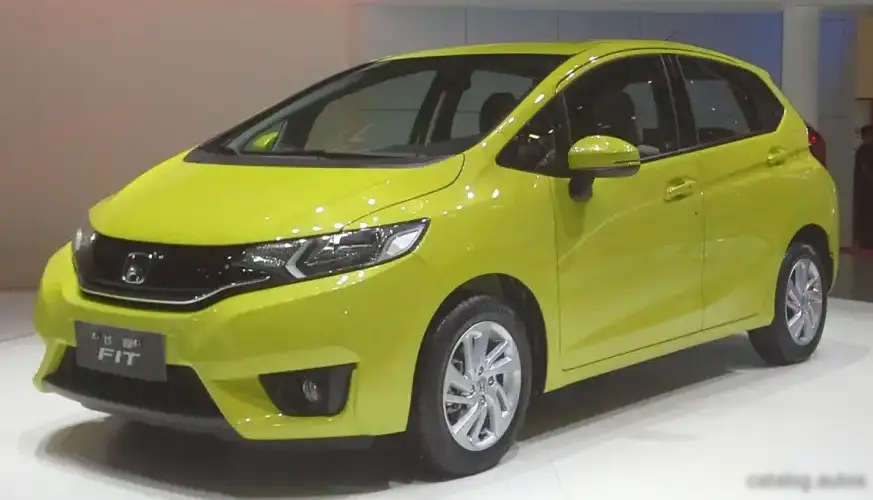
The Honda Fit II Sport 1.5, produced between 2009 and 2012, represents a significant iteration of Honda’s subcompact hatchback, known globally as the Honda Fit. This variant, powered by the 1.5-liter L15A7 engine producing 117 horsepower, occupied a middle ground within the Fit II lineup, offering a balance between fuel efficiency and sporty driving dynamics. It was primarily marketed towards younger drivers and those seeking a practical, yet engaging, vehicle. The Fit II, built on the Honda YF platform (internally designated as the 1HX0/A3), was a key model for Honda in both North America and international markets, lauded for its innovative “Magic Seat” system and surprisingly spacious interior for its size.
Technical Specifications
| Brand | Honda |
| Model | FIT |
| Generation | Fit II |
| Type (Engine) | Sport 1.5 (117 Hp) |
| Start of production | 2009 |
| End of production | 2012 |
| Powertrain Architecture | Internal Combustion engine |
| Body type | Hatchback |
| Seats | 5 |
| Doors | 5 |
| Fuel consumption (urban) | 8.7 l/100 km (27 US mpg) |
| Fuel consumption (extra urban) | 7.1 l/100 km (33.1 US mpg) |
| Fuel consumption (combined) | 8.1 l/100 km (29 US mpg) |
| Fuel Type | Petrol (Gasoline) |
| Emission standard | ULEV-2 |
| Weight-to-power ratio | 9.8 kg/Hp |
| Weight-to-torque ratio | 8 kg/Nm |
| Power | 117 Hp @ 6600 rpm |
| Power per litre | 78.2 Hp/l |
| Torque | 144 Nm @ 4800 rpm (106.21 lb.-ft. @ 4800 rpm) |
| Maximum engine speed | 6800 rpm |
| Engine layout | Front, Transverse |
| Engine Model/Code | L15A7 |
| Engine displacement | 1497 cm3 (91.35 cu. in.) |
| Number of cylinders | 4 |
| Engine configuration | Inline |
| Cylinder Bore | 73 mm (2.87 in.) |
| Piston Stroke | 89.4 mm (3.52 in.) |
| Compression ratio | 10.4:1 |
| Number of valves per cylinder | 4 |
| Fuel injection system | Multi-port manifold injection |
| Engine aspiration | Naturally aspirated engine |
| Valvetrain | SOHC, i-VTEC |
| Engine oil capacity | 3.6 l (3.8 US qt | 3.17 UK qt) |
| Coolant | 4.9 l (5.18 US qt | 4.31 UK qt) |
| Kerb Weight | 1149 kg (2533.11 lbs.) |
| Trunk (boot) space – minimum | 583 l (20.59 cu. ft.) |
| Trunk (boot) space – maximum | 1623 l (57.32 cu. ft.) |
| Fuel tank capacity | 40 l (10.57 US gal | 8.8 UK gal) |
| Length | 4105 mm (161.61 in.) |
| Width | 1695 mm (66.73 in.) |
| Height | 1525 mm (60.04 in.) |
| Wheelbase | 2500 mm (98.43 in.) |
| Front track | 1476 mm (58.11 in.) |
| Rear (Back) track | 1458 mm (57.4 in.) |
| Minimum turning circle | 10.5 m (34.45 ft.) |
| Drivetrain Architecture | Front wheel drive |
| Number of gears | 5 |
| Gearbox type | Manual transmission |
| Front suspension | Independent type McPherson |
| Rear suspension | Torsion |
| Front brakes | Ventilated discs, 261.62 mm |
| Rear brakes | Drum, 200.66 mm |
| Assisting systems | ABS (Anti-lock braking system) |
| Steering type | Steering rack and pinion |
| Power steering | Electric Steering |
| Tires size | 185/55 R16 |
Powertrain & Engine Architecture
The heart of the Fit II Sport 1.5 is the L15A7 engine, a 1.5-liter inline-four cylinder gasoline engine. This engine is part of Honda’s L-series engine family, known for its reliability and fuel efficiency. The L15A7 utilizes a single overhead camshaft (SOHC) design coupled with Honda’s intelligent Variable Valve Timing and Lift Electronic Control (i-VTEC) system. This system optimizes valve timing and lift based on engine speed and load, improving both performance and fuel economy. Fuel delivery is managed by a multi-point fuel injection system. The engine produces 117 horsepower at 6600 rpm and 144 Nm (106.21 lb-ft) of torque at 4800 rpm. The engine is transversely mounted, driving the front wheels. The standard transmission for the Sport trim was a five-speed manual, offering a more engaging driving experience compared to the optional automatic.
Driving Characteristics
The 1.5-liter engine, paired with the five-speed manual transmission, provided a reasonably spirited driving experience for a subcompact car. While not exceptionally powerful, the engine felt responsive and willing to rev. The manual gearbox was well-matched to the engine’s powerband, allowing drivers to effectively utilize the available torque. Compared to the base 1.4-liter engine offered in some markets, the 1.5-liter Sport provided noticeably more power, especially during highway merging and overtaking maneuvers. The gear ratios were tuned for a balance between acceleration and fuel efficiency. The Fit II’s relatively lightweight construction further enhanced its agility and handling. The Sport trim also featured a slightly stiffer suspension setup compared to lower trims, contributing to a more controlled and engaging driving experience.
Equipment & Trim Levels
The Fit II Sport 1.5 typically included a number of standard features designed to appeal to a younger, more active demographic. These included sport seats with enhanced bolstering, a leather-wrapped steering wheel, and a unique front grille. Interior trim often featured metallic accents. Standard equipment also included air conditioning, power windows and locks, and a basic audio system. Optional extras included a navigation system, upgraded audio, and alloy wheels. The “Magic Seat” system, a hallmark of the Fit, allowed for a variety of seating configurations, maximizing cargo space and versatility. The Sport trim sat above the base models in the lineup, offering a more comprehensive feature set and a sportier aesthetic.
Chassis & Braking
The Fit II utilized a McPherson strut independent suspension in the front and a torsion beam suspension in the rear. This setup provided a good balance between ride comfort and handling. The Sport trim often featured a slightly thicker front stabilizer bar compared to lower trims, reducing body roll during cornering. Braking duties were handled by ventilated discs in the front and drum brakes in the rear. Anti-lock Braking System (ABS) was standard. The relatively lightweight nature of the Fit II contributed to its braking performance, allowing for reasonably short stopping distances.
Market Reception & Comparison
The Honda Fit II Sport 1.5 was generally well-received by automotive critics. It was praised for its spacious interior, versatile seating configurations, and fuel efficiency. The 1.5-liter engine was considered a good compromise between performance and economy. Compared to other subcompact hatchbacks of the time, such as the Toyota Yaris and Nissan Versa, the Fit II offered a more engaging driving experience and a more innovative interior. Fuel economy figures of around 29 US mpg combined were competitive for the segment. Reliability was also a strong point, with the L15A7 engine proving to be durable and long-lasting.
Legacy
The Honda Fit II Sport 1.5 has maintained a reputation for reliability and practicality in the used car market. The L15A7 engine is known for its longevity, and routine maintenance is relatively inexpensive. The Fit II’s innovative interior design and versatile seating configurations continue to appeal to buyers seeking a small, yet functional, vehicle. While some owners have reported minor issues with the rear drum brakes, overall, the Fit II Sport 1.5 remains a solid and dependable choice for those seeking an affordable and fuel-efficient hatchback.