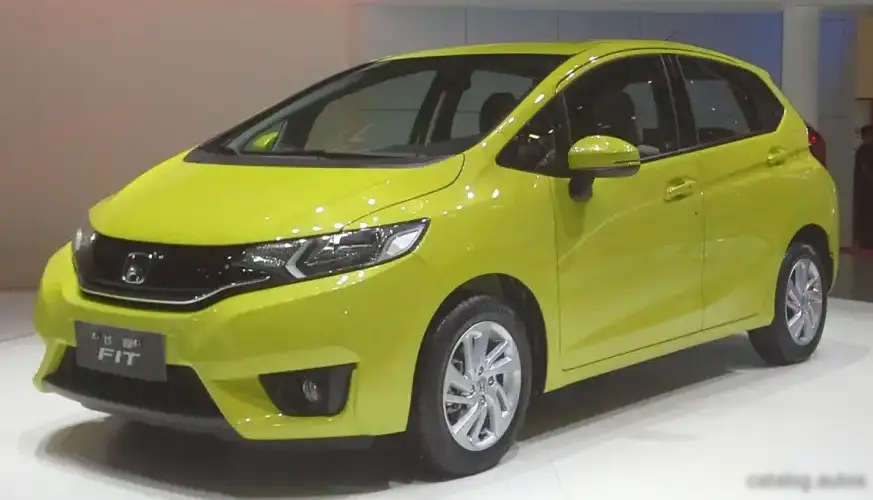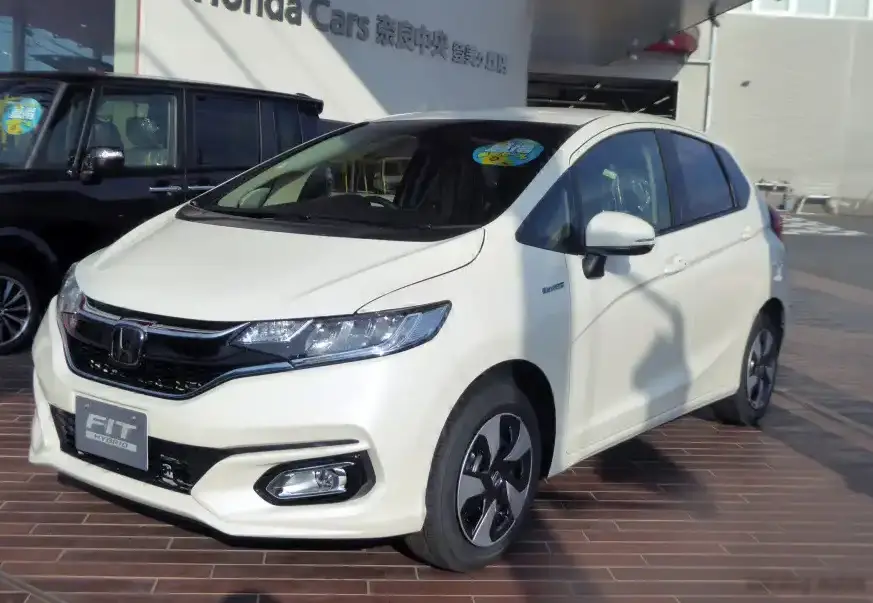
The Honda Fit III (facelift, introduced in 2017) 1.3-liter 4WD Automatic represents a specific configuration within the third generation of Honda’s popular subcompact hatchback. Produced from 2017 to 2020, this variant was primarily aimed at markets where all-wheel drive was desirable for enhanced traction in inclement weather. It occupied a mid-range position in the Fit lineup, offering a balance between affordability, fuel efficiency, and all-weather capability. The facelift brought subtle styling updates and refinements to the already practical and versatile Fit, solidifying its reputation as a clever and space-efficient vehicle.
Technical Specifications
| Brand | Honda |
| Model | FIT |
| Generation | Fit III (facelift 2017) |
| Type (Engine) | 1.3 (99 Hp) 4WD Automatic |
| Start of production | 2017 |
| End of production | 2020 |
| Powertrain Architecture | Internal Combustion engine |
| Body type | Hatchback |
| Seats | 5 |
| Doors | 5 |
| Fuel Type | Petrol (Gasoline) |
| Weight-to-power ratio | 11.3 kg/Hp, 88.4 Hp/tonne |
| Weight-to-torque ratio | 9.4 kg/Nm, 106.3 Nm/tonne |
| Power | 99 Hp @ 6000 rpm |
| Power per litre | 75.2 Hp/l |
| Torque | 119 Nm @ 5000 rpm, 87.77 lb.-ft. @ 5000 rpm |
| Engine layout | Front, Transverse |
| Engine Model/Code | L13B |
| Engine displacement | 1317 cm3, 80.37 cu. in. |
| Number of cylinders | 4 |
| Engine configuration | Inline |
| Cylinder Bore | 73 mm, 2.87 in. |
| Piston Stroke | 78.7 mm, 3.1 in. |
| Compression ratio | 13.5:1 |
| Number of valves per cylinder | 4 |
| Fuel injection system | Multi-port manifold injection |
| Engine aspiration | Naturally aspirated engine |
| Valvetrain | DOHC, i-VTEC |
| Engine oil capacity | 3.3 l, 3.49 US qt | 2.9 UK qt |
| Coolant | 3.48 l, 3.68 US qt | 3.06 UK qt |
| Kerb Weight | 1120 kg, 2469.18 lbs |
| Fuel tank capacity | 40 l, 10.57 US gal | 8.8 UK gal |
| Length | 3990 mm, 157.09 in |
| Width | 1695 mm, 66.73 in |
| Height | 1550 mm, 61.02 in |
| Wheelbase | 2530 mm, 99.61 in |
| Front track | 1480 mm, 58.27 in |
| Rear (Back) track | 1470 mm, 57.87 in |
| Ride height (ground clearance) | 150 mm, 5.91 in |
| Drag coefficient (Cd) | 0.30 |
| Minimum turning circle (turning diameter) | 9.8 m, 32.15 ft |
| Drive wheel | All wheel drive (4×4) |
| Number of gears and type of gearbox | automatic transmission CVT |
| Front brakes | Ventilated discs |
| Rear brakes | Drum |
| Assisting systems | ABS (Anti-lock braking system) |
| Tires size | 185/60 R15 |
| Wheel rims size | 15 |
Powertrain & Engine Architecture
The heart of the 2017-2020 Honda Fit 1.3 4WD Automatic is the L13B engine, a 1.3-liter inline-four cylinder gasoline engine. This engine is part of Honda’s Earth Dreams Technology series, focusing on efficiency and reduced emissions. The L13B utilizes multi-point fuel injection and a double overhead camshaft (DOHC) valvetrain with Honda’s i-VTEC (Variable Valve Timing and Lift Electronic Control) system. This system optimizes valve timing and lift based on engine speed and load, improving both power and fuel economy. The engine produces 99 horsepower at 6000 rpm and 119 Nm (87.77 lb-ft) of torque at 5000 rpm. The engine is transversely mounted in the front of the vehicle. The powertrain is paired with a Continuously Variable Transmission (CVT), which provides smooth, stepless gear changes. This CVT is tuned for fuel efficiency rather than outright performance.
Driving Characteristics
The 1.3-liter engine and CVT combination in the Fit 4WD Automatic delivers adequate, but not exhilarating, performance. Acceleration is modest, with a focus on smooth and predictable power delivery. The CVT effectively keeps the engine in its optimal power band, but it can sometimes feel disconnected from the engine’s actual speed, resulting in a “rubber band” sensation during hard acceleration. Compared to the 1.5-liter engine options available in other Fit trims, the 1.3-liter feels noticeably less powerful, especially when fully loaded or climbing hills. The all-wheel drive system provides enhanced traction in slippery conditions, making it a more confident choice for drivers in regions with snow or rain. However, the added weight of the AWD system and CVT slightly diminishes overall fuel economy compared to front-wheel drive models.
Equipment & Trim Levels
The 1.3 4WD Automatic trim of the Honda Fit typically included standard features such as air conditioning, power windows and locks, a basic audio system with Bluetooth connectivity, and Honda’s Vehicle Stability Assist (VSA) with traction control. Safety features included multiple airbags and anti-lock brakes (ABS). Interior upholstery was typically cloth, and the dashboard featured a straightforward design with easy-to-use controls. Optional extras could include a touchscreen infotainment system with Apple CarPlay and Android Auto compatibility, a rearview camera, and alloy wheels. The specific features varied slightly depending on the regional market.
Chassis & Braking
The Honda Fit III utilizes a front MacPherson strut suspension and a rear torsion beam suspension. The 4WD system adds some weight to the rear, which slightly alters the suspension tuning to maintain balanced handling. The front brakes are ventilated discs, providing good stopping power, while the rear brakes are drums, a cost-saving measure common in this class of vehicle. The steering is electrically assisted, offering light and precise control. The 15-inch wheels and 185/60 R15 tires provide a comfortable ride quality, absorbing bumps and imperfections in the road surface.
Market Reception & Comparison
The Honda Fit 1.3 4WD Automatic was generally well-received by automotive critics for its practicality, fuel efficiency, and clever interior packaging. However, the 1.3-liter engine was often criticized for being underpowered, especially when paired with the CVT and all-wheel drive system. Compared to the 1.5-liter versions, the 1.3 offered lower running costs but sacrificed performance. Fuel economy was a strong point, typically achieving around 35-40 mpg combined. Reliability was also a positive aspect, with the Honda Fit consistently ranking highly in consumer reports. The 4WD system added a premium to the price, making it a less attractive option for buyers in warmer climates where all-wheel drive wasn’t necessary.
Legacy
The Honda Fit III (facelift) 1.3 4WD Automatic has proven to be a reliable and durable vehicle in the used car market. The L13B engine is known for its longevity, and the CVT transmission, while not known for sporty performance, has generally held up well over time with proper maintenance. These models are often sought after by buyers looking for a fuel-efficient, practical, and dependable subcompact hatchback with the added security of all-wheel drive. While not a performance standout, the Fit 1.3 4WD Automatic remains a sensible and economical choice for everyday transportation.