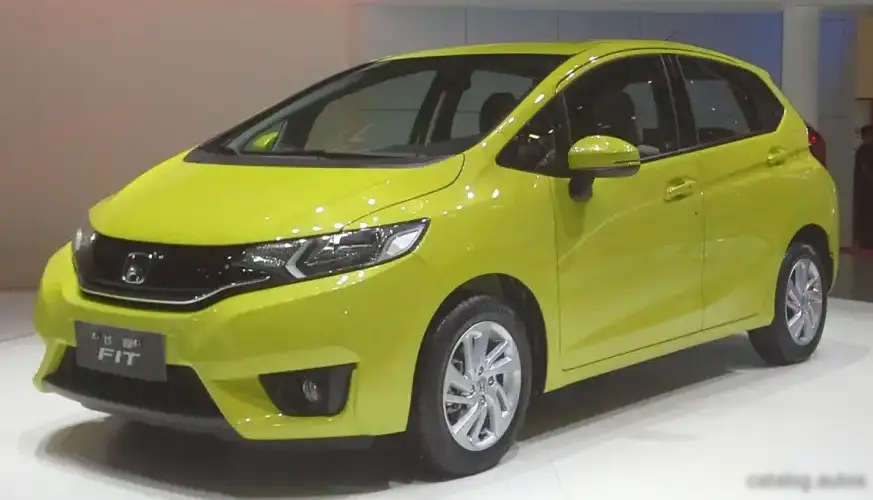
The Honda Fit IV (GR1) 1.3, producing 98 horsepower, paired with a Continuously Variable Transmission (CVT), represents an entry-level offering within the fourth generation of Honda’s globally popular subcompact hatchback. Introduced in February 2020, this variant was primarily aimed at markets seeking fuel efficiency and affordability, particularly in regions where smaller displacement engines are favored. The GR1 Fit builds upon the 1HX0 platform, known for its innovative space utilization and versatile interior. This specific configuration was a key part of Honda’s strategy to offer a broad range of Fit models catering to diverse consumer needs.
Technical Specifications
| Brand | Honda |
| Model | FIT |
| Generation | Fit IV (GR1) |
| Type (Engine) | 1.3 (98 Hp) CVT |
| Start of production | February, 2020 |
| Powertrain Architecture | Internal Combustion engine |
| Body type | Hatchback |
| Seats | 5 |
| Doors | 5 |
| Fuel consumption at Low speed (WLTP) | 6.4-6.6 l/100 km (36.8 – 35.6 US mpg, 44.1 – 42.8 UK mpg, 15.6 – 15.2 km/l) |
| Fuel consumption at Medium speed (WLTP) | 4.7-4.9 l/100 km (50 – 48 US mpg, 60.1 – 57.6 UK mpg, 21.3 – 20.4 km/l) |
| Fuel consumption at high speed (WLTP) | 4.3-4.5 l/100 km (54.7 – 52.3 US mpg, 65.7 – 62.8 UK mpg, 23.3 – 22.2 km/l) |
| Combined fuel consumption (WLTP) | 4.9-5.1 l/100 km (48 – 46.1 US mpg, 57.6 – 55.4 UK mpg, 20.4 – 19.6 km/l) |
| Fuel consumption (economy) – combined | 4.1-5.1 l/100 km (57.4 – 46.1 US mpg, 68.9 – 55.4 UK mpg, 24.4 – 19.6 km/l) |
| Fuel Type | Petrol (Gasoline) |
| Weight-to-power ratio | 10.9 kg/Hp, 91.6 Hp/tonne |
| Weight-to-torque ratio | 9.1 kg/Nm, 110.3 Nm/tonne |
| Power | 98 Hp @ 6000 rpm |
| Power per litre | 74.4 Hp/l |
| Torque | 118 Nm @ 5000 rpm (87.03 lb.-ft. @ 5000 rpm) |
| Engine layout | Front, Transverse |
| Engine Model/Code | L13B |
| Engine displacement | 1317 cm3 (80.37 cu. in.) |
| Number of cylinders | 4 |
| Engine configuration | Inline |
| Cylinder Bore | 73 mm (2.87 in.) |
| Piston Stroke | 78.7 mm (3.1 in.) |
| Compression ratio | 13.5:1 |
| Number of valves per cylinder | 4 |
| Fuel injection system | Direct injection |
| Engine aspiration | Naturally aspirated engine |
| Valvetrain | DOHC |
| Engine oil capacity | 3.3 l (3.49 US qt | 2.9 UK qt) |
| Kerb Weight | 1070-1100 kg (2358.95 – 2425.08 lbs.) |
| Fuel tank capacity | 40 l (10.57 US gal | 8.8 UK gal) |
| Length | 3995 mm (157.28 in.) |
| Width | 1695 mm (66.73 in.) |
| Height | 1515-1540 mm (59.65 – 60.63 in.) |
| Wheelbase | 2530 mm (99.61 in.) |
| Front track | 1485 mm (58.46 in.) |
| Rear (Back) track | 1475 mm (58.07 in.) |
| Ride height (ground clearance) | 135 mm (5.31 in.) |
| Minimum turning circle (turning diameter) | 9.8-10.4 m (32.15 – 34.12 ft.) |
| Drivetrain Architecture | The Internal combustion engine (ICE) drives the front wheels of the vehicle. |
| Drive wheel | Front wheel drive |
| Number of gears and type of gearbox | automatic transmission CVT |
| Front suspension | Independent type McPherson |
| Rear suspension | Torsion |
| Front brakes | Ventilated discs |
| Rear brakes | Disc |
| Assisting systems | ABS (Anti-lock braking system) |
| Steering type | Steering rack and pinion |
| Power steering | Electric Steering |
| Tires size | 185/60 R15; 185/55 R16 |
| Wheel rims size | 15; 16 |
INTRODUCTION
The Honda Fit IV 1.3 CVT, launched in 2020, is a front-wheel-drive, five-door hatchback designed to offer practicality and fuel economy. It occupies the entry-level position within the fourth-generation Fit lineup, serving as the most accessible option for buyers. This model is particularly significant in markets where fuel costs are high and compact city cars are preferred. The GR1 chassis, underpinning this variant, is renowned for its clever packaging, maximizing interior space despite the vehicle’s small footprint. It represents Honda’s commitment to providing efficient and versatile transportation solutions.
Powertrain & Engine Architecture
At the heart of the Fit 1.3 CVT lies the L13B engine, a 1.3-liter inline-four cylinder gasoline engine. This engine utilizes Honda’s direct injection technology (Direct Injection Gasoline – DIG) to enhance fuel efficiency and power delivery. The L13B features a double overhead camshaft (DOHC) valvetrain with four valves per cylinder, contributing to its relatively high specific output for its displacement. The engine’s compression ratio is a high 13.5:1, further optimizing combustion efficiency. Paired with this engine is a Continuously Variable Transmission (CVT), designed to provide smooth, seamless acceleration and maximize fuel economy. Unlike traditional automatic transmissions with fixed gear ratios, the CVT utilizes a belt and pulley system to offer an infinite number of gear ratios within its operating range. This allows the engine to operate at its most efficient RPM regardless of vehicle speed.
Driving Characteristics
The 98 horsepower and 118 Nm (87 lb-ft) of torque produced by the 1.3L engine and CVT combination result in a driving experience focused on efficiency rather than outright performance. Acceleration is adequate for city driving and highway merging, but it’s noticeably slower than higher-powered Fit variants like the 1.5L models. The CVT contributes to a smooth and linear power delivery, but can sometimes feel less responsive than a traditional automatic or manual transmission. The CVT is programmed to prioritize fuel economy, which means it will often hold lower engine speeds during gentle acceleration. The gear ratios are optimized for maximizing fuel efficiency at cruising speeds, making it a comfortable and economical choice for long commutes. Compared to a manual transmission equipped Fit 1.3, the CVT version sacrifices some driver engagement for ease of use and improved fuel consumption.
Equipment & Trim Levels
The Fit 1.3 CVT typically comes standard with a respectable array of features, though it generally represents the base trim level. Standard equipment often includes air conditioning, power windows and locks, a basic audio system with Bluetooth connectivity, and Honda’s suite of safety features, including ABS, Vehicle Stability Assist (VSA), and multiple airbags. Interior upholstery is typically cloth, and the dashboard features a functional, if somewhat basic, design. Optional extras available for this trim could include alloy wheels, a touchscreen infotainment system with Apple CarPlay and Android Auto compatibility, and a rearview camera. Higher trim levels within the Fit IV range offered more luxurious features like leather upholstery, automatic climate control, and advanced driver-assistance systems.
Chassis & Braking
The Fit 1.3 CVT utilizes a McPherson strut independent suspension at the front and a torsion beam suspension at the rear. This suspension setup is tuned for comfort and ride quality, prioritizing a smooth and compliant ride over sporty handling. The front brakes are ventilated discs, providing adequate stopping power, while the rear brakes are solid discs. The electric power steering system offers light and easy steering, making it ideal for maneuvering in tight city streets. The relatively low curb weight of the Fit 1.3 (around 1070-1100 kg) helps to offset the modest engine output, contributing to reasonable handling characteristics.
Market Reception & Comparison
The Honda Fit IV 1.3 CVT was generally well-received by critics for its fuel efficiency, spacious interior, and practicality. However, some reviewers noted that the engine felt underpowered, particularly when fully loaded or driving uphill. Compared to the 1.5L Fit variants, the 1.3L offered significantly lower performance but also a lower price point and better fuel economy. The 1.3L CVT was often seen as a sensible choice for budget-conscious buyers who prioritized fuel efficiency and practicality over performance. Its fuel economy figures consistently ranked among the best in its class, making it an attractive option for commuters and city dwellers.
Legacy
The L13B engine, while not known for being a powerhouse, has proven to be a reliable and durable unit when properly maintained. The CVT transmission, while sometimes criticized for its driving feel, has also demonstrated reasonable long-term reliability. In the used car market, the Fit IV 1.3 CVT remains a popular choice for buyers seeking an affordable and fuel-efficient subcompact hatchback. Its reputation for reliability and practicality ensures continued demand, and its relatively low running costs make it an attractive option for first-time car buyers or those seeking a dependable city car.