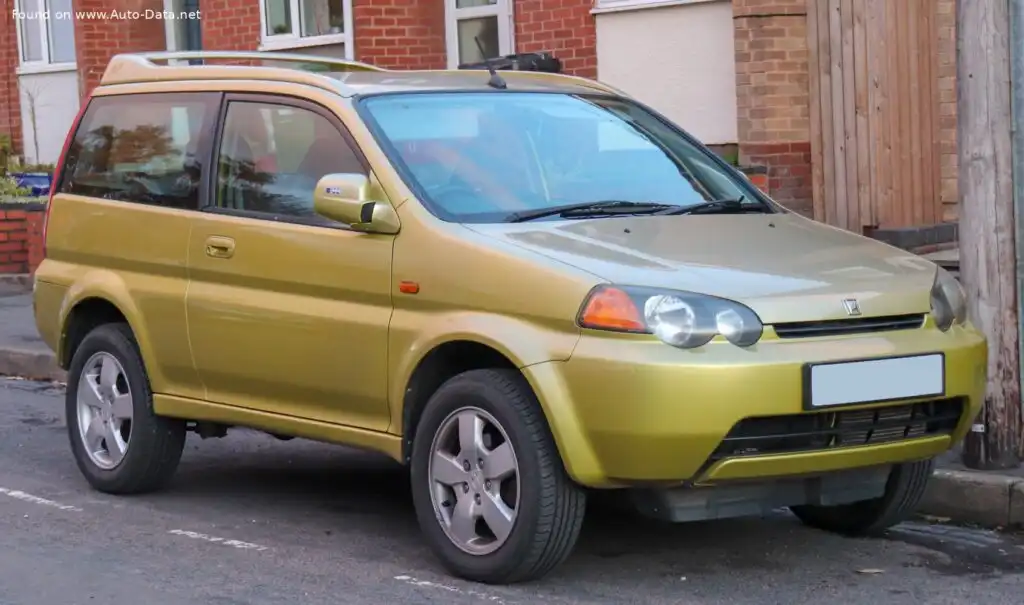
The Honda HR-V (GH) 1.6i 16V 4WD, produced between 1998 and 2005, marked Honda’s initial foray into the burgeoning small SUV/crossover market. This specific variant, powered by the 1.6-liter SOHC engine and equipped with a five-speed manual transmission and all-wheel drive, was positioned as a practical and affordable option within the HR-V lineup. The GH generation, internally designated as the first generation HR-V, was notable for its innovative use of space and its relatively compact dimensions, making it a popular choice in Europe and Japan, where smaller vehicles are favored. It was never officially sold in the United States during this generation.
Technical Specifications
| Brand | Honda |
| Model | HR-V |
| Generation | HR-V (GH) |
| Type (Engine) | 1.6i 16V (105 Hp) 4WD |
| Start of production | 1998 |
| End of production | 2005 |
| Powertrain Architecture | Internal Combustion engine |
| Body type | SUV, Crossover |
| Seats | 5 |
| Doors | 3 |
| Fuel consumption (urban) | 10.4 l/100 km (22.6 US mpg, 27.2 UK mpg, 9.6 km/l) |
| Fuel consumption (extra urban) | 7.6 l/100 km (30.9 US mpg, 37.2 UK mpg, 13.2 km/l) |
| Fuel consumption (combined) | 8.6 l/100 km (27.4 US mpg, 32.8 UK mpg, 11.6 km/l) |
| Fuel Type | Petrol (Gasoline) |
| Acceleration 0 – 100 km/h | 12 sec |
| Acceleration 0 – 62 mph | 12 sec |
| Acceleration 0 – 60 mph | 11.4 sec |
| Maximum speed | 162 km/h (100.66 mph) |
| Weight-to-power ratio | 11.2 kg/Hp, 89 Hp/tonne |
| Weight-to-torque ratio | 8.7 kg/Nm, 114.4 Nm/tonne |
| Power | 105 Hp @ 6200 rpm |
| Power per litre | 66 Hp/l |
| Torque | 135 Nm @ 3500 rpm (99.57 lb.-ft. @ 3500 rpm) |
| Engine layout | Front, Transverse |
| Engine Model/Code | D16W1, D16W2 |
| Engine displacement | 1590 cm3 (97.03 cu. in.) |
| Number of cylinders | 4 |
| Engine configuration | Inline |
| Cylinder Bore | 75 mm (2.95 in.) |
| Piston Stroke | 90 mm (3.54 in.) |
| Compression ratio | 9.4:1 |
| Number of valves per cylinder | 4 |
| Fuel injection system | Multi-port manifold injection |
| Engine aspiration | Naturally aspirated engine |
| Valvetrain | OHC |
| Engine oil capacity | 3.6 l (3.8 US qt | 3.17 UK qt) |
| Coolant capacity | 2.8 l (2.96 US qt | 2.46 UK qt) |
| Kerb Weight | 1180 kg (2601.45 lbs.) |
| Max. weight | 1580 kg (3483.3 lbs.) |
| Max load | 400 kg (881.85 lbs.) |
| Trunk (boot) space – minimum | 285 l (10.06 cu. ft.) |
| Fuel tank capacity | 55 l (14.53 US gal | 12.1 UK gal) |
| Length | 4010 mm (157.87 in.) |
| Width | 1695 mm (66.73 in.) |
| Width including mirrors | 1995 mm (78.54 in.) |
| Height | 1575 mm (62.01 in.) |
| Wheelbase | 2350 mm (92.52 in.) |
| Front track | 1470 mm (57.87 in.) |
| Rear (Back) track | 1455 mm (57.28 in.) |
| Drive wheel | All wheel drive (4×4) |
| Number of gears and type of gearbox | 5 gears, manual transmission |
| Front suspension | Wishbone |
| Rear suspension | De-Dion |
| Front brakes | Ventilated discs |
| Rear brakes | Drum |
| Assisting systems | ABS (Anti-lock braking system) |
| Steering type | Steering rack and pinion |
| Power steering | Hydraulic Steering |
| Tires size | 195/70 R15 T |
Powertrain & Engine Architecture
The heart of the HR-V 1.6i 4WD is the D16W1 or D16W2 1.6-liter inline-four cylinder engine. This engine, part of Honda’s D-series, is a naturally aspirated, single overhead camshaft (SOHC) design. It utilizes a multi-point fuel injection system for efficient fuel delivery. The D16W1 was primarily found in European market vehicles, while the D16W2 was more common in Japan. Both engines are mechanically very similar. The engine produces 105 horsepower at 6200 rpm and 135 Nm (99.57 lb-ft) of torque at 3500 rpm. The five-speed manual transmission provides a relatively direct driving experience, with gear ratios tuned for fuel efficiency and everyday usability rather than outright performance. The all-wheel-drive system is a real-time system, engaging the rear wheels when front wheel slippage is detected, providing enhanced traction in adverse conditions.
Driving Characteristics
The 1.6-liter engine, paired with the manual transmission and all-wheel-drive system, delivers adequate, but not exhilarating, performance. Acceleration from 0-60 mph takes around 11.4 seconds, and top speed is approximately 100.66 mph. The engine feels somewhat strained at higher speeds, and the power delivery is linear but lacks significant punch. The manual transmission offers precise shifts, but the gear ratios are spaced to prioritize fuel economy over rapid acceleration. The all-wheel-drive system provides confident handling in slippery conditions, but adds weight, slightly impacting overall agility. Compared to the more powerful 1.8L VTEC versions, the 1.6L feels noticeably slower, but offers better fuel economy and a more relaxed driving experience.
Equipment & Trim Levels
The 1.6i 4WD trim level typically included basic amenities such as power steering, central locking, electric windows, and an AM/FM radio. Air conditioning was often an optional extra. Interior upholstery was typically cloth, with a relatively simple dashboard layout. Higher trim levels, not always available with the 1.6L engine and 4WD combination, offered features like alloy wheels, a sunroof, and upgraded audio systems. The focus of this trim was practicality and affordability, making it an attractive option for buyers seeking a versatile and economical small SUV.
Chassis & Braking
The HR-V utilizes a front wishbone suspension and a rear De-Dion suspension setup. This configuration provides a comfortable ride and reasonable handling characteristics. The front brakes are ventilated discs, providing adequate stopping power, while the rear brakes are drums. ABS (Anti-lock Braking System) was standard, enhancing safety. The chassis is relatively lightweight, contributing to the vehicle’s fuel efficiency and maneuverability. Stabilizer bars were fitted to both the front and rear axles to reduce body roll during cornering.
Market Reception & Comparison
The HR-V 1.6i 4WD was generally well-received as a practical and versatile small SUV. Critics praised its spacious interior, innovative design, and fuel efficiency. However, some reviewers noted the engine’s lack of power, particularly when fully loaded or driving uphill. Compared to the more powerful 1.8L VTEC models, the 1.6L offered better fuel economy (around 27.4 US mpg combined) but significantly less performance. The 1.6L was also considered more reliable than some of the more complex VTEC variants, due to its simpler engine design.
Legacy
The Honda HR-V (GH) 1.6i 16V 4WD has proven to be a relatively reliable vehicle, with many examples still on the road today. The D16W engine is known for its durability, and routine maintenance is relatively straightforward. However, age-related issues such as corrosion and wear on suspension components are common. In the used car market, these HR-Vs are often sought after by buyers looking for an affordable and practical small SUV with all-wheel-drive capability. The HR-V’s innovative design and versatility helped to establish Honda as a key player in the growing crossover segment.