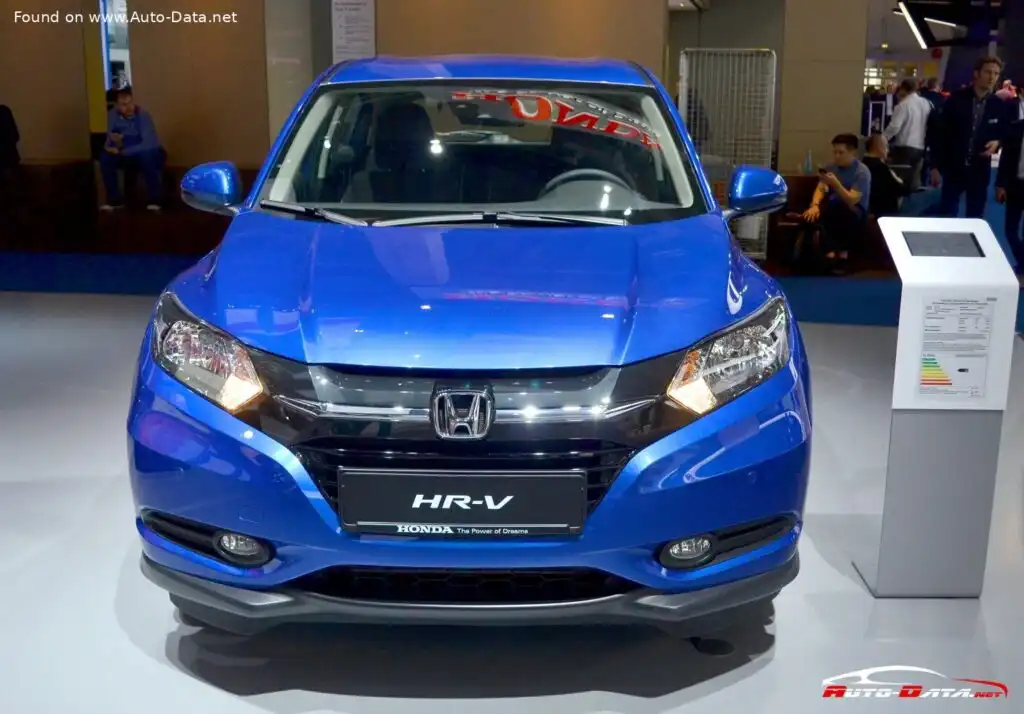
The Honda HR-V II 1.8 i-VTEC AWD CVT, produced from 2016 to 2018, represents a significant iteration of Honda’s subcompact crossover SUV. Positioned as a mid-range offering within the second-generation HR-V (RU series) lineup, this variant combined a naturally aspirated 1.8-liter four-cylinder engine with a Continuously Variable Transmission (CVT) and Honda’s Real Time AWD system. It was primarily marketed towards buyers seeking a practical, fuel-efficient, and all-weather capable vehicle with a focus on everyday usability. The HR-V II, in general, was a key model for Honda in both North American and European markets, offering a versatile package in a growing segment.
Technical Specifications
| Brand | Honda |
| Model | HR-V |
| Generation | HR-V II |
| Type (Engine) | 1.8 i-VTEC (141 Hp) AWD CVT |
| Start of production | 2016 |
| End of production | 2018 |
| Powertrain Architecture | Internal Combustion engine |
| Body type | SUV, Crossover |
| Seats | 5 |
| Doors | 5 |
| Fuel consumption (urban) | 8.7 l/100 km (27 US mpg) |
| Fuel consumption (extra urban) | 7.5 l/100 km (31.4 US mpg) |
| Fuel consumption (combined) | 8.1 l/100 km (29 US mpg) |
| Fuel Type | Petrol (Gasoline) |
| Weight-to-power ratio | 9.9 kg/Hp |
| Weight-to-torque ratio | 8.1 kg/Nm |
| Power | 141 Hp @ 6500 rpm |
| Power per litre | 78.4 Hp/l |
| Torque | 172 Nm @ 4300 rpm (126.86 lb.-ft. @ 4300 rpm) |
| Maximum engine speed | 6700 rpm |
| Engine layout | Front, Transverse |
| Engine Model/Code | R18Z9 |
| Engine displacement | 1799 cm3 (109.78 cu. in.) |
| Number of cylinders | 4 |
| Engine configuration | Inline |
| Cylinder Bore | 81 mm (3.19 in.) |
| Piston Stroke | 87.3 mm (3.44 in.) |
| Compression ratio | 10.6:1 |
| Number of valves per cylinder | 4 |
| Fuel injection system | Multi-port manifold injection |
| Engine aspiration | Naturally aspirated engine |
| Valvetrain | SOHC i-VTEC |
| Engine oil capacity | 3.7 l (3.91 US qt | 3.26 UK qt) |
| Coolant capacity | 5.25 l (5.55 US qt | 4.62 UK qt) |
| Kerb Weight | 1389 kg (3062.22 lbs.) |
| Trunk (boot) space – minimum | 431 l (15.22 cu. ft.) |
| Trunk (boot) space – maximum | 1456 l (51.42 cu. ft.) |
| Fuel tank capacity | 50 l (13.21 US gal | 11 UK gal) |
| Length | 4294 mm (169.06 in.) |
| Width | 1772 mm (69.76 in.) |
| Width including mirrors | 2019 mm (79.49 in.) |
| Height | 1605 mm (63.19 in.) |
| Wheelbase | 2610 mm (102.76 in.) |
| Front track | 1535 mm (60.43 in.) |
| Rear (Back) track | 1540 mm (60.63 in.) |
| Ride height (ground clearance) | 170 mm (6.69 in.) |
| Minimum turning circle | 11.4 m (37.4 ft.) |
| Drive wheel | All wheel drive (4×4) |
| Number of gears and type of gearbox | automatic transmission CVT |
| Front suspension | Independent, type McPherson with coil spring and anti-roll bar |
| Rear suspension | Semi-independent, coil spring |
| Front brakes | Ventilated discs |
| Rear brakes | Disc |
| Assisting systems | ABS (Anti-lock braking system) |
| Steering type | Steering rack and pinion |
| Tires size | 215/55 R17 94V |
| Wheel rims size | 17 |
INTRODUCTION
The Honda HR-V II 1.8 i-VTEC AWD CVT, launched in 2016, was a key component of Honda’s strategy to capture a larger share of the burgeoning subcompact crossover market. Built on the versatile Global Compact Platform (GCP), also known as the 1HX0/A3 platform, the HR-V offered a surprisingly spacious interior and a practical hatchback design. The 1.8L i-VTEC engine and CVT pairing, coupled with the Real Time AWD system, aimed to provide a balance of fuel efficiency, reasonable performance, and all-weather capability. This particular configuration was aimed at buyers who prioritized practicality and ease of use over outright sporty driving dynamics.
Powertrain & Engine Architecture
At the heart of the HR-V 1.8 i-VTEC AWD CVT lies the R18Z9 engine, a 1.8-liter (1799 cc) inline-four cylinder powerplant. This engine utilizes Honda’s Intelligent Variable Valve Timing and Lift Electronic Control (i-VTEC) system, which optimizes valve timing and lift based on engine speed and load, improving both fuel efficiency and power output. The R18Z9 employs multi-point fuel injection and a compression ratio of 10.6:1. The engine produces 141 horsepower at 6500 rpm and 172 Nm (126.86 lb-ft) of torque at 4300 rpm.
The engine is mated to a Continuously Variable Transmission (CVT), which provides seamless gear changes and contributes to improved fuel economy. Unlike traditional automatic transmissions with fixed gear ratios, a CVT uses a belt and pulley system to provide an infinite number of gear ratios within its operating range. The Real Time AWD system is reactive, meaning it primarily operates in front-wheel drive mode and automatically engages the rear wheels when it detects a loss of traction. This system doesn’t have a locking differential or selectable modes.
Driving Characteristics
The 1.8L i-VTEC and CVT combination in the HR-V AWD delivers adequate, but not exhilarating, performance. Acceleration is linear and predictable, with the CVT keeping the engine in its optimal power band. While the CVT eliminates harsh shifts, it can sometimes feel “rubber-bandy” under hard acceleration, where engine RPMs rise quickly without a corresponding increase in speed. Compared to the available six-speed manual transmission, the CVT prioritizes fuel efficiency over driver engagement. The AWD system provides enhanced traction in slippery conditions, but doesn’t transform the HR-V into an off-road vehicle. The steering is light and precise, making it easy to maneuver in urban environments. Overall, the driving experience is comfortable and refined, geared towards everyday commuting and practicality.
Equipment & Trim Levels
The HR-V 1.8 i-VTEC AWD CVT typically came standard with features such as air conditioning, power windows and locks, a rearview camera, Bluetooth connectivity, and a basic audio system. Higher trim levels, often denoted as EX or EX-L, added features like a sunroof, heated front seats, leather upholstery, a more advanced touchscreen infotainment system with Apple CarPlay and Android Auto compatibility, and Honda’s LaneWatch blind spot display. Interior upholstery was typically cloth on the base models, with leather options available on higher trims. Optional extras included navigation, premium audio systems, and various accessory packages.
Chassis & Braking
The HR-V II utilizes a McPherson strut front suspension and a semi-independent torsion beam rear suspension. This setup provides a comfortable ride quality, absorbing bumps and imperfections in the road effectively. The front brakes are ventilated discs, while the rear brakes are solid discs. Anti-lock Braking System (ABS) is standard. The HR-V’s chassis is tuned for comfort and stability rather than sporty handling. Stabilizer bars are present on both the front and rear axles to reduce body roll during cornering, but the overall handling characteristics are geared towards predictable and safe driving.
Market Reception & Comparison
The HR-V 1.8 i-VTEC AWD CVT was generally well-received by critics for its spacious interior, fuel efficiency, and practicality. However, some reviewers noted the engine’s lack of outright power and the CVT’s sometimes uninspiring driving experience. Compared to other trims in the HR-V lineup, the 1.8L CVT offered a more accessible price point and better fuel economy than the sportier trims. Against competitors like the Mazda CX-3 and Jeep Renegade, the HR-V stood out for its interior space and Honda’s reputation for reliability. Fuel economy figures averaged around 29 US mpg combined, making it a competitive option in its class.
Legacy
The R18Z9 engine and CVT combination in the HR-V II has proven to be relatively reliable, with few widespread mechanical issues reported. The CVT, while sometimes criticized for its driving feel, has generally held up well over time with proper maintenance. On the used car market, the HR-V 1.8 i-VTEC AWD CVT remains a popular choice for buyers seeking a practical and affordable subcompact crossover. Its reputation for reliability, combined with its spacious interior and fuel efficiency, continues to make it a compelling option in its segment. Regular maintenance, including CVT fluid changes, is crucial for ensuring the long-term health of the powertrain.