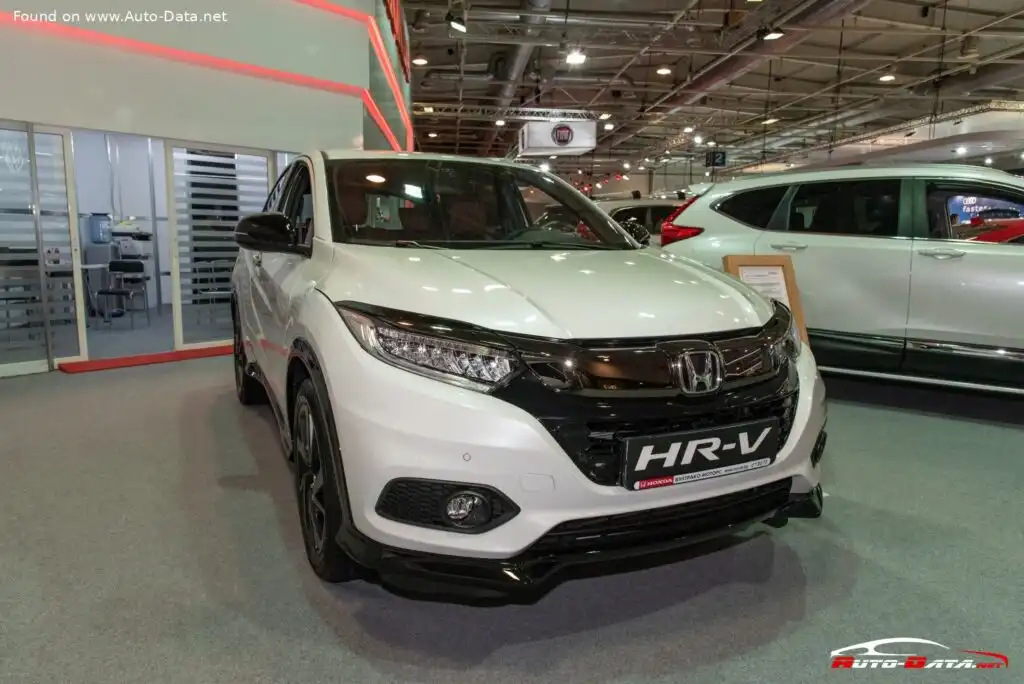
The Honda HR-V II Sport 1.5 VTEC TURBO, produced from 2019 to 2020, represents a mid-cycle refresh of the second-generation HR-V (RU series) primarily aimed at the European and Asian markets. Positioned as a sporty trim level within the HR-V lineup, it offered a more powerful engine option compared to the base models, targeting buyers seeking a blend of fuel efficiency and performance in a subcompact crossover SUV. This variant utilized Honda’s direct-injected, turbocharged 1.5-liter engine paired exclusively with a continuously variable transmission (CVT). It was a key offering in a segment increasingly focused on smaller, efficient, and versatile vehicles.
Technical Specifications
| Brand | Honda |
| Model | HR-V |
| Generation | HR-V II (facelift 2018) |
| Type (Engine) | Sport 1.5 VTEC TURBO (182 Hp) CVT |
| Start of production | 2019 |
| End of production | 2020 |
| Powertrain Architecture | Internal Combustion engine |
| Body type | SUV, Crossover |
| Seats | 5 |
| Doors | 5 |
| Fuel consumption at Low speed (WLTP) | 8.7-8.8 l/100 km (27 – 26.7 US mpg) |
| Fuel consumption at Medium speed (WLTP) | 6.1-6.3 l/100 km (38.6 – 37.3 US mpg) |
| Fuel consumption at high speed (WLTP) | 5.7-5.8 l/100 km (41.3 – 40.6 US mpg) |
| Fuel consumption at very high speed (WLTP) | 7.3-7.5 l/100 km (32.2 – 31.4 US mpg) |
| Combined fuel consumption (WLTP) | 6.8-6.9 l/100 km (34.6 – 34.1 US mpg) |
| CO2 emissions (WLTP) | 122 g/km |
| Fuel consumption (economy) – combined | 5.0-7.6 l/100 km (47 – 30.9 US mpg) |
| CO2 emissions | 137 g/km |
| Fuel Type | Petrol (Gasoline) |
| Acceleration 0 – 100 km/h | 8.6 sec |
| Acceleration 0 – 62 mph | 8.6 sec |
| Acceleration 0 – 60 mph | 8.2 sec |
| Maximum speed | 200 km/h (124.27 mph) |
| Emission standard | Euro 6d-TEMP |
| Weight-to-power ratio | 7.8 kg/Hp |
| Weight-to-torque ratio | 6.5 kg/Nm |
| Power | 182 Hp @ 6000 rpm |
| Torque | 220 Nm @ 1700-5500 rpm (162.26 lb.-ft. @ 1700-5500 rpm) |
| Engine layout | Front, Transverse |
| Engine Model/Code | L15BY |
| Engine displacement | 1498 cm3 (91.41 cu. in.) |
| Number of cylinders | 4 |
| Engine configuration | Inline |
| Cylinder Bore | 73 mm (2.87 in.) |
| Piston Stroke | 89.5 mm (3.52 in.) |
| Compression ratio | 10.6:1 |
| Number of valves per cylinder | 4 |
| Fuel injection system | Direct injection |
| Engine aspiration | Turbocharger, Intercooler |
| Engine oil capacity | 3.5 l (3.7 US qt | 3.08 UK qt) |
| Coolant | 5.77 l (6.1 US qt | 5.08 UK qt) |
| Kerb Weight | 1428-1435 kg (3148.2 – 3163.63 lbs.) |
| Trunk (boot) space – minimum | 448 l (15.82 cu. ft.) |
| Trunk (boot) space – maximum | 1043 l (36.83 cu. ft.) |
| Fuel tank capacity | 50 l (13.21 US gal | 11 UK gal) |
| Length | 4346 mm (171.1 in.) |
| Width including mirrors | 2019 mm (79.49 in.) |
| Height | 1605 mm (63.19 in.) |
| Wheelbase | 2610 mm (102.76 in.) |
| Minimum turning circle | 11.8 m (38.71 ft.) |
| Drivetrain Architecture | Front wheel drive |
| Number of gears and type of gearbox | 7 gears, automatic transmission CVT |
| Front suspension | Independent type McPherson |
| Rear suspension | Torsion |
| Front brakes | Ventilated discs, 293 mm |
| Rear brakes | Disc, 282 mm |
| Tires size | 215/60 R16; 215/55 R17 |
| Wheel rims size | 16; 17 |
Powertrain & Engine Architecture
The heart of the HR-V Sport 1.5 VTEC TURBO is Honda’s L15BY engine, a 1.5-liter inline-four cylinder gasoline engine featuring direct injection and a single turbocharger. This engine is part of Honda’s Earth Dreams Technology series, designed for both performance and efficiency. The direct injection system allows for precise fuel delivery, optimizing combustion and boosting power output. The turbocharger, coupled with an intercooler, provides increased air intake, further enhancing performance. The engine produces 182 horsepower at 6000 rpm and 220 Nm (162 lb-ft) of torque between 1700 and 5500 rpm. This engine code is a refinement of earlier 1.5L turbo engines used in other Honda models, focusing on improved responsiveness and reduced turbo lag. The engine is paired with a continuously variable transmission (CVT), which prioritizes fuel efficiency and smooth acceleration over traditional stepped gear changes. While CVTs are known for their efficiency, Honda’s implementation includes programmed shift points to mimic a conventional automatic transmission, providing a more engaging driving experience.
Driving Characteristics
The 1.5L turbo engine and CVT combination in the HR-V Sport delivers a noticeable improvement in performance compared to the naturally aspirated engines offered in lower trim levels. Acceleration from 0-60 mph takes approximately 8.2 seconds, making it competitive within its class. The CVT is tuned to provide adequate responsiveness, although it lacks the immediate feel of a dual-clutch transmission or traditional automatic. The broad torque curve of the turbo engine ensures ample power for everyday driving and highway overtaking. The CVT’s continuously variable ratios help keep the engine within its optimal power band, maximizing efficiency. However, some drivers may find the engine note during hard acceleration to be somewhat uninspiring due to the CVT’s operation. The suspension is tuned for comfort, providing a relatively smooth ride, but it may exhibit some body roll during aggressive cornering.
Equipment & Trim Levels
The HR-V Sport trim typically included a range of standard features designed to enhance both comfort and convenience. These often included alloy wheels (typically 17-inch), a sporty body kit, and unique interior trim elements. Inside, the Sport trim usually featured sport seats with enhanced bolstering, a leather-wrapped steering wheel, and a touchscreen infotainment system with smartphone integration (Apple CarPlay and Android Auto). Optional extras could include a sunroof, upgraded audio system, and advanced safety features such as lane departure warning and adaptive cruise control. The interior materials were generally of good quality for the segment, with a focus on durability and practicality.
Chassis & Braking
The HR-V Sport utilizes a front-wheel-drive configuration with an independent McPherson strut suspension in the front and a torsion beam suspension in the rear. The front brakes are ventilated discs measuring 293mm, while the rear brakes are solid discs measuring 282mm. This braking setup provides adequate stopping power for the vehicle’s weight and performance. Electric power steering is standard, offering light and precise steering feel. The chassis is designed to balance ride comfort with handling stability, providing a reasonably composed driving experience. Stabilizer bars are included on both axles to reduce body roll during cornering.
Market Reception & Comparison
The HR-V Sport 1.5 VTEC TURBO was generally well-received by automotive critics, who praised its improved performance and fuel efficiency compared to the base models. However, some reviewers noted that the CVT transmission could feel somewhat disconnected and lacked the engagement of a traditional automatic. Compared to other trims in the HR-V lineup, the Sport offered a more dynamic driving experience and a more aggressive appearance. Against competitors such as the Mazda CX-3 and Nissan Juke, the HR-V Sport offered a compelling combination of practicality, fuel economy, and performance. Fuel economy figures typically ranged from 34.6 to 34.1 US mpg combined, making it a relatively efficient option in its class.
Legacy
The L15BY engine and CVT combination in the HR-V Sport has proven to be relatively reliable in long-term ownership. While CVTs have historically been a concern for some buyers, Honda’s implementation has demonstrated good durability. Common maintenance items include regular oil changes, coolant flushes, and CVT fluid replacements. The HR-V Sport remains a popular choice in the used car market, particularly for buyers seeking a fuel-efficient and versatile subcompact crossover with a bit more performance than the base models. Its blend of practicality, efficiency, and sporty styling continues to appeal to a wide range of buyers.