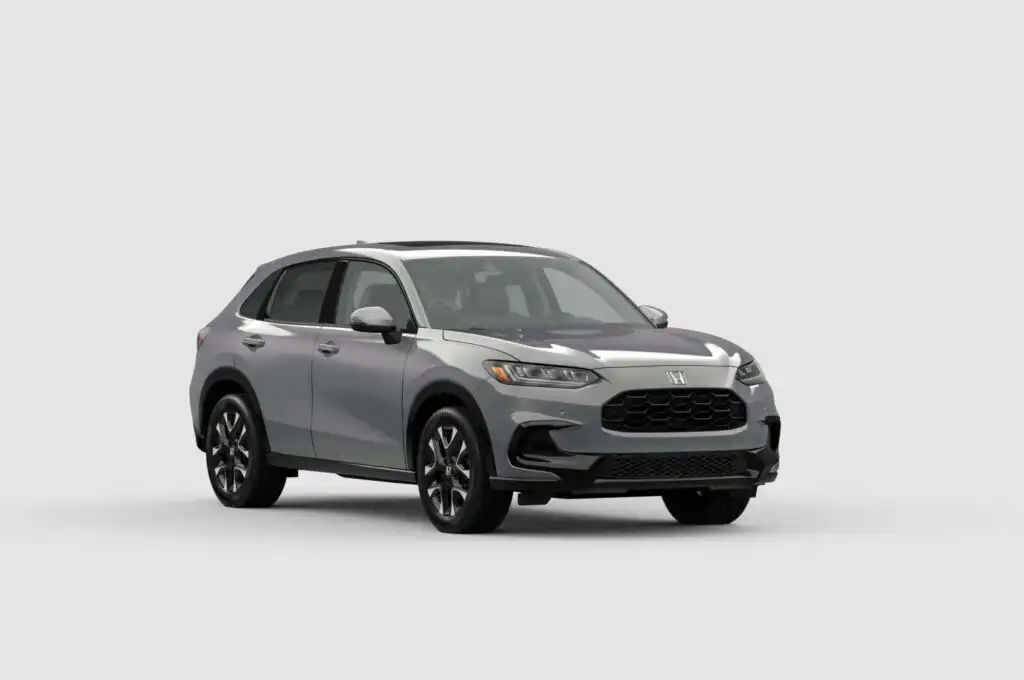
The Honda HR-V III, specifically the facelifted 2024 model year version equipped with the 2.0-liter (158 hp) engine, all-wheel drive (AWD), and a continuously variable transmission (CVT), represents Honda’s entry into the competitive compact SUV/Crossover segment in the United States. Production began in May 2025, building upon the foundation of the third-generation HR-V (RU) introduced in 2023. This variant aims to provide a balance of fuel efficiency, practicality, and available all-weather capability for American consumers. It slots into the HR-V lineup as the higher trim level, offering more power and standard AWD compared to the base engine option.
Technical Specifications
| Brand | Honda |
| Model | HR-V |
| Generation | HR-V III (facelift 2024) |
| Type (Engine) | 2.0 (158 Hp) AWD CVT (USA) |
| Start of production | May, 2025 |
| Powertrain Architecture | Internal Combustion engine |
| Body type | SUV, Crossover |
| Seats | 5 |
| Doors | 5 |
| Fuel consumption (economy) – urban (EPA) | 9.4 l/100 km (25 US mpg) |
| Fuel consumption (economy) – extra urban (EPA) | 7.8 l/100 km (30.2 US mpg) |
| Fuel consumption (economy) – combined (EPA) | 8.7 l/100 km (27 US mpg) |
| Fuel Type | Petrol (Gasoline) |
| Emission standard | LEV4-SULEV30 |
| Weight-to-power ratio | 9.4 kg/Hp |
| Weight-to-torque ratio | 7.9 kg/Nm |
| Power | 158 Hp @ 6500 rpm |
| Power per litre | 79.2 Hp/l |
| Torque | 187 Nm @ 4200 rpm (137.92 lb.-ft. @ 4200 rpm) |
| Maximum engine speed | 6800 rpm |
| Engine layout | Front, Transverse |
| Engine Model/Code | K20Z5 |
| Engine displacement | 1996 cm3 (121.8 cu. in.) |
| Number of cylinders | 4 |
| Engine configuration | Inline |
| Cylinder Bore | 86 mm (3.39 in.) |
| Piston Stroke | 85.9 mm (3.38 in.) |
| Compression ratio | 10.8:1 |
| Number of valves per cylinder | 4 |
| Fuel injection system | Multi-port manifold injection |
| Engine aspiration | Naturally aspirated engine |
| Valvetrain | DOHC, i-VTEC |
| Engine oil capacity | 4.2 l (4.44 US qt | 3.7 UK qt) |
| Coolant | 5.93 l (6.27 US qt | 5.22 UK qt) |
| Kerb Weight | 1486-1513 kg (3276.07 – 3335.59 lbs.) |
| Trunk (boot) space – minimum | 691 l (24.4 cu. ft.) |
| Trunk (boot) space – maximum | 1560 l (55.09 cu. ft.) |
| Fuel tank capacity | 53 l (14 US gal | 11.66 UK gal) |
| Length | 4567 mm (179.8 in.) |
| Width | 1839 mm (72.4 in.) |
| Height | 1610-1621 mm (63.39 – 63.82 in.) |
| Wheelbase | 2654 mm (104.49 in.) |
| Front track | 1590 mm (62.6 in.) |
| Rear (Back) track | 1605 mm (63.19 in.) |
| Ride height (ground clearance) | 178-185 mm (7.01 – 7.28 in.) |
| Minimum turning circle (turning diameter) | 10.7-11.3 m (35.1 – 37.07 ft.) |
| Front brakes | Ventilated discs, 312.42 mm |
| Rear brakes | Disc, 309.88 mm |
| Number of gears and type of gearbox | automatic transmission CVT |
| Front suspension | Independent type McPherson |
| Rear suspension | Independent multi-link suspension |
| Tires size | 215/60 R17 96H; 225/55 R18 98H |
| Wheel rims size | 17; 18 |
INTRODUCTION
The 2024 Honda HR-V, as part of the third generation (RU), underwent a facelift to enhance its styling and features. This 2.0-liter AWD CVT variant is positioned as a step up from the base 2.0-liter front-wheel-drive model, offering increased capability and a more refined driving experience. Built on the Honda Global Small Platform, shared with the Civic, the HR-V aims to provide a spacious and versatile interior within a relatively compact footprint. The facelifted model introduced subtle exterior updates and interior refinements, focusing on improving the overall appeal to the North American market.
Powertrain & Engine Architecture
At the heart of this HR-V variant lies the K20Z5 2.0-liter inline-four cylinder engine. This naturally aspirated engine utilizes multi-point fuel injection and Honda’s i-VTEC (intelligent Variable valve Timing and lift Electronic Control) valvetrain technology. The i-VTEC system allows for variable valve timing and lift, optimizing engine performance and efficiency across a wide range of engine speeds. The engine produces 158 horsepower at 6500 rpm and 187 Nm (137.92 lb-ft) of torque at 4200 rpm. The engine is transversely mounted, driving the front wheels primarily, with power sent to the rear wheels as needed through Honda’s Real Time AWD system. This system uses an electronically controlled multi-plate clutch to engage the rear axle when front wheel slippage is detected. The transmission is a continuously variable transmission (CVT), designed to provide smooth and efficient power delivery. Unlike traditional stepped automatic transmissions, CVTs offer an infinite number of gear ratios within their operating range, optimizing engine speed for fuel economy or performance.
Driving Characteristics
The 2.0-liter engine and CVT combination in the HR-V delivers adequate, though not exhilarating, performance. Acceleration is linear and predictable, suitable for everyday commuting and highway merging. The CVT is programmed to mimic stepped gear changes under hard acceleration, providing a more familiar feel for drivers accustomed to traditional automatics. Compared to a manual transmission equipped HR-V (not offered in the US market for this generation), the CVT prioritizes fuel efficiency over outright performance. The AWD system provides enhanced traction in inclement weather conditions, making it a more confident choice for drivers in regions with snow or rain. The steering is light and precise, making the HR-V easy to maneuver in urban environments. However, some drivers may find the steering lacking in feedback.
Equipment & Trim Levels
The 2.0-liter AWD CVT HR-V typically comes well-equipped with standard features. These generally include a 7-inch touchscreen infotainment system with Apple CarPlay and Android Auto compatibility, Honda Sensing suite of safety features (including adaptive cruise control, lane keeping assist, and automatic emergency braking), and LED headlights. Higher trim levels add features such as a larger touchscreen display, premium audio system, leather upholstery, heated front seats, and a sunroof. Interior upholstery is typically cloth on lower trims, with leather options available on higher trims. The dashboard layout is modern and functional, with a focus on ease of use.
Chassis & Braking
The HR-V utilizes an independent McPherson strut suspension in the front and an independent multi-link suspension in the rear. This suspension setup provides a comfortable ride quality, absorbing bumps and imperfections in the road surface effectively. Stabilizer bars are fitted to both the front and rear axles to reduce body roll during cornering. The braking system consists of ventilated discs in the front and solid discs in the rear. Anti-lock braking system (ABS) and electronic brake-force distribution (EBD) are standard features. The AWD system adds to the vehicle’s stability and control, particularly on slippery surfaces.
Market Reception & Comparison
The 2024 Honda HR-V 2.0 AWD CVT has been generally well-received by automotive critics. It’s praised for its spacious interior, comfortable ride, and standard safety features. However, some reviewers have noted the engine’s lack of outright power and the CVT’s sometimes-unrefined feel. Compared to other compact SUVs in its class, such as the Mazda CX-5 or Toyota Corolla Cross, the HR-V offers a competitive level of features and fuel economy. Its fuel economy of 27 mpg combined is respectable, though not class-leading. Reliability is expected to be strong, consistent with Honda’s reputation for building durable vehicles.
Legacy
The K20Z5 engine, while not a groundbreaking powerplant, is known for its reliability and longevity. The CVT transmission, when properly maintained, is also generally dependable. In the used car market, the 2024 HR-V 2.0 AWD CVT is expected to hold its value reasonably well, thanks to Honda’s strong brand reputation and the vehicle’s practicality and fuel efficiency. Regular maintenance, including fluid changes for the CVT, will be crucial to ensuring the long-term health of the powertrain. As the HR-V continues to evolve, this variant represents a solid and dependable option for buyers seeking a compact SUV with all-weather capability.