Technical Specifications
| Brand | Honda |
| Model | Integra |
| Generation | Integra IV (DC5, facelift 2004) |
| Type (Engine) | 2.0 (160 Hp) Automatic |
| Start of production | September, 2004 |
| End of production | August, 2006 |
| Powertrain Architecture | Internal Combustion engine |
| Body type | Liftback |
| Seats | 4 |
| Doors | 3 |
| Fuel consumption (combined) | 8.1 l/100 km (29 US mpg, 34.9 UK mpg, 12.3 km/l) |
| Fuel Type | Petrol (Gasoline) |
| Weight-to-power ratio | 7.6 kg/Hp, 132.2 Hp/tonne |
| Weight-to-torque ratio | 6.3 kg/Nm, 157.9 Nm/tonne |
| Power | 160 Hp @ 6500 rpm |
| Power per litre | 80.1 Hp/l |
| Torque | 191 Nm @ 4000 rpm (140.87 lb.-ft. @ 4000 rpm) |
| Engine layout | Front, Transverse |
| Engine Model/Code | K20A3 |
| Engine displacement | 1998 cm3 (121.93 cu. in.) |
| Number of cylinders | 4 |
| Engine configuration | Inline |
| Cylinder Bore | 86 mm (3.39 in.) |
| Piston Stroke | 86 mm (3.39 in.) |
| Compression ratio | 9.8:1 |
| Number of valves per cylinder | 4 |
| Fuel injection system | Multi-port manifold injection |
| Engine aspiration | Naturally aspirated engine |
| Valvetrain | DOHC i-VTEC |
| Engine oil capacity | 4.2 l (4.44 US qt | 3.7 UK qt) |
| Coolant | 6.4 l (6.76 US qt | 5.63 UK qt) |
| Kerb Weight | 1210 kg (2667.59 lbs.) |
| Fuel tank capacity | 50 l (13.21 US gal | 11 UK gal) |
| Permitted trailer load with brakes (12%) | 450 kg (992.08 lbs.) |
| Permitted trailer load without brakes | 450 kg (992.08 lbs.) |
| Length | 4400 mm (173.23 in.) |
| Width | 1725 mm (67.91 in.) |
| Height | 1395 mm (54.92 in.) |
| Ride height (ground clearance) | 125 mm (4.92 in.) |
| Minimum turning circle (turning diameter) | 11.6 m (38.06 ft.) |
| Drivetrain Architecture | The Internal combustion engine (ICE) drives the front wheels of the vehicle. |
| Drive wheel | Front wheel drive |
| Number of gears and type of gearbox | 5 gears, automatic transmission |
| Front suspension | Independent, type McPherson with coil spring and anti-roll bar |
| Rear suspension | Double wishbone, Transverse stabilizer, Coil spring |
| Front brakes | Ventilated discs |
| Rear brakes | Disc |
| Assisting systems | ABS (Anti-lock braking system) |
| Steering type | Steering rack and pinion |
| Power steering | Hydraulic Steering |
| Tires size | 205/55 R16 |
| Wheel rims size | 6.5J x 16 |
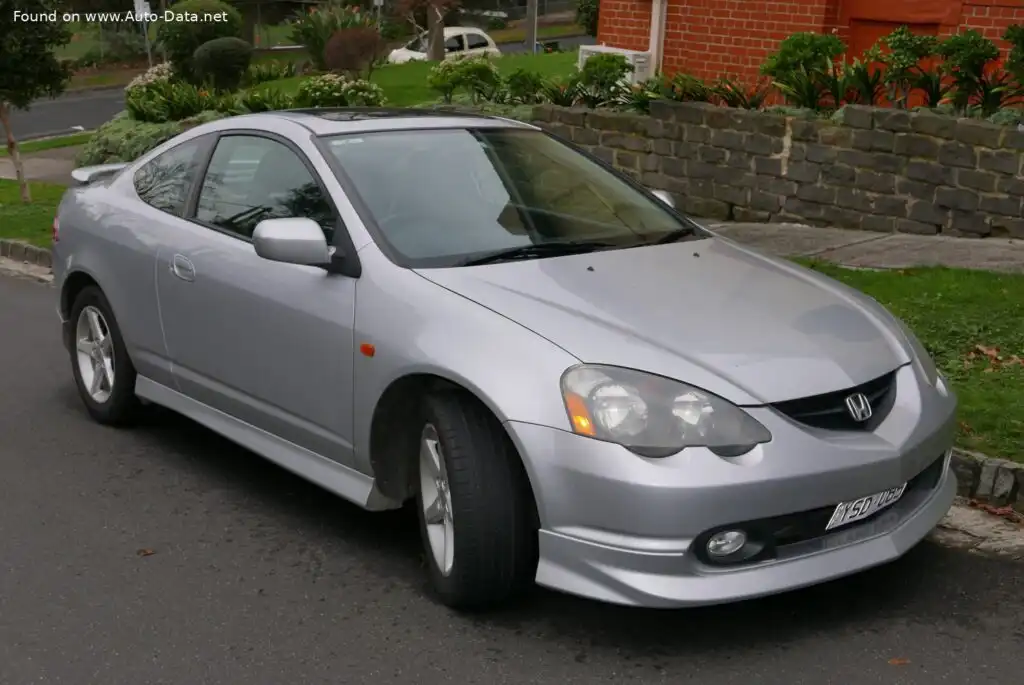
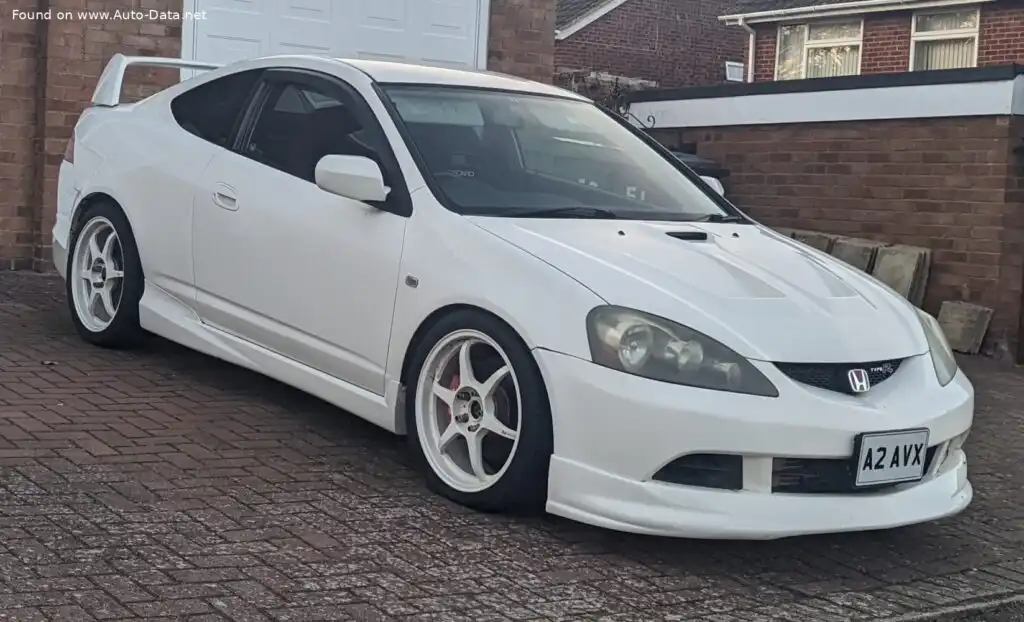
The Honda Integra IV (DC5), specifically the facelifted version produced from September 2004 to August 2006, marked a significant departure in Honda’s compact sports coupe lineage. This generation transitioned from the traditional notchback design of previous Integras to a more modern three-door liftback configuration. The 2.0-liter (160 horsepower) automatic variant occupied a middle ground within the DC5 lineup, offering a balance between performance and everyday usability. It provided a more accessible entry point into the Integra experience compared to the six-speed manual models, particularly the Type S, while still maintaining a respectable level of performance and Honda’s renowned reliability. The DC5 Integra was primarily marketed in Japan and other Asian markets, with limited official imports to North America.
Powertrain & Engine Architecture
The 2004-2006 Honda Integra IV Automatic is powered by the K20A3 engine, a 1.998-liter inline-four cylinder powerplant. This engine is a member of Honda’s celebrated K-series family, well-known for its high-revving capabilities and robust construction. While sharing the fundamental architecture with the more powerful K20A found in the Integra Type S, the K20A3 features a lower compression ratio (9.8:1 versus 11.0:1) and a less aggressive camshaft profile, resulting in a more moderate 160 horsepower output. The engine employs a multi-point fuel injection system and Honda’s Variable Valve Timing and Lift Electronic Control (VTEC) technology. However, the i-VTEC system in the K20A3 is calibrated for fuel efficiency and smoother power delivery, rather than the peak performance focus of the Type S version. The five-speed automatic transmission was specifically chosen to deliver a comfortable and convenient driving experience, prioritizing ease of use over the more engaging feel of the manual gearbox.
Driving Characteristics
The Integra IV 2.0 Automatic provides a smooth and refined driving experience. The automatic transmission, while not offering the quickest shifts, delivers seamless gear changes and contributes to the car’s overall comfort. Acceleration is adequate for daily driving, with the 160 hp engine providing sufficient power for merging onto highways and passing slower vehicles. Compared to the manual transmission versions, or the higher-output Type S, the automatic feels noticeably less responsive. The gear ratios are optimized for fuel economy and comfortable cruising, rather than outright performance. While the automatic transmission does diminish some of the sporty character of the Integra, it broadens the car’s appeal to a wider range of drivers.
Equipment & Trim Levels
The 2.0-liter automatic Integra IV typically came equipped with a reasonable array of standard features. These included power windows, power locks, air conditioning, and a basic audio system. Interior upholstery was generally cloth, with a functional and straightforward dashboard layout. Optional extras could include alloy wheels, a sunroof, and upgraded audio systems. This variant generally occupied a mid-range position in the trim level hierarchy, bridging the gap between the base models and the more performance-oriented Type S.
Chassis & Braking
The DC5 Integra utilizes a McPherson strut front suspension and a double wishbone rear suspension, providing a well-balanced and responsive handling experience. The suspension tuning in the automatic variant is slightly softer than that of the Type S, prioritizing ride comfort over ultimate handling precision. Braking is handled by ventilated discs at the front and solid discs at the rear, equipped with an Anti-lock Braking System (ABS) as standard. The braking system provides adequate stopping power for everyday driving, though it may not offer the same level of performance as the larger brakes found on the Type S.
Market Reception & Comparison
The Integra IV 2.0 Automatic received generally positive reviews, with critics praising its reliability, fuel efficiency, and comfortable ride. However, it was often criticized for its lack of sporting character when compared to the manual transmission models and the Type S. Fuel economy was a strong point, achieving around 29 US mpg in combined driving. Compared to other vehicles in its class, the Integra offered a compelling combination of practicality, reliability, and a touch of sporty flair. Some reviewers noted that the automatic transmission, while convenient, detracted from the overall driving experience that the Integra platform was capable of delivering.
Legacy
The K20A3 engine and the five-speed automatic transmission pairing in the DC5 Integra have proven to be remarkably reliable over the long term. These engines are known for their durability and ability to withstand high mileage with proper maintenance. In the used car market, the 2.0-liter automatic Integra IV represents a relatively affordable and dependable option for those seeking a compact and practical coupe. While it may not possess the same enthusiast appeal as the Type S, it remains a popular choice for drivers who prioritize comfort, reliability, and fuel efficiency. The DC5 Integra, even in its automatic guise, continues to be appreciated for its Honda engineering and overall build quality, making it a solid choice for a used vehicle.