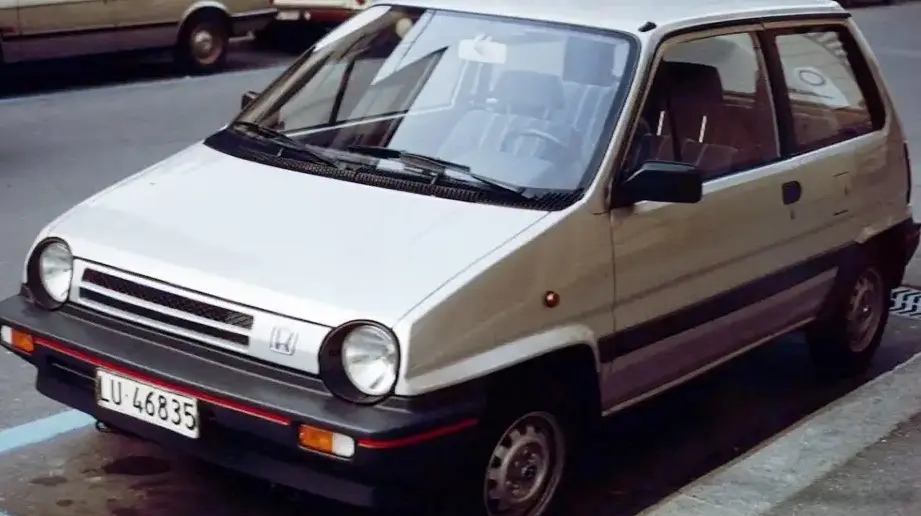
The Honda Jazz (AA), introduced in January 1984 and produced through February 1985, represents Honda’s initial foray into the supermini segment, primarily targeted at the Japanese domestic market (JDM). This first-generation Jazz, known internally as the AA series, was a significant departure for Honda, which was then more recognized for larger, more performance-oriented vehicles. The 1.2-liter (75.12 cubic inches) variant, producing 56 horsepower, served as the entry point to the Jazz lineup, offering an affordable and economical option for urban commuters. It was a key model in establishing Honda’s presence in the increasingly popular small car category.
Technical Specifications
| Brand | Honda |
| Model | Jazz |
| Generation | Jazz (AA) |
| Type (Engine) | 1.2 (56 Hp) |
| Start of production | January, 1984 |
| End of production | February, 1985 |
| Powertrain Architecture | Internal Combustion engine |
| Body type | Hatchback |
| Seats | 5 |
| Doors | 3 |
| Fuel consumption (urban) | 6.2 l/100 km (37.9 US mpg, 45.6 UK mpg, 16.1 km/l) |
| Fuel consumption (extra urban) | 4.9 l/100 km (48 US mpg, 57.6 UK mpg, 20.4 km/l) |
| Fuel Type | Petrol (Gasoline) |
| Acceleration 0 – 100 km/h | 13 sec |
| Acceleration 0 – 62 mph | 13 sec |
| Acceleration 0 – 60 mph | 12.4 sec |
| Maximum speed | 145 km/h (90.1 mph) |
| Weight-to-power ratio | 12.3 kg/Hp, 81.4 Hp/tonne |
| Weight-to-torque ratio | 7.4 kg/Nm, 135.2 Nm/tonne |
| Power | 56 Hp @ 5000 rpm |
| Power per litre | 45.5 Hp/l |
| Torque | 93 Nm @ 3500 rpm (68.59 lb.-ft. @ 3500 rpm) |
| Engine layout | Front, Transverse |
| Engine Model/Code | ER |
| Engine displacement | 1231 cm3 (75.12 cu. in.) |
| Number of cylinders | 4 |
| Engine configuration | Inline |
| Cylinder Bore | 66 mm (2.6 in.) |
| Piston Stroke | 90 mm (3.54 in.) |
| Compression ratio | 10.2:1 |
| Number of valves per cylinder | 2 |
| Fuel injection system | Carburettor |
| Engine aspiration | Naturally aspirated engine |
| Valvetrain | SOHC |
| Engine oil capacity | 3.5 l (3.7 US qt | 3.08 UK qt) |
| Coolant | 4.3 l (4.54 US qt | 3.78 UK qt) |
| Kerb Weight | 688 kg (1516.78 lbs.) |
| Max. weight | 1070 kg (2358.95 lbs.) |
| Max load | 382 kg (842.17 lbs.) |
| Fuel tank capacity | 41 l (10.83 US gal | 9.02 UK gal) |
| Max. roof load | 40 kg (88.18 lbs.) |
| Length | 3380 mm (133.07 in.) |
| Width | 1570 mm (61.81 in.) |
| Height | 1470 mm (57.87 in.) |
| Wheelbase | 2220 mm (87.4 in.) |
| Front track | 1370 mm (53.94 in.) |
| Rear (Back) track | 1370 mm (53.94 in.) |
| Drag coefficient (Cd) | 0.4 |
| Minimum turning circle | 9.8 m (32.15 ft.) |
| Drivetrain Architecture | The Internal combustion engine (ICE) drives the front wheels of the vehicle. |
| Drive wheel | Front wheel drive |
| Number of gears | 5 gears, manual transmission |
| Front suspension | Independent, type McPherson with coil spring and anti-roll bar |
| Rear suspension | Independent coil spring |
| Front brakes | Disc |
| Rear brakes | Drum |
| Steering type | Steering rack and pinion |
| Wheel rims size | 4J x 12 |
Powertrain & Engine Architecture
The heart of the Jazz 1.2 was the ER series engine, a 1231cc inline-four cylinder unit. This engine utilized a single overhead camshaft (SOHC) valvetrain with two valves per cylinder. Fuel delivery was managed by a carburetor, a common feature for vehicles of this era, prioritizing simplicity and cost-effectiveness over the more advanced fuel injection systems. The engine produced 56 horsepower at 5000 rpm and 93 Nm (68.59 lb-ft) of torque at 3500 rpm. The engine’s transverse mounting and front-wheel drive configuration were relatively modern for the time, contributing to efficient packaging within the small chassis. The transmission was a standard five-speed manual, offering a reasonable balance between fuel economy and drivability.
Driving Characteristics
The 1.2-liter Jazz, with its modest power output, was not designed for outright speed. Acceleration from 0 to 60 mph took approximately 12.4 seconds, and the top speed was around 90 mph. However, the engine proved to be surprisingly tractable, offering adequate power for navigating urban streets and highways. The five-speed manual transmission allowed drivers to keep the engine in its optimal power band, maximizing efficiency and responsiveness. Compared to potential future higher-performance variants, the 1.2 offered a smoother, more relaxed driving experience, prioritizing fuel economy and ease of use over spirited performance. The gear ratios were tuned for maximizing fuel efficiency, resulting in a slightly less engaging driving experience than the more powerful options.
Equipment & Trim Levels
The base-level Jazz 1.2 was fairly spartan in terms of equipment, reflecting its position as the entry-level model. Standard features typically included cloth upholstery, basic instrumentation, and a simple AM/FM radio. Optional extras, such as upgraded audio systems, power windows, and a sunroof, were available, but these added to the vehicle’s cost. The interior design was functional and focused on maximizing space within the compact dimensions of the car. The dashboard layout was straightforward, with clearly labeled controls. Trim levels were relatively limited, with the focus being on providing a basic, reliable, and affordable mode of transportation.
Chassis & Braking
The Jazz AA featured an independent McPherson strut suspension in the front, providing a comfortable ride and decent handling characteristics. The rear suspension utilized an independent coil spring setup. Braking duties were handled by disc brakes in the front and drum brakes in the rear, a common configuration for vehicles in this price range during the 1980s. The steering system was a rack and pinion setup, offering precise and responsive steering feel. The chassis was designed to be lightweight, contributing to the car’s overall fuel efficiency and agility. Stabilizer bars were present, helping to reduce body roll during cornering.
Market Reception & Comparison
The Honda Jazz 1.2 was generally well-received by critics for its fuel efficiency, practicality, and reliability. However, some reviewers noted its lack of power and relatively basic interior. Compared to other superminis of the time, such as the Fiat Uno and the Renault 5, the Jazz offered a more refined driving experience and a reputation for Honda’s renowned build quality. Its fuel economy was competitive, and its maintenance costs were relatively low. The 1.2-liter engine was considered a good compromise between performance and economy, making it a popular choice for first-time car buyers and urban commuters.
Legacy
The Honda Jazz (AA) 1.2, while not a performance icon, laid the foundation for Honda’s successful entry into the supermini market. The ER engine proved to be a durable and reliable unit, and many examples remain on the road today. In the used car market, the Jazz AA 1.2 is valued for its simplicity, affordability, and Honda’s reputation for reliability. It represents a significant piece of automotive history, showcasing Honda’s ability to adapt to changing market demands and produce a compelling small car that resonated with consumers. The AA series paved the way for subsequent generations of the Jazz, which have continued to be popular choices in the supermini segment.