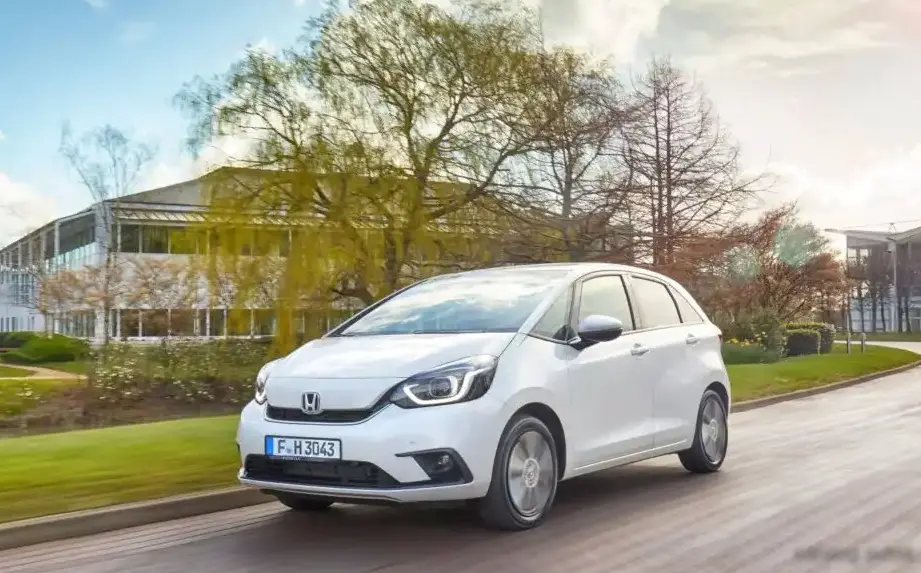
Technical Specifications
| Brand | Honda |
| Model | Jazz |
| Generation | Jazz IV |
| Type (Engine) | 1.5 i-MMD (109 Hp) e:HEV e-CVT |
| Start of production | July, 2020 |
| End of production | April, 2023 |
| Powertrain Architecture | FHEV (Full Hybrid Electric Vehicle) |
| Body type | Hatchback |
| Seats | 5 |
| Doors | 5 |
| Fuel consumption at Low speed (WLTP) | 3.5-3.6 l/100 km (67.2 – 65.3 US mpg) |
| Fuel consumption at Medium speed (WLTP) | 3.8-3.9 l/100 km (61.9 – 60.3 US mpg) |
| Fuel consumption at high speed (WLTP) | 3.9 l/100 km (60.3 US mpg) |
| Fuel consumption at very high speed (WLTP) | 5.8-5.9 l/100 km (40.6 – 39.9 US mpg) |
| Combined fuel consumption (WLTP) | 4.5-4.6 l/100 km (52.3 – 51.1 US mpg) |
| CO2 emissions (WLTP) | 102-104 g/km |
| Fuel Type | Petrol (Gasoline) |
| Acceleration 0 – 100 km/h | 9.4-9.5 sec |
| Acceleration 0 – 62 mph | 9.4-9.5 sec |
| Acceleration 0 – 60 mph | 8.9 sec |
| Maximum speed | 174 km/h (108.12 mph) |
| Emission standard | EURO 6d-TEMP |
| Weight-to-power ratio | 11.3 kg/Hp |
| Weight-to-torque ratio | 4.9 kg/Nm |
| Electric motor power | 109 Hp |
| Electric motor Torque | 253 Nm (186.6 lb.-ft.) |
| Power | 98 Hp @ 5500-6400 rpm |
| Torque | 131 Nm @ 4500-5000 rpm (96.62 lb.-ft. @ 4500-5000 rpm) |
| Engine displacement | 1498 cm3 (91.41 cu. in.) |
| Number of cylinders | 4 |
| Compression ratio | 13.5:1 |
| Kerb Weight | 1228-1246 kg (2707.28 – 2746.96 lbs.) |
| Max. weight | 1710 kg (3769.9 lbs.) |
| Trunk (boot) space – minimum | 304 l (10.74 cu. ft.) |
| Trunk (boot) space – maximum | 1205 l (42.55 cu. ft.) |
| Fuel tank capacity | 40 l (10.57 US gal) |
| Length | 4044 mm (159.21 in.) |
| Width | 1694 mm (66.69 in.) |
| Height | 1526 mm (60.08 in.) |
| Wheelbase | 2517 mm (99.09 in.) |
| Gearbox | automatic transmission e-CVT |
The Honda Jazz IV 1.5 i-MMD (109 Hp) e:HEV, often marketed as the Honda Fit in certain regions, represents a notable advancement in Honda’s supermini offerings. Introduced in July 2020 and produced through April 2023, this variant was a crucial part of the fourth-generation Jazz (GK series) lineup, specifically designed to attract buyers who prioritized fuel efficiency and a smooth driving experience. It features Honda’s innovative e:HEV hybrid system, signifying a move towards electrification for this popular hatchback. This model was primarily targeted towards the European and Asian markets, where demand for fuel-efficient compact cars is particularly strong.
Powertrain & Engine Architecture
The core of the Jazz IV 1.5 i-MMD e:HEV is Honda’s Intelligent Multi-Mode Drive (i-MMD) system. This isn’t a traditional parallel hybrid configuration; rather, it’s a series-parallel hybrid. The 1.5-liter LEB8 inline-four gasoline engine (producing 98 horsepower and 131 Nm of torque) primarily functions as a generator, supplying power to the electric motor. The electric motor, generating 109 hp and 253 Nm of torque, is the primary driver of the front wheels. The system intelligently switches between EV mode (purely electric), Hybrid mode (engine generating electricity), and Engine mode (engine directly driving the wheels at higher speeds) to optimize efficiency. The e-CVT (electronic continuously variable transmission) lacks traditional gears; it’s a single-speed reduction gear, delivering a seamless and linear power delivery. The engine employs direct injection and Honda’s VTEC variable valve timing system to enhance both efficiency and performance.
Driving Characteristics
The 1.5 i-MMD e:HEV provides a distinctly different driving experience compared to the standard gasoline Jazz or even the 1.5-liter manual versions. The e-CVT offers smooth, nearly silent acceleration, especially at lower speeds. The absence of conventional gear changes contributes to a relaxed and refined feel. While the combined system output of 109 hp isn’t exceptionally high, the instant torque from the electric motor provides brisk acceleration, reaching 0-60 mph in approximately 8.9 seconds. Compared to the manual transmission models, the e-CVT prioritizes fuel economy over outright performance. The engine can sometimes feel stressed during hard acceleration, as it operates primarily within its most efficient range. The regenerative braking system is effective, contributing to overall efficiency and providing a noticeable deceleration effect when lifting off the throttle.
Equipment & Trim Levels
The 1.5 i-MMD e:HEV generally occupied a mid-to-upper position within the Jazz IV lineup. Standard equipment typically included Honda Sensing, a comprehensive suite of advanced safety features encompassing adaptive cruise control, lane keeping assist, and collision mitigation braking system. Interior features included a touchscreen infotainment system with Apple CarPlay and Android Auto compatibility, automatic climate control, and comfortable seating. Higher trim levels added features such as heated front seats, a premium audio system, and upgraded interior materials. Exterior features often included alloy wheels, LED headlights, and a rear parking camera. The overall interior design was modern and functional, with Honda’s ingenious “Magic Seats” offering exceptional versatility for cargo transport.
Chassis & Braking
The Jazz IV utilizes a torsion beam rear suspension, a cost-effective and space-saving design. The front suspension consists of MacPherson struts. The suspension tuning prioritizes comfort and ride quality over sporty handling. Braking is provided by ventilated discs at the front and solid discs at the rear. ABS (Anti-lock Braking System) and EBD (Electronic Brakeforce Distribution) are standard features. The steering is electrically assisted, providing light and precise control. The weight of the hybrid components does slightly affect handling, making the car feel a bit heavier than the standard gasoline models.
Market Reception & Comparison
The Honda Jazz IV 1.5 i-MMD e:HEV was generally well-received by automotive critics. Its exceptional fuel economy, smooth driving experience, and spacious interior were frequently lauded. However, some reviewers pointed out the lack of engaging driving dynamics and the engine’s occasional strain under hard acceleration. Compared to other hybrid options in the same segment, such as the Toyota Yaris Hybrid, the Jazz offered a more refined driving experience and a more spacious interior. The Yaris Hybrid, however, typically achieved slightly better fuel economy. In terms of reliability, Honda has a strong reputation, and the i-MMD system has proven to be generally reliable, although the long-term durability of the hybrid components remains a consideration.
Legacy
The Honda Jazz IV 1.5 i-MMD e:HEV represents a significant step in Honda’s electrification strategy. The i-MMD system has become a cornerstone of Honda’s hybrid technology, and it continues to be refined and improved in subsequent models. On the used car market, these models tend to hold their value well due to their fuel efficiency and Honda’s reputation for reliability. Potential buyers should be mindful of the importance of maintaining the hybrid system components, including the battery pack, to ensure long-term performance and longevity. The Jazz IV 1.5 i-MMD e:HEV remains a practical and efficient choice for buyers seeking a compact hybrid hatchback.