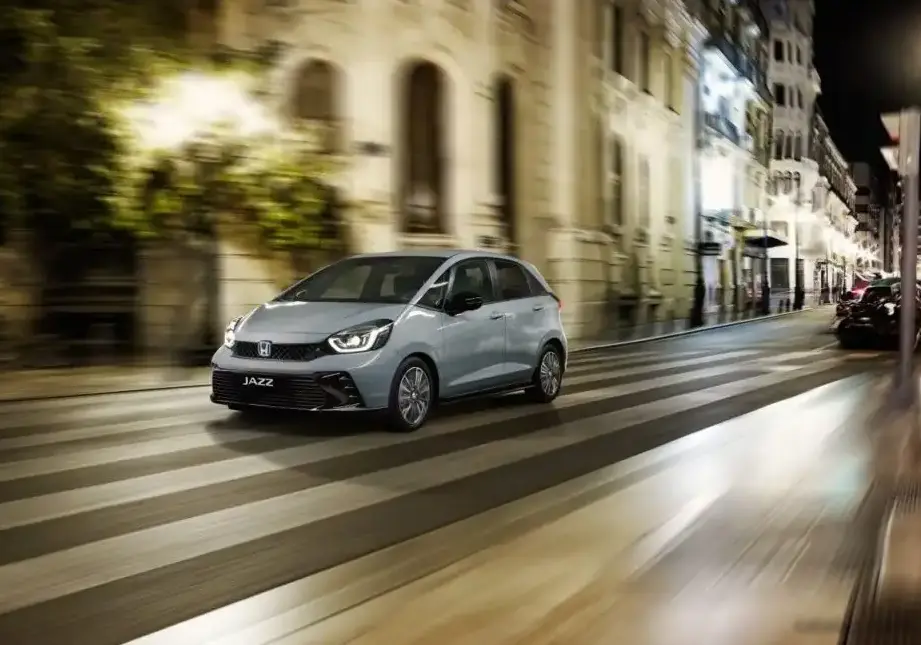
Technical Specifications
| Brand | Honda |
| Model | Jazz |
| Generation | Jazz IV (facelift 2023) |
| Type (Engine) | 1.5 i-MMD (122 Hp) e:HEV e-CVT |
| Start of production | April, 2023 |
| Powertrain Architecture | FHEV (Full Hybrid Electric Vehicle) |
| Body type | Hatchback |
| Seats | 5 |
| Doors | 5 |
| Fuel consumption at Low speed (WLTP) | 3.6-4 l/100 km (65.3 – 58.8 US mpg) |
| Fuel consumption at Medium speed (WLTP) | 3.7-3.8 l/100 km (63.6 – 61.9 US mpg) |
| Fuel consumption at High speed (WLTP) | 3.9-4 l/100 km (60.3 – 58.8 US mpg) |
| Fuel consumption at Very High speed (WLTP) | 5.8-6 l/100 km (40.6 – 39.2 US mpg) |
| Combined fuel consumption (WLTP) | 4.5-4.7 l/100 km (52.3 – 50 US mpg) |
| CO2 emissions (WLTP) | 102-106 g/km |
| Fuel consumption (economy) – urban (NEDC) | 2.5-2.6 l/100 km (94.1 – 90.5 US mpg) |
| Fuel consumption (economy) – extra urban (NEDC) | 4.4-4.5 l/100 km (53.5 – 52.3 US mpg) |
| Fuel consumption (economy) – combined (NEDC) | 3.7-3.8 l/100 km (63.6 – 61.9 US mpg) |
| CO2 emissions (NEDC) | 85-87 g/km |
| Fuel Type | Petrol (Gasoline) |
| Acceleration 0 – 100 km/h | 9.4 sec |
| Acceleration 0 – 62 mph | 9.4 sec |
| Acceleration 0 – 60 mph | 8.9 sec |
| Maximum speed | 175 km/h (108.74 mph) |
| Emission standard | Euro 6d |
| Weight-to-power ratio | 10.1 kg/Hp |
| Weight-to-torque ratio | 4.8 kg/Nm |
| Battery location | Below the floor, under the rear seats |
| Electric motor power | 122 Hp |
| Electric motor Torque | 253 Nm (186.6 lb.-ft.) |
| Electric motor location | Integrated into the transmission |
| System power | 122 Hp |
| System torque | 253 Nm (186.6 lb.-ft.) |
| Power | 107 Hp @ 6000-6400 rpm |
| Torque | 131 Nm @ 4500-5000 rpm (96.62 lb.-ft. @ 4500-5000 rpm) |
| Engine layout | Front, Transverse |
| Engine Model/Code | LEB8 |
| Engine displacement | 1498 cm3 (91.41 cu. in.) |
| Number of cylinders | 4 |
| Engine configuration | Inline |
| Cylinder Bore | 73 mm (2.87 in.) |
| Piston Stroke | 89.5 mm (3.52 in.) |
| Compression ratio | 13.5:1 |
| Number of valves per cylinder | 4 |
| Fuel injection system | Multi-port manifold injection |
| Engine aspiration | Naturally aspirated engine |
| Valvetrain | DOHC, i-VTEC |
| Engine oil capacity | 4.3 l (4.54 US qt | 3.78 UK qt) |
| Coolant | 5 l (5.28 US qt | 4.4 UK qt) |
| Kerb Weight | 1227-1239 kg (2705.07 – 2731.53 lbs.) |
| Max. weight | 1690 kg (3725.81 lbs.) |
| Max load | 451-463 kg (994.28 – 1020.74 lbs.) |
| Trunk (boot) space – minimum | 304 l (10.74 cu. ft.) |
| Trunk (boot) space – maximum | 1205 l (42.55 cu. ft.) |
| Fuel tank capacity | 40 l (10.57 US gal | 8.8 UK gal) |
| Max. roof load | 35 kg (77.16 lbs.) |
| Permitted trailer load with brakes (12%) | 500 kg (1102.31 lbs.) |
| Permitted trailer load without brakes | 500 kg (1102.31 lbs.) |
| Length | 4089 mm (160.98 in.) |
| Width | 1694 mm (66.69 in.) |
| Width with mirrors folded | 1814 mm (71.42 in.) |
| Width including mirrors | 1966 mm (77.4 in.) |
| Height | 1526 mm (60.08 in.) |
| Wheelbase | 2517 mm (99.09 in.) |
| Front track | 1487 mm (58.54 in.) |
| Rear (Back) track | 1474 mm (58.03 in.) |
| Ride height (ground clearance) | 136 mm (5.35 in.) |
| Minimum turning circle (turning diameter) | 10.1-10.7 m (33.14 – 35.1 ft.) |
| Drivetrain Architecture | The Internal combustion engine (ICE) and electric motor drive the front wheels. |
| Drive wheel | Front wheel drive |
| Number of gears and type of gearbox | automatic transmission e-CVT |
| Front suspension | Independent type McPherson |
| Rear suspension | Torsion |
| Front brakes | Ventilated discs, 262 mm |
| Rear brakes | Disc, 239 mm |
| Assisting systems | ABS (Anti-lock braking system) |
| Steering type | Steering rack and pinion |
| Power steering | Electric Steering |
| Tires size | 185/60 R15; 185/55 R16 |
| Wheel rims size | 15; 16 |
The Honda Jazz IV 1.5 i-MMD e:HEV, introduced with the 2023 facelift, is a front-wheel-drive, five-door hatchback powered by a sophisticated full hybrid system. It’s built on Honda’s Global Small Car platform, also known as the 1HX0/A3 platform, which prioritizes space efficiency and versatility. This variant is particularly important in European and Asian markets where fuel efficiency and compact dimensions are highly valued. The facelift brought subtle styling revisions, enhanced safety features, and refinements to the hybrid powertrain. This model aims to appeal to buyers seeking a practical, economical, and technologically advanced city car.
Powertrain & Engine Architecture
At the heart of the Jazz 1.5 i-MMD e:HEV lies Honda’s Intelligent Multi-Mode Drive (i-MMD) hybrid system. This isn’t a traditional parallel hybrid; instead, it primarily uses the electric motor to drive the wheels, with the 1.5-liter LEB8 gasoline engine acting mainly as a generator to recharge the battery. The engine itself is a naturally aspirated, inline-four cylinder unit producing 107 horsepower at 6000-6400 rpm and 131 Nm of torque at 4500-5000 rpm. It features direct injection and Honda’s i-VTEC variable valve timing system. The e-CVT (electronic Continuously Variable Transmission) isn’t a conventional CVT with belts and pulleys; it’s a single-speed gearbox coupled with two electric motors – a generator motor (MG1) and a propulsion motor (MG2). The system intelligently switches between EV mode, hybrid mode, and engine drive mode, optimizing for efficiency and performance. The engine code LEB8 is a key identifier for this specific engine configuration.
Driving Characteristics
The 1.5 i-MMD e:HEV delivers a unique driving experience. Acceleration from 0-60 mph takes approximately 8.9 seconds, and 0-100 km/h in 9.4 seconds, which is adequate for urban and suburban driving. The e-CVT provides smooth, linear acceleration, lacking the stepped gear changes of a traditional automatic. The emphasis is on quiet operation and fuel efficiency. Compared to a manual transmission Jazz, the e-CVT prioritizes ease of use over driver engagement. While the higher-output 1.5-liter engine found in some markets offers more spirited performance, the i-MMD system excels in maximizing fuel economy, particularly in city driving where the electric motor can operate frequently. The gear ratios are optimized for efficiency rather than outright speed, resulting in a relaxed and refined driving experience.
Equipment & Trim Levels
The Jazz 1.5 i-MMD e:HEV typically comes well-equipped, even in base trim levels. Standard features often include Honda Sensing suite of safety technologies (including adaptive cruise control, lane keeping assist, and collision mitigation braking system), a touchscreen infotainment system with Apple CarPlay and Android Auto compatibility, automatic climate control, and keyless entry. Higher trim levels add features like heated seats, a premium audio system, and upgraded interior materials. Interior upholstery is typically cloth, with options for leather in higher trims. The dashboard layout is modern and minimalist, prioritizing functionality and ease of use. Optional extras often include a sunroof, navigation system, and parking sensors.
Chassis & Braking
The Jazz IV utilizes a McPherson strut front suspension and a torsion beam rear suspension. This setup provides a comfortable ride quality, well-suited for city streets. The facelifted model received subtle suspension tweaks to further improve ride comfort and handling. Braking duties are handled by ventilated discs at the front and solid discs at the rear. ABS (Anti-lock Braking System) is standard. The weight of the hybrid components does add to the overall vehicle weight (1227-1239 kg), but the low center of gravity helps to maintain stable handling. Stabilizer bars are fitted to both the front and rear axles to reduce body roll during cornering.
Market Reception & Comparison
The Honda Jazz 1.5 i-MMD e:HEV has been generally well-received by automotive critics, praised for its fuel efficiency, spacious interior, and innovative features. Compared to other trims in the Jazz lineup, the e:HEV variant commands a premium price due to its advanced hybrid technology. However, the fuel savings often offset the higher initial cost over the vehicle’s lifespan. Compared to competitors like the Toyota Yaris Hybrid, the Jazz offers a more spacious interior and a more refined driving experience, although the Yaris may offer slightly better fuel economy in certain driving conditions. Reliability is a strong point for Honda, and the i-MMD system has proven to be durable and dependable.
Legacy
The 1.5 i-MMD e:HEV powertrain represents a significant step forward in Honda’s hybrid technology. The i-MMD system has become a cornerstone of Honda’s hybrid strategy, and its efficiency and reliability have established a strong reputation. In the used car market, these models are generally sought after for their fuel economy and low running costs. While long-term durability of the hybrid components is generally good, regular maintenance, including battery health checks, is crucial to ensure optimal performance and longevity. The Jazz IV 1.5 i-MMD e:HEV is likely to remain a popular choice for buyers seeking a practical, economical, and environmentally friendly city car for years to come.