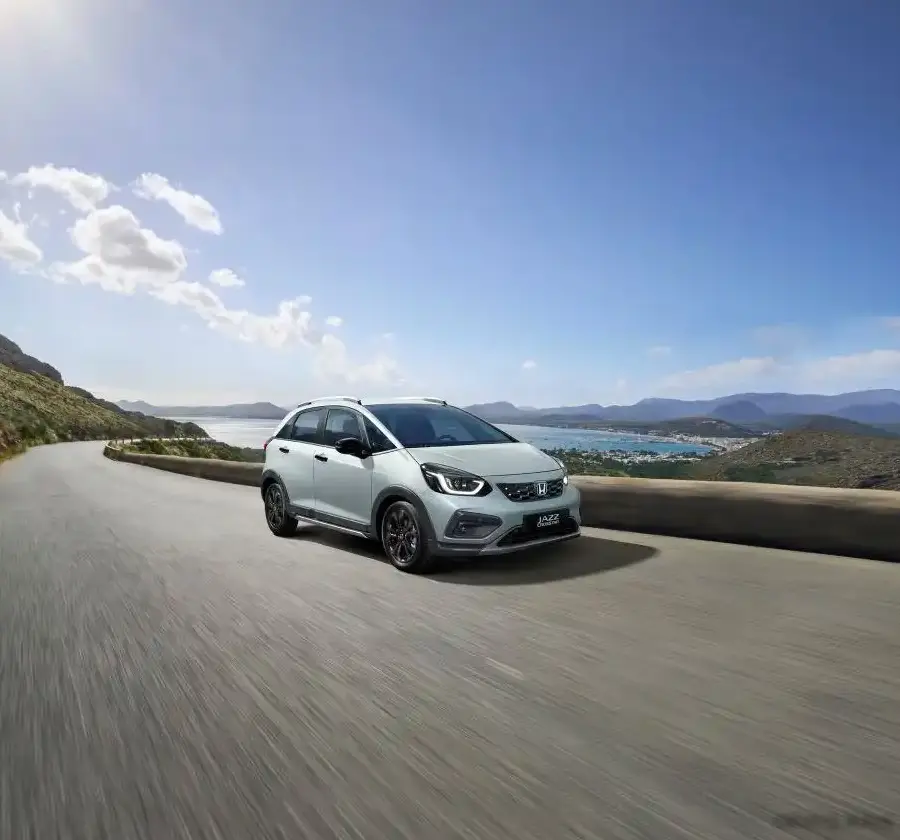
The Honda Jazz IV (facelift 2023) Crosstar 1.5 i-MMD (122 Hp) e:HEV e-CVT represents a notable evolution of Honda’s globally successful subcompact hatchback. Introduced in April 2023, this variant builds upon the fourth-generation Jazz (released in 2020), incorporating styling cues and features from the Crosstar trim level while utilizing Honda’s advanced e:HEV hybrid powertrain. Positioned as a more rugged and adventurous version of the standard Jazz, the Crosstar 1.5 i-MMD caters to buyers seeking a fuel-efficient, versatile, and technologically advanced vehicle. It primarily targets the European and Asian markets, where the subcompact hatchback segment remains highly competitive.
Technical Specifications
| Brand | Honda |
| Model | Jazz |
| Generation | Jazz IV (facelift 2023) |
| Type (Engine) | Crosstar 1.5 i-MMD (122 Hp) e:HEV e-CVT |
| Start of production | April, 2023 |
| Powertrain Architecture | FHEV (Full Hybrid Electric Vehicle) |
| Body type | Hatchback |
| Seats | 5 |
| Doors | 5 |
| Fuel consumption at Low speed (WLTP) | 3.9 l/100 km (60.3 US mpg, 72.4 UK mpg, 25.6 km/l) |
| Fuel consumption at Medium speed (WLTP) | 3.9 l/100 km (60.3 US mpg, 72.4 UK mpg, 25.6 km/l) |
| Fuel consumption at high speed (WLTP) | 4.2 l/100 km (56 US mpg, 67.3 UK mpg, 23.8 km/l) |
| Fuel consumption at very high speed (WLTP) | 6.2 l/100 km (37.9 US mpg, 45.6 UK mpg, 16.1 km/l) |
| Combined fuel consumption (WLTP) | 4.8 l/100 km (49 US mpg, 58.9 UK mpg, 20.8 km/l) |
| CO2 emissions (WLTP) | 108 g/km |
| Fuel consumption (economy) – urban (NEDC) | 2.7 l/100 km (87.1 US mpg, 104.6 UK mpg, 37 km/l) |
| Fuel consumption (economy) – extra urban (NEDC) | 4.6 l/100 km (51.1 US mpg, 61.4 UK mpg, 21.7 km/l) |
| Fuel consumption (economy) – combined (NEDC) | 3.9 l/100 km (60.3 US mpg, 72.4 UK mpg, 25.6 km/l) |
| CO2 emissions (NEDC) | 89 g/km |
| Fuel Type | Petrol (Gasoline) |
| Acceleration 0 – 100 km/h | 9.7 sec |
| Acceleration 0 – 62 mph | 9.7 sec |
| Acceleration 0 – 60 mph | 9.2 sec |
| Maximum speed | 175 km/h (108.74 mph) |
| Emission standard | Euro 6d |
| Weight-to-power ratio | 10.2 kg/Hp, 98 Hp/tonne |
| Weight-to-torque ratio | 4.9 kg/Nm, 203.2 Nm/tonne |
| Battery location | Below the floor, under the rear seats |
| Electric motor power | 122 Hp |
| Electric motor Torque | 253 Nm (186.6 lb.-ft.) |
| Electric motor location | Integrated into the transmission |
| System power | 122 Hp |
| System torque | 253 Nm (186.6 lb.-ft.) |
| Power | 107 Hp @ 6000-6400 rpm |
| Torque | 131 Nm @ 4500-5000 rpm (96.62 lb.-ft. @ 4500-5000 rpm) |
| Engine layout | Front, Transverse |
| Engine Model/Code | LEB8 |
| Engine displacement | 1498 cm3 (91.41 cu. in.) |
| Number of cylinders | 4 |
| Engine configuration | Inline |
| Cylinder Bore | 73 mm (2.87 in.) |
| Piston Stroke | 89.5 mm (3.52 in.) |
| Compression ratio | 13.5:1 |
| Number of valves per cylinder | 4 |
| Fuel injection system | Multi-port manifold injection |
| Engine aspiration | Naturally aspirated engine |
| Valvetrain | DOHC, i-VTEC |
| Engine oil capacity | 4.3 l (4.54 US qt | 3.78 UK qt) |
| Coolant | 5 l (5.28 US qt | 4.4 UK qt) |
| Kerb Weight | 1245 kg (2744.76 lbs.) |
| Max. weight | 1690 kg (3725.81 lbs.) |
| Max load | 445 kg (981.06 lbs.) |
| Trunk (boot) space – minimum | 304 l (10.74 cu. ft.) |
| Trunk (boot) space – maximum | 1205 l (42.55 cu. ft.) |
| Fuel tank capacity | 40 l (10.57 US gal | 8.8 UK gal) |
| Max. roof load | 50 kg (110.23 lbs.) |
| Permitted trailer load with brakes (12%) | 500 kg (1102.31 lbs.) |
| Permitted trailer load without brakes | 500 kg (1102.31 lbs.) |
| Length | 4105 mm (161.61 in.) |
| Width | 1725 mm (67.91 in.) |
| Width with mirrors folded | 1814 mm (71.42 in.) |
| Width including mirrors | 1966 mm (77.4 in.) |
| Height | 1556 mm (61.26 in.) |
| Wheelbase | 2520 mm (99.21 in.) |
| Front track | 1498 mm (58.98 in.) |
| Rear (Back) track | 1485 mm (58.46 in.) |
| Ride height (ground clearance) | 146 mm (5.75 in.) |
| Minimum turning circle (turning diameter) | 10.1 m (33.14 ft.) |
| Drivetrain Architecture | The Internal combustion engine (ICE) and electric motor drive the front wheels of the car with the ability to work in full electric or mixed mode. There are parallel and serial hybrid modes. |
| Drive wheel | Front wheel drive |
| Number of gears and type of gearbox | automatic transmission e-CVT |
| Front suspension | Independent type McPherson |
| Rear suspension | Torsion |
| Front brakes | Ventilated discs, 262 mm |
| Rear brakes | Disc, 239 mm |
| Assisting systems | ABS (Anti-lock braking system) |
| Steering type | Steering rack and pinion |
| Power steering | Electric Steering |
| Tires size | 185/60 R16 |
| Wheel rims size | 6J x 16 |
Powertrain & Engine Architecture
The Crosstar 1.5 i-MMD utilizes Honda’s Intelligent Multi-Mode Drive (i-MMD) hybrid system. This isn’t a traditional parallel hybrid; instead, it’s a series-parallel hybrid. The 1.5-liter LEB8 inline-four gasoline engine (107 hp) primarily functions as a generator, powering an electric motor that drives the front wheels. At higher speeds, a direct drive mode engages, mechanically linking the engine to the wheels for improved efficiency. The engine features multi-point fuel injection, a DOHC i-VTEC valvetrain, and a high compression ratio of 13.5:1. The e-CVT (electronic continuously variable transmission) doesn’t have traditional gears; it seamlessly adjusts the ratio to optimize engine and motor efficiency. The electric motor itself produces 122 hp and 253 Nm of torque. The battery is located under the rear seats, minimizing impact on passenger space.
Driving Characteristics
The 1.5 i-MMD e:HEV offers a unique driving experience. Acceleration to 60 mph takes approximately 9.2 seconds, and 0-100 km/h is achieved in 9.7 seconds. While not overtly sporty, the instant torque from the electric motor provides brisk acceleration in urban environments. The e-CVT contributes to a smooth, linear power delivery, lacking the stepped shifts of a conventional automatic. Compared to a manual transmission Jazz, the e-CVT prioritizes efficiency over driver engagement. The hybrid system allows for short periods of all-electric driving, particularly at lower speeds, further enhancing fuel economy. The Crosstar’s slightly increased weight compared to the standard Jazz is noticeable, but the added power from the hybrid system mitigates this effect.
Equipment & Trim Levels
The Crosstar trim level adds a distinct aesthetic and feature set to the Jazz. Standard equipment includes Honda Sensing suite of safety features (including adaptive cruise control, lane keeping assist, and collision mitigation braking system), a touchscreen infotainment system with Apple CarPlay and Android Auto compatibility, and climate control. The Crosstar also features unique exterior styling elements such as rugged-looking bumpers, roof rails, and water-repellent upholstery. Optional extras typically include a premium audio system, navigation, and parking sensors.
Chassis & Braking
The Jazz Crosstar utilizes a front independent McPherson strut suspension and a rear torsion beam setup. This configuration provides a comfortable ride quality, well-suited for everyday driving. The Crosstar’s slightly raised ride height (146 mm) contributes to its more adventurous appearance and provides a degree of increased ground clearance. Braking duties are handled by ventilated discs at the front and solid discs at the rear. ABS (Anti-lock Braking System) is standard.
Market Reception & Comparison
The Honda Jazz IV (facelift 2023) Crosstar 1.5 i-MMD has been well-received by automotive critics for its fuel efficiency, practicality, and advanced technology. Compared to other trims in the Jazz lineup, the e-CVT version offers superior fuel economy, particularly in urban driving conditions. However, it comes at a higher price point. Compared to competitors like the Toyota Yaris Hybrid, the Jazz Crosstar offers a more spacious interior and a more refined driving experience. Reliability is a strong point for Honda, and the i-MMD hybrid system has proven to be durable in real-world use.
Legacy
The Honda Jazz IV (facelift 2023) Crosstar 1.5 i-MMD represents a significant step forward in Honda’s hybrid technology. The i-MMD system is known for its reliability and efficiency, and the LEB8 engine has a good track record. On the used car market, these models are expected to hold their value well due to their fuel efficiency and Honda’s reputation for dependability. The Crosstar trim level has proven popular, appealing to buyers seeking a stylish and practical subcompact hatchback with a focus on fuel economy and technology.