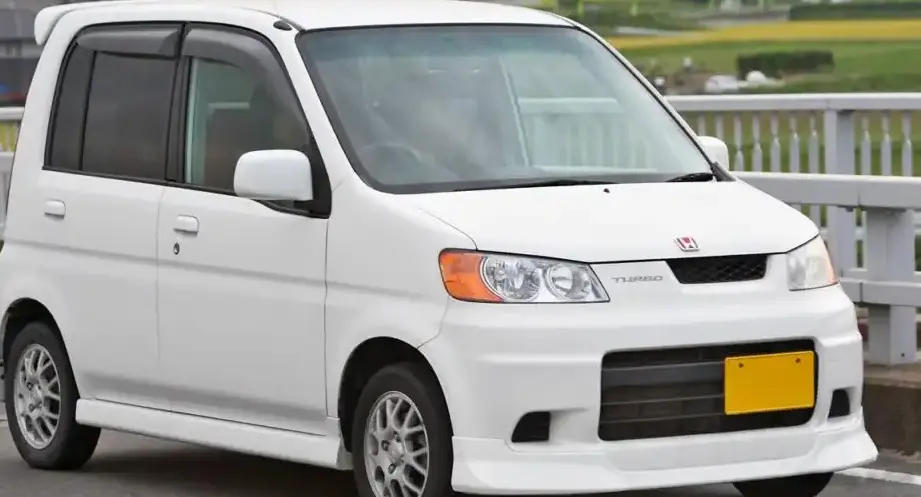
The Honda Life II 0.7, producing 50 horsepower, was a compact, front-wheel drive minivan produced by Honda between 1997 and 1998. It represented a continuation of the Life series, a kei car-sized vehicle popular in Japan for its practicality and efficient use of space. This particular variant, with its small displacement engine, was positioned as the entry-level offering within the Life II range, appealing to buyers prioritizing fuel economy and affordability. It was part of the broader Life II generation, internally designated as the JA4, and built upon a dedicated platform optimized for maximizing interior volume within Japan’s stringent kei car regulations.
Technical Specifications
| Brand | Honda |
| Model | Life |
| Generation | Life II |
| Type (Engine) | 0.7 (50 Hp) |
| Start of production | 1997 |
| End of production | 1998 |
| Powertrain Architecture | Internal Combustion engine |
| Body type | Minivan |
| Seats | 4 |
| Doors | 5 |
| Fuel consumption (urban) | 7 l/100 km (33.6 US mpg, 40.4 UK mpg, 14.3 km/l) |
| Fuel consumption (extra urban) | 4 l/100 km (58.8 US mpg, 70.6 UK mpg, 25 km/l) |
| Fuel Type | Petrol (Gasoline) |
| Maximum speed | 130 km/h (80.78 mph) |
| Weight-to-power ratio | 15.8 kg/Hp (63.3 Hp/tonne) |
| Weight-to-torque ratio | 13 kg/Nm (77.2 Nm/tonne) |
| Power | 50 Hp @ 7000 rpm |
| Power per litre | 76.1 Hp/l |
| Torque | 61 Nm @ 4500 rpm (44.99 lb.-ft. @ 4500 rpm) |
| Engine layout | Front, Transverse |
| Engine displacement | 657 cm3 (40.09 cu. in.) |
| Number of cylinders | 3 |
| Engine configuration | Inline |
| Cylinder Bore | 66 mm (2.6 in.) |
| Piston Stroke | 64 mm (2.52 in.) |
| Compression ratio | 10.5:1 |
| Number of valves per cylinder | 4 |
| Fuel injection system | Multi-port manifold injection |
| Engine aspiration | Naturally aspirated engine |
| Valvetrain | OHC |
| Kerb Weight | 790 kg (1741.65 lbs.) |
| Fuel tank capacity | 31 l (8.19 US gal | 6.82 UK gal) |
| Length | 3395 mm (133.66 in.) |
| Width | 1475 mm (58.07 in.) |
| Height | 1610 mm (63.39 in.) |
| Wheelbase | 2360 mm (92.91 in.) |
| Front track | 1305 mm (51.38 in.) |
| Rear track | 1295 mm (50.98 in.) |
| Minimum turning circle | 9 m (29.53 ft.) |
| Drivetrain Architecture | The Internal combustion engine (ICE) drives the front wheels of the vehicle. |
| Drive wheel | Front wheel drive |
| Number of gears and type of gearbox | 5 gears, manual transmission |
| Front suspension | Spring Strut |
| Rear suspension | Coil spring |
| Front brakes | Disc |
| Rear brakes | Drum |
| Assisting systems | ABS (Anti-lock braking system) |
| Steering type | Steering rack and pinion |
| Power steering | Hydraulic Steering |
| Tires size | 155/70 R12 |
Powertrain & Engine Architecture
The heart of the Life II 0.7 was a 657cc inline-three cylinder engine, designated as part of the Honda’s engine family. This engine utilized a single overhead camshaft (OHC) valvetrain and a multi-port fuel injection system. The 10.5:1 compression ratio helped extract a modest 50 horsepower at 7000 rpm and 61 Nm (45 lb-ft) of torque at 4500 rpm. The engine’s compact size and lightweight construction were key to meeting kei car regulations. The engine was transversely mounted, driving the front wheels through a five-speed manual transmission. While an automatic transmission was offered on other Life II variants, the 0.7-liter engine was exclusively paired with the manual gearbox, emphasizing its focus on affordability and driver engagement.
Driving Characteristics
The 0.7-liter Life II was not designed for outright speed. Its performance was best described as adequate for urban driving and short trips. The 50 horsepower engine required frequent downshifts to maintain momentum, especially when encountering hills or overtaking. The five-speed manual transmission allowed drivers to keep the engine in its optimal power band, but the overall experience was geared towards efficiency rather than exhilaration. Compared to the slightly more powerful 1.0-liter versions of the Life II, the 0.7 felt noticeably slower, but it offered superior fuel economy. The gear ratios were tuned for maximizing fuel efficiency, resulting in a relatively tall final drive.
Equipment & Trim Levels
The Life II 0.7 was typically offered with a basic level of equipment, reflecting its position as the entry-level model. Standard features generally included cloth upholstery, a simple dashboard layout, and manual windows and door locks. Air conditioning was often an optional extra. Interior space was maximized through clever packaging, offering surprising room for four adults despite the vehicle’s diminutive exterior dimensions. The dashboard design was functional and straightforward, prioritizing usability over aesthetics. Optional extras could include upgraded audio systems and different wheel covers.
Chassis & Braking
The Life II utilized a relatively simple chassis design. Front suspension consisted of MacPherson strut springs, while the rear employed a coil spring setup. The front brakes were discs, providing adequate stopping power for the vehicle’s weight and performance. However, the rear brakes were drums, a cost-saving measure common in this class of vehicle. ABS (Anti-lock Braking System) was included as a standard safety feature. The steering was rack and pinion with hydraulic assistance, providing light and easy maneuverability. The relatively narrow tires (155/70 R12) contributed to fuel efficiency but offered limited grip.
Market Reception & Comparison
The Honda Life II 0.7 was well-received in Japan as an affordable and practical transportation solution. Critics praised its fuel efficiency and spacious interior, but noted its limited performance. Compared to other kei car rivals, such as the Suzuki Alto and Daihatsu Mira, the Life II offered a slightly more refined driving experience and a reputation for Honda reliability. The 0.7-liter engine provided significantly better fuel economy than the larger 1.0-liter engine options, making it a popular choice for commuters and city dwellers. However, the lack of an automatic transmission option for this variant may have limited its appeal to some buyers.
Legacy
The Honda Life II 0.7, while not a performance icon, remains a testament to Honda’s engineering prowess in maximizing space and efficiency within the constraints of kei car regulations. The engine, while modest in output, proved to be relatively reliable and durable. Today, these vehicles are increasingly sought after by enthusiasts and collectors, particularly those interested in Japanese domestic market (JDM) cars. Parts availability can be a challenge, but the engine’s simplicity makes it relatively easy to maintain. The Life II 0.7 represents a unique chapter in Honda’s history, showcasing the company’s commitment to providing affordable and practical transportation solutions.