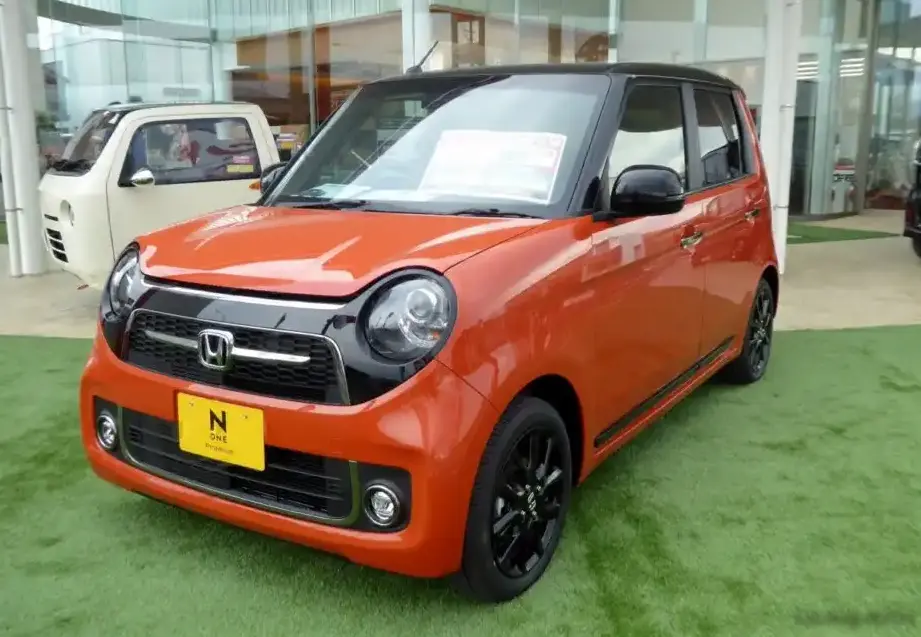
The Honda N-One II 0.7 (58 hp) CVT is a kei car produced by Honda, representing the second generation of the N-One model. Introduced in 2020, this variant occupies the entry-level position within the N-One II lineup, primarily targeted at the Japanese domestic market. The N-One series is notable for its retro-inspired styling, reminiscent of the original Honda N360 from the 1960s, combined with modern safety and convenience features. This specific 0.7-liter, CVT-equipped model prioritizes fuel efficiency and ease of driving within the constraints of the kei car regulations.
Technical Specifications
| Brand | Honda |
| Model | N-One |
| Generation | N-One II |
| Type (Engine) | 0.7 (58 Hp) CVT |
| Start of production | 2020 |
| Powertrain Architecture | Internal Combustion engine |
| Body type | Hatchback |
| Seats | 4 |
| Doors | 5 |
| Fuel consumption (urban) | 5.13 l/100 km (45.9 US mpg) |
| Fuel consumption (extra urban) | 4.12 l/100 km (57.1 US mpg) |
| Fuel Type | Petrol (Gasoline) |
| Weight-to-power ratio | 14.5 kg/Hp |
| Weight-to-torque ratio | 12.9 kg/Nm |
| Power | 58 Hp @ 7300 rpm |
| Power per litre | 88.1 Hp/l |
| Torque | 65 Nm @ 4800 rpm (47.94 lb.-ft. @ 4800 rpm) |
| Engine layout | Front, Transverse |
| Engine Model/Code | S07B |
| Engine displacement | 658 cm3 (40.15 cu. in.) |
| Number of cylinders | 3 |
| Engine configuration | Inline |
| Cylinder Bore | 60 mm (2.36 in.) |
| Piston Stroke | 77.6 mm (3.06 in.) |
| Compression ratio | 12:1 |
| Number of valves per cylinder | 4 |
| Fuel injection system | Multi-port manifold injection |
| Engine aspiration | Naturally aspirated engine |
| Valvetrain | DOHC |
| Kerb Weight | 840 kg (1851.88 lbs.) |
| Fuel tank capacity | 27 l (7.13 US gal | 5.94 UK gal) |
| Length | 3395 mm (133.66 in.) |
| Width | 1475 mm (58.07 in.) |
| Height | 1545 mm (60.83 in.) |
| Wheelbase | 2520 mm (99.21 in.) |
| Front track | 1305 mm (51.38 in.) |
| Rear track | 1305 mm (51.38 in.) |
| Ride height (ground clearance) | 135 mm (5.31 in.) |
| Minimum turning circle | 9.0 m (29.53 ft.) |
| Drivetrain Architecture | Front wheel drive |
| Number of gears and type of gearbox | automatic transmission CVT |
| Front suspension | Independent type McPherson |
| Rear suspension | Torsion |
| Front brakes | Disc |
| Rear brakes | Drum |
| Assisting systems | ABS (Anti-lock braking system) |
| Steering type | Steering rack and pinion |
| Power steering | Electric Steering |
| Tires size | 155/65 R14 |
Powertrain & Engine Architecture
The N-One II 0.7 CVT is powered by Honda’s S07B engine, a 658cc inline three-cylinder unit. This engine utilizes a multi-point fuel injection system and a double overhead camshaft (DOHC) valvetrain with four valves per cylinder. The S07B is a naturally aspirated engine, meaning it does not employ turbocharging or supercharging. The engine’s design prioritizes fuel efficiency and smooth operation, typical of kei car engines. The Continuously Variable Transmission (CVT) is specifically tuned for urban driving, offering seamless acceleration and optimized fuel consumption. Unlike some CVTs that simulate fixed gear ratios, this unit focuses on maintaining the engine within its most efficient operating range.
Driving Characteristics
The 58 horsepower output and CVT pairing result in modest, but adequate, performance for city driving. Acceleration is linear, but not particularly brisk. The CVT eliminates traditional gear shifts, providing a smooth and consistent power delivery. Compared to the more powerful N-One variants (such as those with the 660cc turbocharged engine), this version feels noticeably less responsive, especially when overtaking or climbing hills. The CVT’s programming emphasizes fuel economy over sporty driving dynamics. The relatively light weight of the N-One (840 kg) helps to mitigate the limited power, making it feel nimble in urban environments. The gear ratios are optimized for low-speed maneuverability and efficient cruising at legal limits.
Equipment & Trim Levels
The base N-One II 0.7 CVT trim typically includes standard features such as air conditioning, power windows, power steering, and an audio system with USB connectivity. Safety features include ABS (Anti-lock Braking System) and airbags. Interior upholstery is generally cloth, with a functional and durable design. Optional extras available for this trim level often include a navigation system, a rearview camera, and alloy wheels. Higher trim levels within the N-One II range offer upgrades such as leather upholstery, automatic climate control, and advanced safety features like Honda Sensing (a suite of driver-assistance technologies).
Chassis & Braking
The N-One II utilizes a front-engine, front-wheel-drive layout. The front suspension employs an independent McPherson strut setup, providing a comfortable ride and reasonable handling. The rear suspension utilizes a torsion beam, a cost-effective and space-saving design common in kei cars. The braking system features disc brakes on the front wheels and drum brakes on the rear. This configuration is typical for vehicles in this weight class and price range. The electric power steering provides light and easy steering, making it ideal for navigating tight city streets.
Market Reception & Comparison
The Honda N-One II 0.7 CVT was generally well-received in Japan for its practicality, fuel efficiency, and retro styling. Critics praised its ease of driving and maneuverability in congested urban areas. However, the limited power output was a common point of criticism, particularly for drivers accustomed to larger, more powerful vehicles. Compared to other kei car options, such as the Suzuki Alto or Daihatsu Mira, the N-One offered a more stylish and refined interior, but at a slightly higher price point. The 0.7L CVT version was often seen as a sensible choice for budget-conscious buyers prioritizing fuel economy and ease of use over performance.
Legacy
The Honda N-One II 0.7 CVT, while not a performance standout, represents a successful example of a modern kei car that blends retro aesthetics with contemporary technology. The S07B engine, while simple in design, has proven to be relatively reliable. On the used car market, these models are generally sought after for their low running costs and practicality. The N-One series as a whole has contributed to the continued popularity of kei cars in Japan, offering a unique and affordable transportation option for urban dwellers. The combination of a fuel-efficient engine and a smooth CVT transmission makes it a practical choice for daily commuting and short trips.