Technical Specifications
| Brand | Honda |
| Model | NSX |
| Generation | NSX I Coupe (facelift 2002) |
| Type (Engine) | 3.2 V6 VTEC (280 Hp) |
| Start of production | 2002 |
| End of production | 2005 |
| Powertrain Architecture | Internal Combustion engine |
| Body type | Coupe |
| Seats | 2 |
| Doors | 2 |
| Fuel consumption (economy) – urban (NEDC) | 17.9 l/100 km (13.1 US mpg, 15.8 UK mpg, 5.6 km/l) |
| Fuel consumption (economy) – extra urban (NEDC) | 9.1 l/100 km (25.8 US mpg, 31 UK mpg, 11 km/l) |
| Fuel consumption (economy) – combined (NEDC) | 12.4 l/100 km (19 US mpg, 22.8 UK mpg, 8.1 km/l) |
| CO2 emissions (NEDC) | 291 g/km |
| Fuel Type | Petrol (Gasoline) |
| Acceleration 0 – 100 km/h | 5.7 sec |
| Acceleration 0 – 62 mph | 5.7 sec |
| Acceleration 0 – 60 mph | 5.4 sec |
| Maximum speed | 274 km/h (170.26 mph) |
| Emission standard | Euro 3 |
| Weight-to-power ratio | 5.2 kg/Hp, 193.8 Hp/tonne |
| Weight-to-torque ratio | 4.8 kg/Nm, 206.2 Nm/tonne |
| Power | 280 Hp @ 7300 rpm |
| Power per litre | 88.1 Hp/l |
| Torque | 298 Nm @ 5300 rpm (219.79 lb.-ft. @ 5300 rpm) |
| Maximum engine speed | 8000 rpm |
| Engine layout | Middle, Transverse |
| Engine Model/Code | C32B2 |
| Engine displacement | 3179 cm3 (193.99 cu. in.) |
| Number of cylinders | 6 |
| Engine configuration | V-engine |
| Cylinder Bore | 93 mm (3.66 in.) |
| Piston Stroke | 78 mm (3.07 in.) |
| Compression ratio | 10.2:1 |
| Number of valves per cylinder | 4 |
| Fuel injection system | Multi-port manifold injection |
| Engine aspiration | Naturally aspirated engine |
| Valvetrain | DOHC, VTEC |
| Engine oil capacity | 5 l (5.28 US qt | 4.4 UK qt) |
| Coolant | 16 l (16.91 US qt | 14.08 UK qt) |
| Kerb Weight | 1445 kg (3185.68 lbs.) |
| Max. weight | 1610 kg (3549.44 lbs.) |
| Max load | 165 kg (363.76 lbs.) |
| Trunk (boot) space – minimum | 154 l (5.44 cu. ft.) |
| Fuel tank capacity | 70 l (18.49 US gal | 15.4 UK gal) |
| Length | 4425 mm (174.21 in.) |
| Width | 1810 mm (71.26 in.) |
| Height | 1170 mm (46.06 in.) |
| Wheelbase | 2530 mm (99.61 in.) |
| Front track | 1510 mm (59.45 in.) |
| Rear (Back) track | 1530 mm (60.24 in.) |
| Ride height (ground clearance) | 130 mm (5.12 in.) |
| Minimum turning circle (turning diameter) | 11.6 m (38.06 ft.) |
| Drivetrain Architecture | Rear wheel drive |
| Drive wheel | Rear wheel drive |
| Number of gears and type of gearbox | 6 gears, manual transmission |
| Front suspension | Coil spring, Double wishbone, Transverse stabilizer |
| Rear suspension | Double wishbone, Transverse stabilizer, Coil spring |
| Front brakes | Ventilated discs, 298 mm |
| Rear brakes | Ventilated discs, 303 mm |
| Assisting systems | ABS (Anti-lock braking system) |
| Steering type | Steering rack and pinion |
| Power steering | Electric Steering |
| Tires size | Front wheel tires: 215/40 R17Rear wheel tires: 255/40 R17 |
| Wheel rims size | Front wheel rims: 7J x 17Rear wheel rims: 9J x 17 |
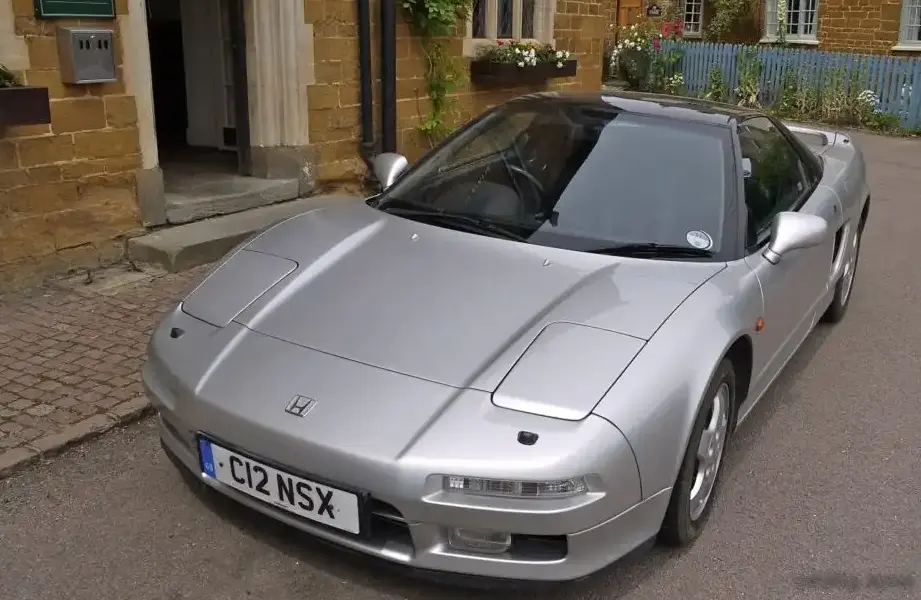
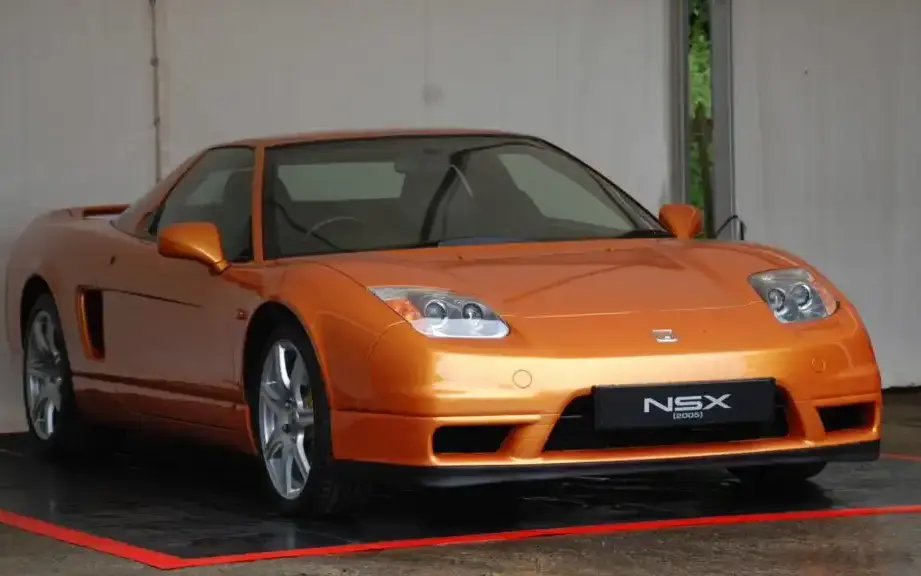
The 2002-2005 Honda NSX Coupe with the 3.2-liter V6 engine represented the pinnacle of the first-generation NSX. Following the initial 3.0-liter model, the larger displacement engine and subtle styling updates aimed to maintain the NSX’s competitive edge. Built on the 1HX0/A3 platform, this iteration was primarily targeted towards the North American market, where demand for high-performance sports cars remained strong. The NSX continued Honda’s tradition of engineering excellence, offering a unique blend of performance, reliability, and everyday usability.
Powertrain & Engine Architecture
The heart of the 2002-2005 NSX is the C32B2 3.2-liter V6 engine. This engine built upon the foundation of the earlier C30A 3.0-liter engine, featuring a larger bore and stroke. The engine utilizes a 60-degree V-angle for optimal balance and smoothness. It employs Honda’s Variable Valve Timing and Lift Electronic Control (VTEC) system on both intake and exhaust valves, providing a broad powerband and high peak horsepower. Fuel delivery is managed by a multi-port fuel injection system. The engine’s aluminum block and cylinder heads contribute to its relatively lightweight construction. The NSX exclusively came with a 6-speed manual transmission, renowned for its precise shifts and robust construction. The transmission is a rear-wheel drive configuration, contributing to the car’s balanced handling characteristics.
Driving Characteristics
The 3.2-liter NSX offered a noticeable improvement in performance over the earlier 3.0-liter models. The increased displacement and refined VTEC system resulted in a more potent and responsive driving experience. While not overwhelmingly powerful by modern standards, the 280 hp engine provided ample power for spirited driving on both the street and the track. The 6-speed manual transmission allowed drivers to fully exploit the engine’s powerband. The NSX’s mid-engine layout and well-tuned suspension contributed to exceptional handling balance and cornering grip. The steering was precise and communicative, providing a direct connection to the road. Compared to potential alternatives like the Porsche 911 of the same era, the NSX offered a more accessible and user-friendly driving experience, prioritizing balance and predictability over outright aggression.
Equipment & Trim Levels
The 2002-2005 NSX Coupe was relatively well-equipped, though it prioritized performance over lavish luxury. Standard features included leather upholstery, power windows and locks, air conditioning, and a premium sound system. The interior design was driver-focused, with ergonomically placed controls and a clear instrument cluster. Optional extras included a navigation system, upgraded audio, and various cosmetic enhancements. The NSX did not offer a wide range of trim levels; it was largely sold as a single, well-specified model with limited customization options.
Chassis & Braking
The NSX’s chassis was a revolutionary design, utilizing an all-aluminum monocoque construction – a first for a mass-produced car. This lightweight chassis provided exceptional rigidity and contributed to the car’s precise handling. The suspension featured independent double wishbones at all four corners, with coil springs and transverse stabilizers. Braking duties were handled by ventilated disc brakes on all four wheels, equipped with an Anti-lock Braking System (ABS). The braking system provided strong and consistent stopping power, essential for a high-performance sports car.
Market Reception & Comparison
The 2002-2005 NSX was generally well-received by automotive critics. It was praised for its exceptional handling, responsive engine, and overall refinement. However, some critics noted that its performance, while impressive, was beginning to lag behind newer competitors. Compared to the 3.0-liter NSX, the 3.2-liter model offered a noticeable improvement in power and torque, making it a more desirable option for enthusiasts. Fuel economy was reasonable for a sports car of its caliber, averaging around 19 mpg in combined driving. Reliability was a strong point, consistent with Honda’s reputation for building durable vehicles.
Legacy
The Honda NSX, particularly the 3.2-liter version, has become a highly sought-after collector’s car. Its innovative design, exceptional engineering, and enduring appeal have cemented its place in automotive history. The C32B2 engine is known for its robustness and longevity, provided it receives regular maintenance. While parts availability can be a challenge, the NSX’s relatively simple mechanical design makes it a rewarding car to own and maintain. Today, the 2002-2005 NSX Coupe represents a unique and compelling alternative to more contemporary sports cars, offering a blend of performance, reliability, and timeless style.