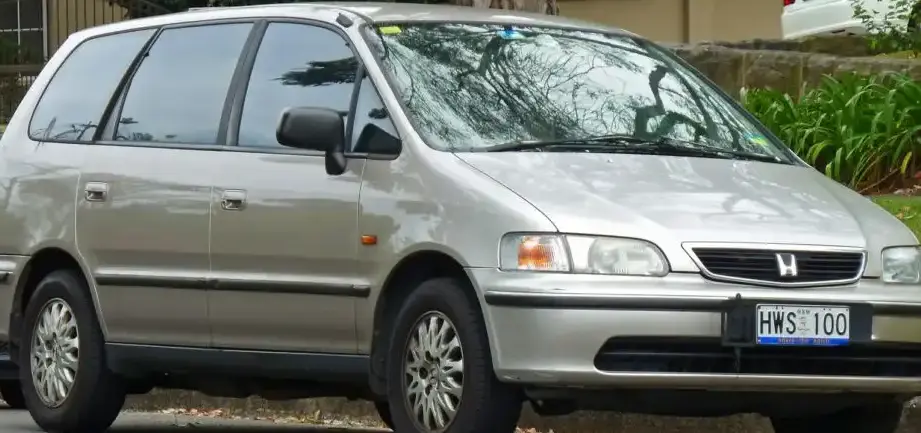
The Honda Odyssey I 2.3i 4WD, produced between 1994 and 1999, represents Honda’s initial foray into the mid-size minivan segment, specifically tailored for the Japanese domestic market (JDM) and select export markets. This variant, equipped with the F23A7 engine and a five-speed manual transmission coupled with a full-time four-wheel drive system, occupied a unique position within the Odyssey lineup, offering a blend of practicality, space, and all-weather capability. It was positioned as a more versatile and driver-focused option compared to the more common front-wheel drive models.
Technical Specifications
| Brand | Honda |
| Model | Odyssey |
| Generation | Odyssey I |
| Type (Engine) | 2.3i 4WD (150 Hp) |
| Start of production | 1994 |
| End of production | 1999 |
| Powertrain Architecture | Internal Combustion engine |
| Body type | Minivan |
| Seats | 7 |
| Doors | 5 |
| Fuel Type | Petrol (Gasoline) |
| Power | 150 Hp @ 5700 rpm |
| Power per litre | 66.5 Hp/l |
| Torque | 200 Nm @ 4700 rpm / 147.51 lb.-ft. @ 4700 rpm |
| Engine layout | Front, Transverse |
| Engine Model/Code | F23A7 |
| Engine displacement | 2254 cm3 / 137.55 cu. in. |
| Number of cylinders | 4 |
| Engine configuration | Inline |
| Cylinder Bore | 86 mm / 3.39 in. |
| Piston Stroke | 97 mm / 3.82 in. |
| Compression ratio | 9.3:1 |
| Number of valves per cylinder | 4 |
| Fuel injection system | Multi-port manifold injection |
| Engine aspiration | Naturally aspirated engine |
| Valvetrain | OHC |
| Engine oil capacity | 4.3 l / 4.54 US qt | 3.78 UK qt |
| Fuel tank capacity | 65 l / 17.17 US gal | 14.3 UK gal |
| Length | 4750 mm / 187.01 in. |
| Width | 1770 mm / 69.69 in. |
| Height | 1645 mm / 64.76 in. |
| Wheelbase | 2830 mm / 111.42 in. |
| Front track | 1525 mm / 60.04 in. |
| Rear (Back) track | 1540 mm / 60.63 in. |
| Drive wheel | All wheel drive (4×4) |
| Number of gears and type of gearbox | 5 gears, manual transmission |
| Front brakes | Disc |
| Rear brakes | Disc |
| Assisting systems | ABS (Anti-lock braking system) |
| Tires size | 205/65 R15 |
Powertrain & Engine Architecture
The heart of the Odyssey I 2.3i 4WD is the F23A7 engine, a 2.3-liter inline-four cylinder gasoline engine. This engine utilizes a single overhead camshaft (OHC) valvetrain and multi-point fuel injection. The F23A7 was known for its relative simplicity and durability, prioritizing reliability over outright performance. The engine’s 9.3:1 compression ratio contributed to a balance between fuel efficiency and power output. The five-speed manual transmission was a key differentiator for this trim, offering drivers more control compared to the automatic transmissions available in other Odyssey variants. The four-wheel drive system employed a viscous coupling to distribute torque between the front and rear axles, providing enhanced traction in slippery conditions without requiring driver intervention.
Driving Characteristics
The 150 horsepower and 200 Nm (147.51 lb-ft) of torque delivered by the F23A7 engine, combined with the five-speed manual transmission, provided a reasonably engaging driving experience for a minivan. While not particularly quick, the 2.3i 4WD offered sufficient power for everyday driving and highway cruising, even when fully loaded with passengers and cargo. The manual transmission allowed drivers to optimize gear selection for varying road conditions and driving styles. Compared to the automatic transmission versions, the manual offered better acceleration and fuel economy. The four-wheel drive system significantly improved handling and stability on loose surfaces like gravel or snow, making it a practical choice for regions with inclement weather. The gear ratios were tuned for a balance of acceleration and fuel efficiency, with a relatively tall fifth gear for comfortable highway cruising.
Equipment & Trim Levels
The Odyssey I 2.3i 4WD typically came equipped with a respectable level of standard features for its time. These included power windows and locks, air conditioning, and an AM/FM radio. Interior upholstery was typically cloth, with a functional and durable design. Optional extras could include upgraded audio systems, alloy wheels, and a sunroof. The dashboard layout was straightforward and user-friendly, prioritizing practicality over luxury. The 4WD variant often featured a slightly more robust interior trim compared to base models, reflecting its more adventurous positioning.
Chassis & Braking
The Odyssey I utilized a MacPherson strut front suspension and a multi-link rear suspension, providing a comfortable ride quality. The 4WD models often featured slightly stiffer springs and dampers to compensate for the added weight of the four-wheel drive components. Braking duties were handled by disc brakes on all four wheels, a notable feature for a minivan of this era. An Anti-lock Braking System (ABS) was standard, enhancing safety and control during emergency braking situations. The tires, typically 205/65 R15, provided a good balance of grip and ride comfort.
Market Reception & Comparison
The Odyssey I 2.3i 4WD was generally well-received by critics and consumers who appreciated its practicality, spaciousness, and all-weather capability. It was often praised for its comfortable ride and user-friendly interior. Compared to the front-wheel drive Odyssey variants, the 4WD model appealed to buyers who lived in regions with harsh winters or frequently drove on unpaved roads. However, the 4WD system did add to the vehicle’s weight and slightly reduced fuel economy. Compared to competitors like the Toyota Previa, the Odyssey offered a more affordable price point and a more engaging driving experience, particularly with the manual transmission.
Legacy
The Honda Odyssey I 2.3i 4WD, while not the most common variant, holds a special place in the model’s history. The F23A7 engine proved to be a reliable and durable powerplant, and many examples are still on the road today. The combination of a manual transmission and four-wheel drive remains a relatively rare and sought-after configuration among enthusiasts. In the used car market, well-maintained examples of the 2.3i 4WD command a premium due to their unique features and relative scarcity. The Odyssey I established Honda as a serious contender in the minivan segment, paving the way for future generations of the popular vehicle.