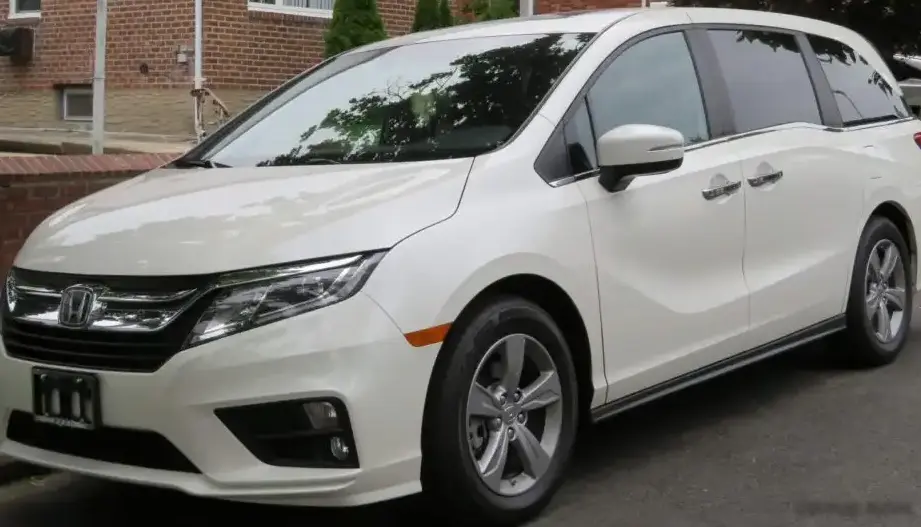
The Honda Odyssey V, produced from 2018 to 2020, represents the fifth generation of Honda’s popular minivan. Positioned as a family-focused vehicle, the Odyssey V continued Honda’s tradition of offering a spacious and reliable people mover. This particular variant, equipped with the 3.5-liter V6 engine producing 280 horsepower and paired with a 9-speed automatic transmission, was a mainstay of the lineup, offering a balance of performance and fuel efficiency. It served as a mid-to-upper trim level, offering more features than the base LX model but falling below the fully-loaded Elite trim.
Technical Specifications
| Brand | Honda |
| Model | Odyssey |
| Generation | Odyssey V |
| Type | 3.5 V6 (280 Hp) Automatic 9-speed |
| Start of production | 2018 |
| End of production | 2020 |
| Powertrain Architecture | Internal Combustion engine |
| Body type | Minivan |
| Seats | 7-8 |
| Doors | 5 |
| Fuel consumption (urban) | 12.4 l/100 km (19 US mpg) |
| Fuel consumption (extra urban) | 8.4 l/100 km (28 US mpg) |
| Fuel consumption (combined) | 10.7 l/100 km (22 US mpg) |
| Fuel Type | Petrol (Gasoline) |
| Emission standard | Euro 6 |
| Weight-to-power ratio | 7.1 kg/Hp |
| Weight-to-torque ratio | 5.6 kg/Nm |
| Power | 280 Hp @ 6000 rpm |
| Power per litre | 80.7 Hp/l |
| Torque | 355 Nm @ 4700 rpm (261.83 lb.-ft. @ 4700 rpm) |
| Maximum engine speed | 6800 rpm |
| Engine layout | Front, Transverse |
| Engine Model/Code | J35Y6 |
| Engine displacement | 3471 cm3 (211.81 cu. in.) |
| Number of cylinders | 6 |
| Engine configuration | V-engine |
| Cylinder Bore | 89 mm (3.5 in.) |
| Piston Stroke | 93 mm (3.66 in.) |
| Compression ratio | 11.5:1 |
| Number of valves per cylinder | 4 |
| Fuel injection system | Direct injection |
| Engine aspiration | Naturally aspirated engine |
| Valvetrain | SOHC, i-VTEC |
| Engine oil capacity | 5.4 l (5.71 US qt | 4.75 UK qt) |
| Coolant capacity | 6.38 l (6.74 US qt | 5.61 UK qt) |
| Kerb Weight | 1975-2040 kg (4354.13 – 4497.43 lbs.) |
| Trunk (boot) space – minimum | 929 l (32.81 cu. ft.) |
| Trunk (boot) space – maximum | 4474 l (158 cu. ft.) |
| Fuel tank capacity | 74 l (19.55 US gal | 16.28 UK gal) |
| Permitted trailer load with brakes (12%) | 1361 kg (3000.49 lbs.) |
| Length | 5161 mm (203.19 in.) |
| Width | 1994 mm (78.5 in.) |
| Height | 1735 mm (68.31 in.) |
| Wheelbase | 3000 mm (118.11 in.) |
| Front track | 1709 mm (67.28 in.) |
| Rear track | 1707 mm (67.2 in.) |
| Drivetrain Architecture | Front wheel drive |
| Number of gears | 9 |
| Gearbox type | Automatic transmission |
| Front suspension | Independent type McPherson |
| Rear suspension | Independent coil spring, Wishbone, Trailing arm |
| Front brakes | Ventilated discs |
| Rear brakes | Disc |
| Assisting systems | ABS (Anti-lock braking system) |
| Steering type | Steering rack and pinion |
| Power steering | Electric Steering |
| Tires size | 235/60 R18 |
| Wheel rims size | 18 |
Introduction
The fifth-generation Honda Odyssey, launched in 2018, represented a significant evolution in minivan design and functionality. Built on an updated version of the 1HX0 platform, the Odyssey V aimed to provide a more refined driving experience and enhanced family-friendly features. The 3.5-liter V6 engine paired with a 9-speed automatic transmission was a key component of this generation, offering a substantial upgrade in both power and efficiency compared to previous models. This combination became a popular choice for buyers seeking a versatile and capable minivan.
Powertrain & Engine Architecture
At the heart of the Odyssey V 3.5 is the J35Y6 engine, a 3.5-liter naturally aspirated V6. This engine utilizes Honda’s i-VTEC (intelligent Variable valve Timing and lift Electronic Control) system, which optimizes valve timing and lift for improved performance and fuel economy across the rev range. Direct fuel injection further enhances efficiency and responsiveness. The engine produces 280 horsepower at 6000 rpm and 262 lb-ft of torque at 4700 rpm. The 9-speed automatic transmission, a ZF-sourced unit, replaced the previous 6-speed automatic, providing closer gear ratios for smoother acceleration and improved highway cruising. This transmission features a torque converter lock-up clutch for enhanced efficiency and a manual shift mode for driver control.
Driving Characteristics
The 3.5L V6 and 9-speed automatic combination in the Odyssey V delivers a noticeably more refined driving experience than earlier Odysseys. Acceleration is brisk, making merging onto highways and overtaking other vehicles effortless. The 9-speed transmission allows the engine to stay within its optimal power band more frequently, resulting in a more responsive feel. While not a sports car, the Odyssey V handles surprisingly well for its size, with well-tuned suspension providing a comfortable ride. Compared to the base LX model with its less powerful engine, the V trim offers a significant performance advantage. It also feels more composed than models equipped with the optional 2.5L inline-4 engine, which prioritizes fuel economy over outright power.
Equipment & Trim Levels
The Odyssey V trim level included a generous array of standard features. Interior appointments typically included cloth upholstery, though leather was available as an option. Standard equipment included a touchscreen infotainment system with Apple CarPlay and Android Auto compatibility, a rearview camera, Honda Sensing suite of safety features (including adaptive cruise control and lane keeping assist), and automatic climate control. Optional extras included a rear entertainment system, a premium audio system, and power-adjustable front seats. The V trim offered a good balance of features and value, making it a popular choice for families.
Chassis & Braking
The Odyssey V utilizes a front-wheel-drive layout with an independent McPherson strut suspension in the front and an independent multi-link suspension in the rear. This suspension setup provides a comfortable ride and good handling characteristics. Disc brakes are standard on all four wheels, providing ample stopping power. Anti-lock braking system (ABS) and electronic brake-force distribution (EBD) are also standard features. The chassis is designed to minimize noise, vibration, and harshness (NVH), contributing to a quiet and refined cabin experience.
Market Reception & Comparison
The 2018-2020 Honda Odyssey V was generally well-received by automotive critics. Reviewers praised its spacious interior, comfortable ride, and improved performance compared to previous generations. The 9-speed automatic transmission was noted for its smooth operation, although some reviewers found it occasionally hesitant. Fuel economy was considered competitive for its class, averaging around 22 mpg combined. Compared to rivals like the Chrysler Pacifica and Toyota Sienna, the Odyssey V was often lauded for its reliability and resale value. The Sienna, with its standard hybrid powertrain, offered superior fuel economy, while the Pacifica provided a plug-in hybrid option.
Legacy
The J35Y6 engine and 9-speed automatic transmission pairing in the Odyssey V have proven to be relatively reliable. While some owners have reported minor issues with the transmission, such as occasional rough shifting, these are not widespread. The Odyssey V continues to be a popular choice in the used car market, known for its practicality, reliability, and family-friendly features. Its spacious interior, comfortable ride, and strong resale value make it a compelling option for buyers seeking a well-rounded minivan.