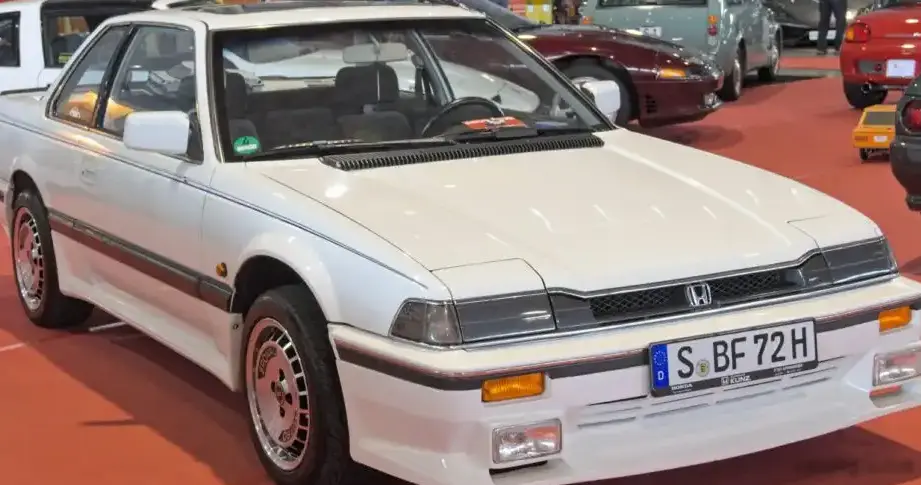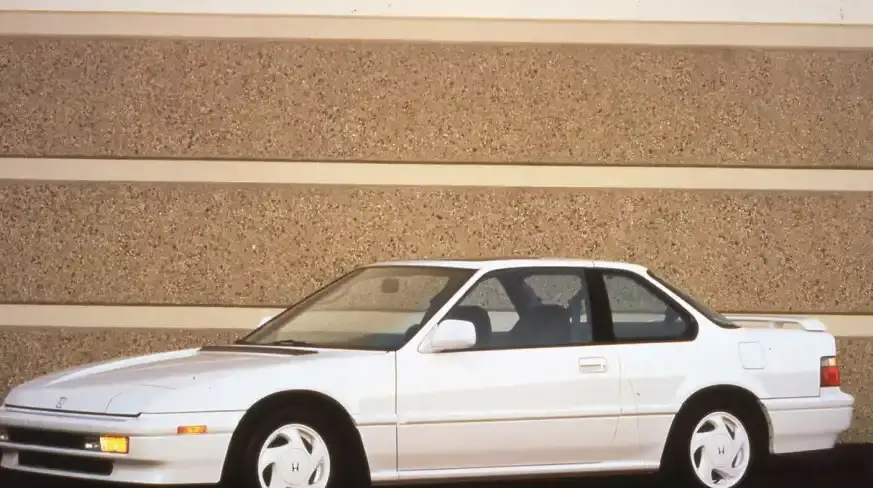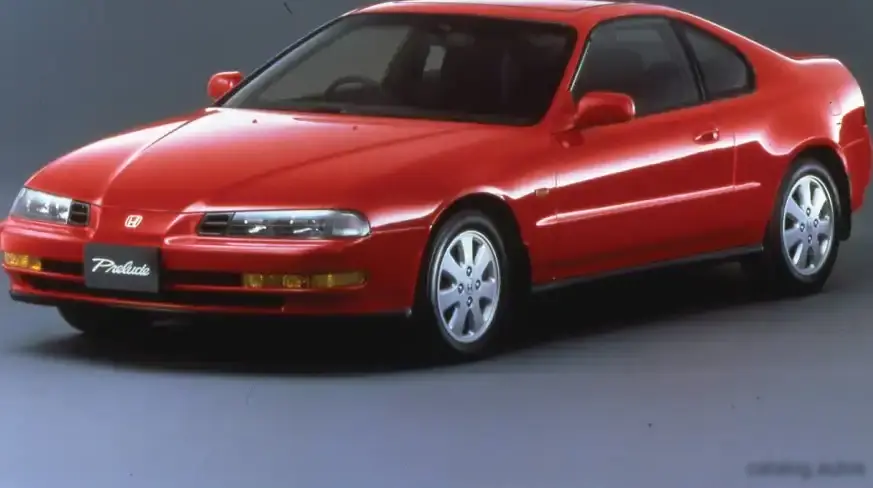
The Honda Prelude IV (BB), produced between 1992 and 1996, represented a significant evolution in Honda’s sports coupe lineage. The BB generation, internally designated as the BB1, BB2, BB3, and BB4, continued the Prelude’s tradition of offering a sophisticated blend of sporty handling, comfortable cruising, and distinctive styling. The 2.0i 16V (BB3) variant, equipped with the F20A4 engine producing 133 horsepower, occupied a middle ground within the lineup, offering a balance between performance and affordability. It served as a popular choice for buyers seeking a more engaging driving experience than the base models, without the higher price tag of the more powerful 2.2 VTEC versions.
Technical Specifications
| Brand | Honda |
| Model | Prelude |
| Generation | Prelude IV (BB) |
| Type (Engine) | 2.0i 16V (BB3) (133 Hp) |
| Start of production | 1992 |
| End of production | 1996 |
| Powertrain Architecture | Internal Combustion engine |
| Body type | Coupe |
| Seats | 4 |
| Doors | 2 |
| Fuel consumption (combined) | 8.6 l/100 km |
| Fuel consumption (US mpg) | 27.4 US mpg |
| Fuel consumption (UK mpg) | 32.8 UK mpg |
| Fuel consumption (km/l) | 11.6 km/l |
| Fuel Type | Petrol (Gasoline) |
| Acceleration 0 – 100 km/h | 9.2 sec |
| Acceleration 0 – 62 mph | 9.2 sec |
| Acceleration 0 – 60 mph | 8.7 sec |
| Maximum speed | 201 km/h (124.9 mph) |
| Weight-to-power ratio | 9.2 kg/Hp |
| Power | 133 Hp @ 5300 rpm |
| Power per litre | 66.6 Hp/l |
| Torque | 179 Nm @ 5000 rpm (132.02 lb.-ft. @ 5000 rpm) |
| Engine layout | Front, Transverse |
| Engine Model/Code | F20A4 |
| Engine displacement | 1996 cm3 (121.8 cu. in.) |
| Number of cylinders | 4 |
| Engine configuration | Inline |
| Cylinder Bore | 85 mm (3.35 in.) |
| Piston Stroke | 88 mm (3.46 in.) |
| Compression ratio | 9.5:1 |
| Number of valves per cylinder | 4 |
| Fuel injection system | Multi-port manifold injection |
| Engine aspiration | Naturally aspirated engine |
| Valvetrain | OHC |
| Engine oil capacity | 3.8 l (4.02 US qt | 3.34 UK qt) |
| Kerb Weight | 1220 kg (2689.64 lbs.) |
| Max. weight | 1720 kg (3791.95 lbs.) |
| Max load | 500 kg (1102.31 lbs.) |
| Trunk (boot) space – minimum | 278 l (9.82 cu. ft.) |
| Fuel tank capacity | 60 l (15.85 US gal | 13.2 UK gal) |
| Length | 4440 mm (174.8 in.) |
| Width | 1765 mm (69.49 in.) |
| Height | 1290 mm (50.79 in.) |
| Wheelbase | 2550 mm (100.39 in.) |
| Front track | 1525 mm (60.04 in.) |
| Rear (Back) track | 1515 mm (59.65 in.) |
| Drivetrain Architecture | The Internal combustion engine (ICE) drives the front wheels of the vehicle. |
| Drive wheel | Front wheel drive |
| Number of gears and type of gearbox | 5 gears, manual transmission |
| Front suspension | Double wishbone |
| Rear suspension | Double wishbone |
| Front brakes | Ventilated discs |
| Rear brakes | Disc |
| Assisting systems | ABS (Anti-lock braking system) |
| Steering type | Steering rack and pinion |
| Power steering | Hydraulic Steering |
| Tires size | 195/65 R14 |
INTRODUCTION
The 1992-1996 Honda Prelude IV (BB3) 2.0i 16V represented a refinement of the third-generation model, building upon its reputation for stylish design and engaging driving dynamics. Positioned within the BB series, the BB3 offered a compelling alternative to the base 1.6-liter models and the higher-performance 2.2-liter VTEC variants. It was primarily marketed towards buyers who desired a sporty coupe with a degree of practicality and refinement, appealing to a broad demographic. The BB series Preludes were exclusively front-wheel drive, continuing Honda’s commitment to this configuration for its sporty coupes.
Powertrain & Engine Architecture
The heart of the BB3 Prelude is the F20A4 engine, a 1996cc inline-four cylinder powerplant. This engine featured a single overhead camshaft (SOHC) valvetrain operating 16 valves (four per cylinder). The F20A4 utilized Honda’s PGM-FI multi-point fuel injection system, delivering precise fuel metering for optimal combustion efficiency and performance. Unlike the more advanced VTEC (Variable Valve Timing and Lift Electronic Control) system found in the 2.2-liter models, the F20A4 relied on conventional camshaft profiles. The engine’s design prioritized smooth power delivery and reliability over outright peak horsepower. The BB3 was typically paired with a 5-speed manual transmission, although a 4-speed automatic transmission was also available. The automatic transmission, while offering convenience, did impact acceleration and fuel economy compared to the manual.
Driving Characteristics
The 2.0i 16V Prelude BB3 offered a balanced driving experience. With 133 horsepower and 132 lb-ft of torque, it wasn’t a particularly quick car by modern standards, but it provided adequate power for everyday driving and spirited backroad excursions. The 0-60 mph time of around 8.7 seconds was respectable for its era. The manual transmission allowed for precise gear selection and maximized engine responsiveness, while the automatic, though smoother, felt somewhat less engaging. The Prelude’s independent double wishbone suspension on all four wheels contributed to its well-controlled ride and predictable handling. Steering was precise and well-weighted, providing good feedback to the driver. Compared to the 2.2 VTEC models, the BB3 felt less urgent in its acceleration, but it offered a more linear and predictable power delivery, making it easier to drive in various conditions.
Equipment & Trim Levels
The BB3 Prelude typically came equipped with a reasonable level of standard features. Interior appointments included cloth upholstery, power windows and locks, and an AM/FM stereo. Air conditioning was a common inclusion. Optional extras included a sunroof, upgraded audio systems, and alloy wheels. The dashboard layout was driver-focused, with clearly marked gauges and intuitive controls. The interior design emphasized comfort and ergonomics, providing a pleasant environment for both driver and passengers. Trim levels varied slightly depending on the market, but generally, the BB3 represented a mid-range offering, bridging the gap between the more basic models and the fully equipped VTEC versions.
Chassis & Braking
The BB3 Prelude utilized a front-wheel-drive chassis with independent double wishbone suspension at all four corners. This suspension design provided excellent ride quality and handling characteristics. The front brakes were ventilated discs, offering strong stopping power, while the rear brakes were solid discs. Anti-lock braking system (ABS) was standard, enhancing safety and control during emergency braking situations. The chassis was relatively lightweight, contributing to the car’s nimble handling. Stabilizer bars were fitted to both the front and rear suspension, further reducing body roll during cornering.
Market Reception & Comparison
The 2.0i 16V (BB3) Prelude received generally positive reviews from automotive critics. It was praised for its stylish design, comfortable interior, and engaging driving dynamics. Critics noted that it offered a good balance between performance and affordability. Compared to the 1.6-liter models, the BB3 provided a noticeable increase in power and performance. However, it lacked the outright excitement of the 2.2 VTEC versions. Fuel economy was considered reasonable for a sports coupe of its era, averaging around 27.4 mpg in combined driving. Reliability was also a strong point, with the F20A4 engine proving to be durable and long-lasting.
Legacy
The Honda Prelude IV (BB3) 2.0i 16V has maintained a loyal following among enthusiasts. The F20A4 engine is known for its reliability and relatively simple maintenance requirements. While not as sought-after as the VTEC models, the BB3 offers a compelling entry point into Prelude ownership, providing a classic Honda driving experience at a more affordable price. Well-maintained examples are becoming increasingly rare, and values have been steadily rising in recent years. The BB3 remains a testament to Honda’s engineering prowess and its commitment to building fun-to-drive, reliable automobiles.