
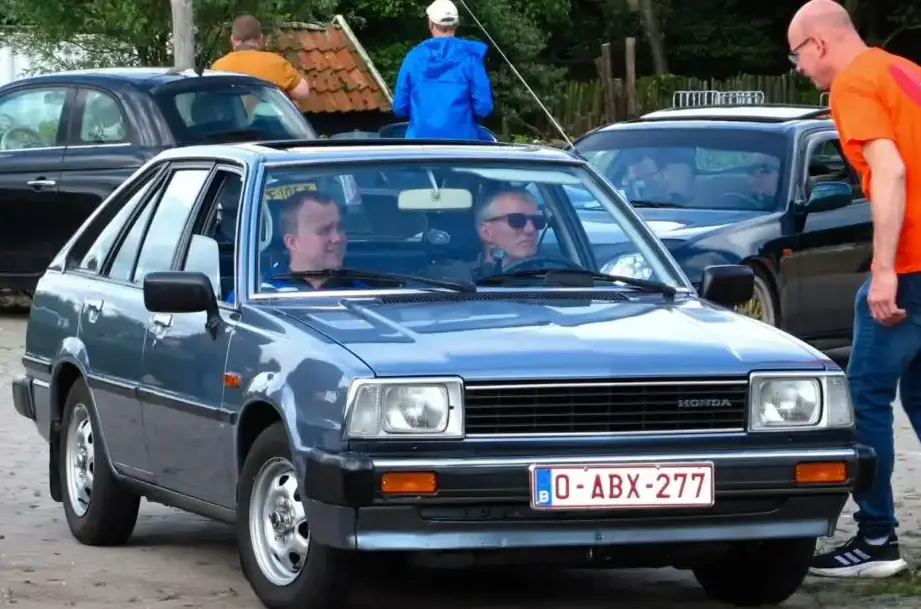
The Honda Quintet (SU) 1.6 EX, produced between November 1980 and July 1983, represented a key offering in Honda’s lineup during the early 1980s. Positioned as a practical and relatively affordable compact hatchback, the Quintet aimed to provide a balance of fuel efficiency, reliability, and everyday usability. This particular 1.6 EX variant, equipped with an 80 horsepower engine and a five-speed manual transmission, served as a mid-range option within the Quintet family, slotting between the base models and potentially more luxurious or performance-oriented trims (depending on regional availability). The Quintet (SU) was a significant model for Honda, particularly in markets outside of North America, and helped solidify the brand’s reputation for engineering excellence and dependability.
Technical Specifications
| Brand | Honda |
| Model | Quintet |
| Generation | Quintet (SU) |
| Type (Engine) | 1.6 EX (80 Hp) |
| Start of production | November, 1980 |
| End of production | July, 1983 |
| Powertrain Architecture | Internal Combustion engine |
| Body type | Hatchback |
| Seats | 5 |
| Doors | 5 |
| Fuel Type | Petrol (Gasoline) |
| Maximum speed | 162 km/h (100.66 mph) |
| Weight-to-power ratio | 10.4 kg/Hp, 95.9 Hp/tonne |
| Weight-to-torque ratio | 6.6 kg/Nm, 152.3 Nm/tonne |
| Power | 80 Hp @ 5300 rpm |
| Power per litre | 49.9 Hp/l |
| Torque | 127 Nm @ 3500 rpm (93.67 lb.-ft. @ 3500 rpm) |
| Engine layout | Front, Transverse |
| Engine Model/Code | EP with CVCC |
| Engine displacement | 1602 cm3 (97.76 cu. in.) |
| Number of cylinders | 4 |
| Engine configuration | Inline |
| Cylinder Bore | 77 mm (3.03 in.) |
| Piston Stroke | 86 mm (3.39 in.) |
| Compression ratio | 8.4:1 |
| Number of valves per cylinder | 2 |
| Fuel injection system | Carburettor |
| Engine aspiration | Naturally aspirated engine |
| Valvetrain | SOHC |
| Coolant | 7 l (7.4 US qt | 6.16 UK qt) |
| Kerb Weight | 834 kg (1838.66 lbs.) |
| Max. weight | 1379 kg (3040.17 lbs.) |
| Max load | 545 kg (1201.52 lbs.) |
| Trunk (boot) space – minimum | 340 l (12.01 cu. ft.) |
| Trunk (boot) space – maximum | 920 l (32.49 cu. ft.) |
| Fuel tank capacity | 50 l (13.21 US gal | 11 UK gal) |
| Length | 4110 mm (161.81 in.) |
| Width | 1615 mm (63.58 in.) |
| Height | 1355 mm (53.35 in.) |
| Wheelbase | 2360 mm (92.91 in.) |
| Front track | 1360 mm (53.54 in.) |
| Rear (Back) track | 1380 mm (54.33 in.) |
| Minimum turning circle (turning diameter) | 10.2 m (33.46 ft.) |
| Drivetrain Architecture | The Internal combustion engine (ICE) drives the front wheels of the vehicle. |
| Drive wheel | Front wheel drive |
| Number of gears and type of gearbox | 5 gears, manual transmission |
| Front suspension | Independent, type McPherson with coil spring and anti-roll bar |
| Rear suspension | McPherson, Transverse stabilizer |
| Front brakes | Disc |
| Rear brakes | Drum |
| Steering type | Steering rack and pinion |
Powertrain & Engine Architecture
The heart of the Quintet 1.6 EX was the Honda EP engine, a 1.6-liter inline-four cylinder powerplant. This engine utilized Honda’s Compound Vortex Controlled Combustion (CVCC) technology, a notable innovation for its time. CVCC employed a specially designed cylinder head with a pre-chamber and a main combustion chamber, allowing for cleaner and more complete combustion with a three-way catalytic converter (where emissions regulations required it). The engine featured a single overhead camshaft (SOHC) valvetrain operating two valves per cylinder. Fuel delivery was managed by a carburetor, a common setup for vehicles of this era. The 80 horsepower output at 5300 rpm and 127 Nm (93.67 lb-ft) of torque at 3500 rpm were respectable figures for a naturally aspirated 1.6-liter engine in the early 1980s. The five-speed manual transmission provided a good balance between acceleration and fuel economy, with gear ratios tailored for everyday driving.
Driving Characteristics
The 1.6 EX, with its 80 hp and five-speed manual, offered a reasonably engaging driving experience. While not a sports car, the engine provided adequate power for typical commuting and highway cruising. The five-speed gearbox allowed drivers to keep the engine in its optimal power band, enhancing responsiveness. Compared to potential lower-powered variants (if offered), the 1.6 EX provided noticeably more pep. However, it wouldn’t match the performance of any potential sportier trims. The front-wheel-drive layout contributed to predictable handling, and the relatively light weight of the Quintet (834 kg or 1838.66 lbs) helped to mitigate the effects of the modest horsepower output. The gear ratios were fairly standard for the time, prioritizing fuel efficiency in higher gears and providing sufficient acceleration in the lower gears.
Equipment & Trim Levels
The 1.6 EX trim level typically included features such as cloth upholstery, a basic instrument cluster, and a steering wheel. Depending on the market, options could include a radio, upgraded speakers, and potentially power windows or central locking. The interior design was functional and straightforward, prioritizing practicality over luxury. The dashboard layout was typical of Japanese cars of the period, with clearly labeled controls and a focus on ergonomics. The rear seats offered reasonable space for passengers, and the hatchback configuration provided a versatile cargo area. The folding rear seats expanded the cargo capacity significantly, from 340 liters (12.01 cu. ft.) with the seats up to 920 liters (32.49 cu. ft.) with them folded down.
Chassis & Braking
The Quintet (SU) utilized a McPherson strut suspension setup at both the front and rear, a common configuration for front-wheel-drive cars of this era. The front suspension incorporated a coil spring and anti-roll bar to improve handling and reduce body roll. The rear suspension also featured a transverse stabilizer. Braking duties were handled by disc brakes at the front and drum brakes at the rear. While the front discs provided adequate stopping power, the rear drums were less effective, particularly under heavy braking. The steering system employed a rack and pinion setup, providing precise and responsive steering feel.
Market Reception & Comparison
The Honda Quintet 1.6 EX was generally well-received by automotive critics for its reliability, fuel efficiency, and practicality. It was often praised for its smooth engine and comfortable ride. Compared to other compact hatchbacks of the time, the Quintet offered a compelling combination of features and value. The CVCC engine was a selling point, as it helped the car meet increasingly stringent emissions standards. However, some critics noted that the interior was somewhat basic and lacked the refinement of some European competitors. Fuel economy was a strong point, making it an attractive option for budget-conscious buyers.
Legacy
The Honda Quintet (SU) 1.6 EX, while not a particularly rare or collectible car today, remains a testament to Honda’s engineering prowess and commitment to quality. The EP engine, with its CVCC technology, was a significant step forward in reducing emissions. The Quintet’s simple and robust design contributed to its long-term reliability, and many examples are still on the road today. In the used car market, these vehicles are often sought after by enthusiasts looking for a classic Honda that is relatively easy to maintain and offers a rewarding driving experience. The 1.6 EX variant, with its balance of performance and fuel economy, represents a sweet spot in the Quintet lineup, making it a desirable choice for those seeking a well-rounded and dependable compact hatchback.
