
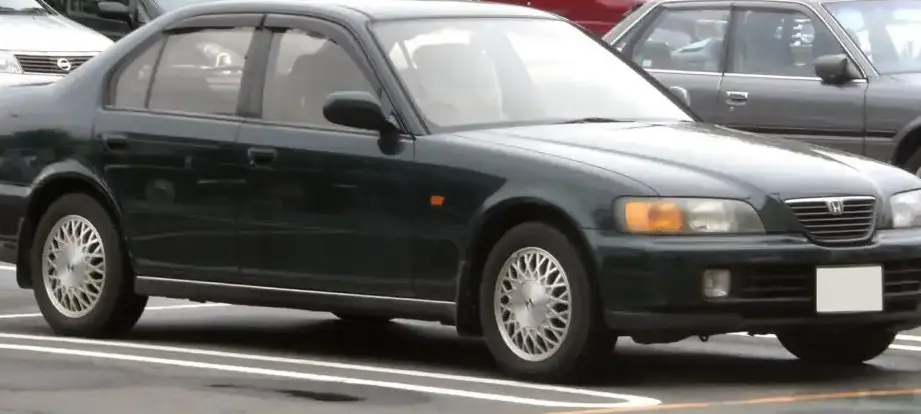
The Honda Rafaga was a mid-size sedan produced by Honda from 1993 to 1997, primarily for the Japanese domestic market (JDM). Positioned above the Accord and below the Inspire/Vigor models, the Rafaga aimed to offer a more sporty and stylish alternative within Honda’s lineup. The 2.5 i variant, equipped with the 5-cylinder engine producing 180 horsepower, represented the top-of-the-line offering for the Rafaga. It was a relatively short-lived model, discontinued as Honda reorganized its sedan offerings and focused on the newer Accord and Inspire/Vigor platforms.
Technical Specifications
| Brand | Honda |
| Model | Rafaga |
| Generation | Rafaga |
| Type (Engine) | 2.5 i (180 Hp) |
| Start of production | 1993 year |
| End of production | 1997 year |
| Powertrain Architecture | Internal Combustion engine |
| Body type | Sedan |
| Seats | 5 |
| Doors | 4 |
| Fuel Type | Petrol (Gasoline) |
| Emission standard | Euro 2 |
| Weight-to-power ratio | 7.3 kg/Hp, 136.4 Hp/tonne |
| Weight-to-torque ratio | 5.8 kg/Nm, 171.2 Nm/tonne |
| Power | 180 Hp @ 6500 rpm |
| Power per litre | 73.4 Hp/l |
| Torque | 226 Nm @ 3800 rpm, 166.69 lb.-ft. @ 3800 rpm |
| Engine layout | Front, Longitudinal |
| Engine displacement | 2451 cm3, 149.57 cu. in. |
| Number of cylinders | 5 |
| Engine configuration | Inline |
| Cylinder Bore | 85 mm, 3.35 in. |
| Piston Stroke | 86.4 mm, 3.4 in. |
| Compression ratio | 9.3:1 |
| Number of valves per cylinder | 4 |
| Fuel injection system | Multi-port manifold injection |
| Engine aspiration | Naturally aspirated engine |
| Valvetrain | OHC |
| Kerb Weight | 1320 kg, 2910.1 lbs |
| Fuel tank capacity | 65 l, 17.17 US gal | 14.3 UK gal |
| Length | 4555 mm, 179.33 in. |
| Width | 1695 mm, 66.73 in. |
| Height | 1425 mm, 56.1 in. |
| Wheelbase | 2770 mm, 109.06 in. |
| Front track | 1465 mm, 57.68 in. |
| Rear (Back) track | 1465 mm, 57.68 in. |
| Minimum turning circle (turning diameter) | 11 m, 36.09 ft |
| Drivetrain Architecture | The Internal combustion engine (ICE) drives the front wheels of the vehicle. |
| Drive wheel | Front wheel drive |
| Number of gears and type of gearbox | 5 gears, manual transmission |
| Front brakes | Ventilated discs |
| Rear brakes | Disc |
| Assisting systems | ABS (Anti-lock braking system) |
| Tires size | 205/55 R15 |
| Wheel rims size | 6JJ x 15 |
Powertrain & Engine Architecture
The heart of the Rafaga 2.5 i was the G25A inline-5 cylinder engine. This engine was a significant departure from Honda’s more common inline-4 configurations. The 2.5-liter displacement was achieved with a bore of 85mm and a stroke of 86.4mm, operating with a compression ratio of 9.3:1. The engine utilized a single overhead camshaft (OHC) valvetrain with four valves per cylinder. Fuel delivery was managed by a multi-port fuel injection system, contributing to its relatively smooth power delivery. The G25A engine was known for its refined character and distinctive exhaust note, a characteristic of five-cylinder engines. The 180 horsepower output was respectable for its time, placing it in competition with other mid-size sedans. The engine was mounted longitudinally in the front of the vehicle, driving the front wheels.
Driving Characteristics
The Rafaga 2.5 i, with its 180 hp and 226 Nm (166.69 lb-ft) of torque, offered a balanced driving experience. The five-speed manual transmission allowed for reasonably quick acceleration, although it wasn’t a particularly sporty car. The engine provided adequate power for highway cruising and overtaking maneuvers. Compared to the lower-spec Rafaga models with smaller engines, the 2.5 i offered a noticeable improvement in performance. While not as nimble as some of its rear-wheel-drive competitors, the front-wheel-drive layout provided good traction in most conditions. The suspension was tuned for comfort, resulting in a smooth ride, but it wasn’t particularly engaging for enthusiastic drivers. The gear ratios were fairly standard for the time, prioritizing fuel efficiency and comfortable cruising over outright acceleration.
Equipment & Trim Levels
The Rafaga 2.5 i was generally well-equipped for its era. Standard features typically included power windows, power locks, air conditioning, and an AM/FM stereo. Higher trim levels offered options such as leather upholstery, a sunroof, and upgraded audio systems. The interior design was functional and relatively understated, reflecting the Japanese aesthetic of the time. The dashboard layout was straightforward, with easy-to-read gauges. The seats were comfortable and provided adequate support for long journeys. The Rafaga aimed for a more premium feel than the Accord, but it didn’t quite reach the luxury levels of the Inspire or Vigor.
Chassis & Braking
The Rafaga utilized a front-engine, front-wheel-drive layout with an independent suspension system at the front and a semi-independent suspension at the rear. The front suspension consisted of MacPherson struts, while the rear employed a torsion beam setup. This configuration provided a good balance between ride comfort and handling. Braking duties were handled by ventilated discs at the front and solid discs at the rear. An Anti-lock Braking System (ABS) was standard, enhancing safety and control during hard braking. The tires were typically 205/55 R15, providing adequate grip for everyday driving. The chassis was designed to provide a stable and predictable driving experience.
Market Reception & Comparison
The Honda Rafaga 2.5 i was generally well-received by Japanese automotive critics. It was praised for its refined engine, comfortable ride, and spacious interior. However, some critics noted that it lacked the sporty character of some of its competitors. Compared to the lower-spec Rafaga models, the 2.5 i offered a significant performance upgrade, but it also came at a higher price. Fuel economy was reasonable for a 2.5-liter engine, but it wasn’t class-leading. Reliability was generally good, as expected from a Honda product. The Rafaga competed with other mid-size sedans such as the Toyota Camry and Nissan Maxima.
Legacy
The Honda Rafaga, while not a long-lived model, remains a fondly remembered car among JDM enthusiasts. The 2.5 i variant, with its distinctive five-cylinder engine, is particularly sought after. The G25A engine is known for its durability and relatively simple maintenance requirements. Today, finding a well-maintained Rafaga 2.5 i can be challenging, but they are becoming increasingly collectible. The Rafaga represents a unique chapter in Honda’s history, showcasing the company’s willingness to experiment with different engine configurations and styling approaches. Its legacy lives on through the enthusiasm of its owners and the appreciation of JDM car culture.
