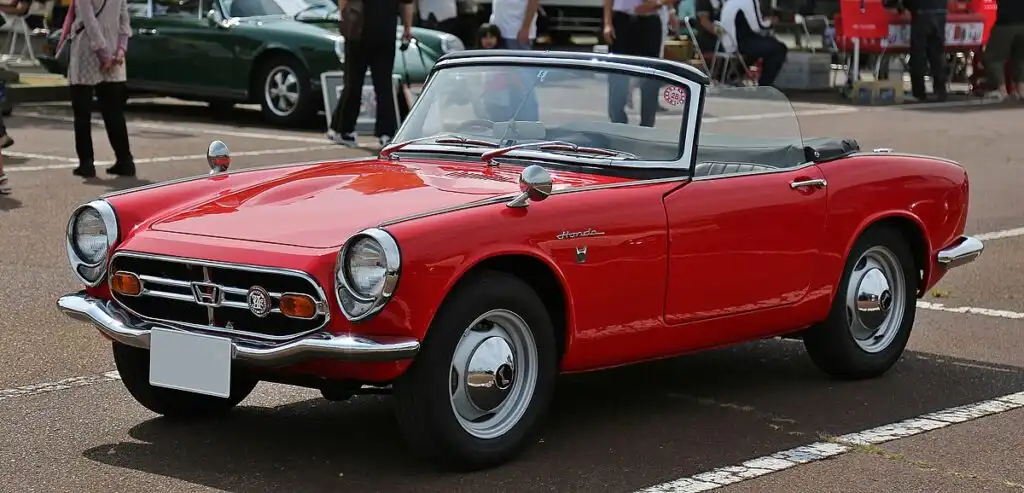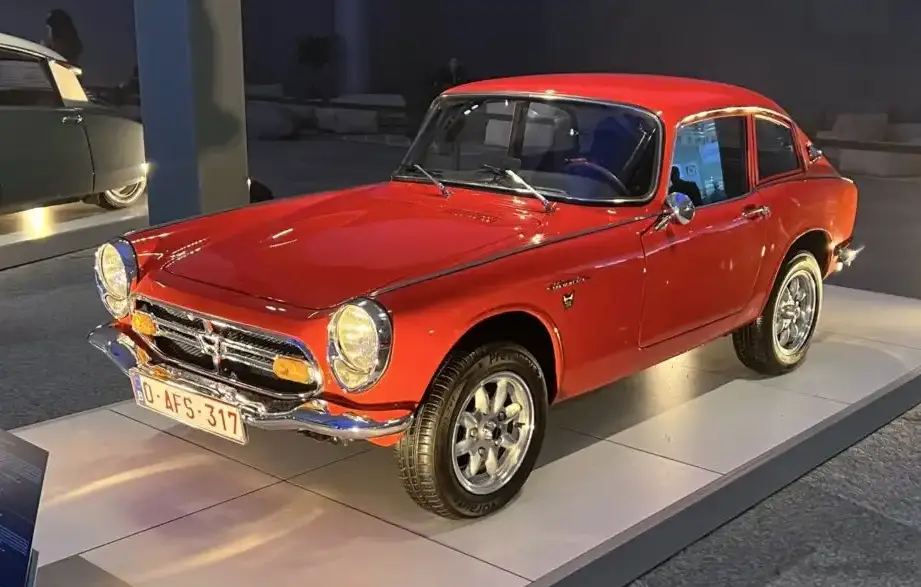
The Honda S800, produced between 1966 and 1970, represents a high point in Honda’s early sports car development. Following the success of the S500, the S800 was designed to offer increased performance and refinement while maintaining the lightweight, nimble characteristics that defined the “S” series. This 0.8-liter (70 hp) variant, while not the most powerful iteration of the S800, was a significant offering in its time, representing a balance between affordability and the exhilarating driving experience Honda aimed to deliver. It was built upon the S800 platform, a dedicated sports car chassis, and served as a stepping stone for Honda’s growing reputation for engineering excellence.
Technical Specifications
| Brand | Honda |
| Model | S800 |
| Generation | S800 |
| Type (Engine) | 0.8 (70 Hp) |
| Start of production | 1966 |
| End of production | 1970 |
| Powertrain Architecture | Internal Combustion engine |
| Body type | Coupe |
| Seats | 2 |
| Doors | 3 |
| Fuel consumption (economy) – combined | 9 l/100 km |
| Fuel consumption (economy) – combined | 26.1 US mpg |
| Fuel consumption (economy) – combined | 31.4 UK mpg |
| Fuel consumption (economy) – combined | 11.1 km/l |
| Fuel Type | Petrol (Gasoline) |
| Acceleration 0 – 100 km/h | 12.5 sec |
| Acceleration 0 – 62 mph | 12.5 sec |
| Acceleration 0 – 60 mph | 11.9 sec |
| Maximum speed | 160 km/h |
| Maximum speed | 99.42 mph |
| Weight-to-power ratio | 10.8 kg/Hp |
| Weight-to-power ratio | 92.7 Hp/tonne |
| Weight-to-torque ratio | 11.4 kg/Nm |
| Weight-to-torque ratio | 87.4 Nm/tonne |
| Power | 70 Hp @ 8500 rpm |
| Power per litre | 88.5 Hp/l |
| Torque | 66 Nm @ 6000 rpm |
| Torque | 48.68 lb.-ft. @ 6000 rpm |
| Engine layout | Front, Longitudinal |
| Engine displacement | 791 cm3 |
| Engine displacement | 48.27 cu. in. |
| Number of cylinders | 4 |
| Engine configuration | Inline |
| Cylinder Bore | 60 mm |
| Cylinder Bore | 2.36 in. |
| Piston Stroke | 70 mm |
| Piston Stroke | 2.76 in. |
| Compression ratio | 9.2:1 |
| Fuel injection system | Carburettor |
| Engine aspiration | Naturally aspirated engine |
| Engine oil capacity | 3.7 l |
| Engine oil capacity | 3.91 US qt |
| Engine oil capacity | 3.26 UK qt |
| Kerb Weight | 755 kg |
| Kerb Weight | 1664.49 lbs |
| Fuel tank capacity | 30 l |
| Fuel tank capacity | 7.93 US gal |
| Fuel tank capacity | 6.6 UK gal |
| Length | 3335 mm |
| Length | 131.3 in. |
| Width | 1400 mm |
| Width | 55.12 in. |
| Height | 1215 mm |
| Height | 47.83 in. |
| Wheelbase | 2000 mm |
| Wheelbase | 78.74 in. |
| Ride height (ground clearance) | 160 mm |
| Ride height (ground clearance) | 6.3 in. |
| Minimum turning circle (turning diameter) | 8.8 m |
| Minimum turning circle (turning diameter) | 28.87 ft. |
| Drivetrain Architecture | The Internal combustion engine (ICE) drives the rear wheels of the vehicle. |
| Drive wheel | Rear wheel drive |
| Number of gears and type of gearbox | 4 gears, manual transmission |
| Front suspension | Independent torsion bar, double wishbone |
| Rear suspension | Rigid axle suspension, Coil spring |
| Front brakes | Disc |
| Rear brakes | Drum |
| Steering type | Steering rack and pinion |
Powertrain & Engine Architecture
The heart of the S800 is its 791cc inline-four cylinder engine. This engine, designated as the C70 series, was a significant advancement over the S500’s powerplant. While the 70 hp output of this specific variant might seem modest by modern standards, it was considerable for a sub-800cc engine in the 1960s. The engine featured a chain-driven double overhead camshaft (DOHC) design, a relatively sophisticated feature for the time, allowing for high-revving performance. It utilized twin side-draft Mikuni carburetors, contributing to its responsive throttle behavior. The engine’s layout was front-mounted and longitudinal, driving the rear wheels. The four-speed manual transmission was a key component in maximizing the engine’s potential, offering precise gear changes and a direct connection to the drivetrain. The engine’s relatively small displacement and high-revving nature demanded frequent gear changes to stay within its optimal power band.
Driving Characteristics
The S800 0.8 (70 hp) offered a distinctly engaging driving experience. Its lightweight construction (approximately 755 kg or 1664 lbs) meant that the 70 horsepower was sufficient to provide brisk acceleration, with a 0-60 mph time of around 11.9 seconds and a top speed of 99.42 mph. However, it was the *way* the car delivered its performance that was most notable. The engine needed to be revved to extract its full potential, and the close-ratio four-speed gearbox encouraged frequent shifting. Compared to the later, more powerful 100 hp S800, this variant felt less urgent at lower speeds, but it remained remarkably nimble and balanced in corners. The rear-wheel drive configuration and well-tuned suspension provided a predictable and enjoyable handling experience. The car’s small size and excellent visibility further enhanced its driver appeal.
Equipment & Trim Levels
The S800 was relatively spartan in its equipment levels, reflecting its focus on driving purity. Standard features included comfortable bucket seats, a three-spoke steering wheel, and basic instrumentation – speedometer, tachometer, fuel gauge, and oil pressure gauge. Interior trim was functional and straightforward, typically featuring vinyl upholstery. Optional extras were limited but could include a radio, heater, and upgraded wheels. The S800 wasn’t about luxury; it was about providing a direct and unfiltered connection between the driver and the road. The trim level for the 70 hp version was generally the base model, prioritizing affordability and accessibility.
Chassis & Braking
The S800’s chassis was a monocoque construction, contributing to its light weight and rigidity. Front suspension utilized independent torsion bar and double wishbone setup, providing excellent handling and ride comfort. The rear suspension employed a rigid axle with coil springs. Braking was accomplished via disc brakes on the front wheels and drum brakes on the rear. While adequate for the car’s performance, the braking system wasn’t particularly powerful by modern standards. Steering was via a rack and pinion system, offering precise and responsive control. The relatively short wheelbase (2000 mm or 78.74 in) contributed to the car’s nimble handling characteristics.
Market Reception & Comparison
The Honda S800 was well-received by automotive journalists and enthusiasts, particularly for its engineering sophistication and engaging driving experience. It was often compared to other small sports cars of the era, such as the MG Midget and the Triumph Spitfire. The S800 generally offered a more refined and technologically advanced package than its British competitors, but it was also more expensive. The 70 hp variant, while offering a more accessible price point, was sometimes criticized for lacking the outright performance of the 100 hp version. However, its fuel economy (around 26.1 US mpg) was competitive for the time, and its reliability was generally considered to be good.
Legacy
The Honda S800 holds a significant place in automotive history as a pioneering example of Japanese sports car engineering. It demonstrated Honda’s commitment to innovation and its ability to produce high-performance, lightweight vehicles. Today, the S800 is a sought-after classic car, prized by collectors and enthusiasts for its rarity, its unique character, and its engaging driving experience. The 70 hp variant, while less common than the 100 hp version, remains a desirable example of the S800 lineage. The engine, while requiring regular maintenance, is generally considered to be robust and reliable when properly cared for. Its legacy continues to inspire Honda’s ongoing pursuit of performance and driving enjoyment.