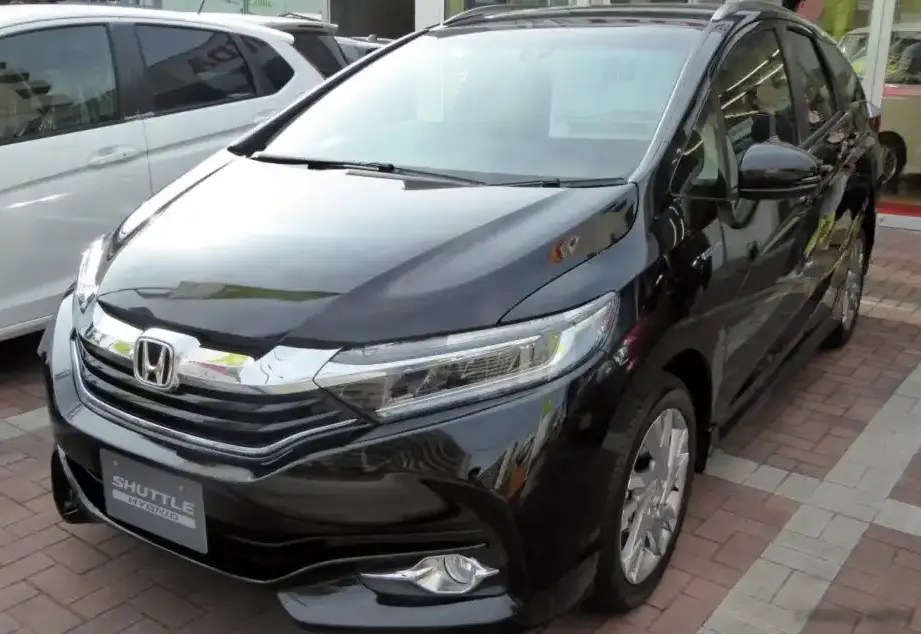
The Honda Shuttle 1.5 (129 hp) CVT, marketed primarily in Japan and other Asian markets from 2015 to May 2019, represents a practical and fuel-efficient entry in the compact minivan segment. Positioned as a versatile vehicle for families and small businesses, the Shuttle – known as the Honda Vezel/HR-V in many other global markets – offered a spacious interior and Honda’s reputation for reliability. This specific 1.5-liter variant with a Continuously Variable Transmission (CVT) served as a core offering within the Shuttle lineup, balancing affordability with acceptable performance and fuel economy. It was part of the broader Honda Vezel/HR-V (RU series) generation, built on the Global Small Platform.
Technical Specifications
| Brand | Honda |
| Model | Shuttle |
| Generation | Shuttle |
| Type (Engine) | 1.5 (129 Hp) CVT |
| Start of production | 2015 |
| End of production | May, 2019 |
| Powertrain Architecture | Internal Combustion engine |
| Body type | Minivan |
| Seats | 5 |
| Doors | 5 |
| Fuel consumption at Low speed (WLTP) | 6.9 l/100 km (34.1 US mpg, 40.9 UK mpg, 14.5 km/l) |
| Fuel consumption at Medium speed (WLTP) | 4.9 l/100 km (48 US mpg, 57.6 UK mpg, 20.4 km/l) |
| Fuel consumption at high speed (WLTP) | 4.5 l/100 km (52.3 US mpg, 62.8 UK mpg, 22.2 km/l) |
| Combined fuel consumption (WLTP) | 5.1 l/100 km (46.1 US mpg, 55.4 UK mpg, 19.6 km/l) |
| Fuel Type | Petrol (Gasoline) |
| Weight-to-power ratio | 8.8 kg/Hp, 114.2 Hp/tonne |
| Weight-to-torque ratio | 7.4 kg/Nm, 135.4 Nm/tonne |
| Power | 129 Hp @ 6600 rpm |
| Power per litre | 86.2 Hp/l |
| Torque | 153 Nm @ 4600 rpm (112.85 lb.-ft. @ 4600 rpm) |
| Engine layout | Front, Transverse |
| Engine Model/Code | L15B |
| Engine displacement | 1496 cm3 (91.29 cu. in.) |
| Number of cylinders | 4 |
| Engine configuration | Inline |
| Cylinder Bore | 73 mm (2.87 in.) |
| Piston Stroke | 89.4 mm (3.52 in.) |
| Compression ratio | 11.5:1 |
| Number of valves per cylinder | 4 |
| Engine aspiration | Naturally aspirated engine |
| Valvetrain | DOHC, VVT |
| Engine oil capacity | 3.3 l (3.49 US qt | 2.9 UK qt) |
| Coolant | 3.78 l (3.99 US qt | 3.33 UK qt) |
| Kerb Weight | 1130 kg (2491.22 lbs.) |
| Fuel tank capacity | 40 l (10.57 US gal | 8.8 UK gal) |
| Length | 4440 mm (174.8 in.) |
| Width | 1695 mm (66.73 in.) |
| Height | 1545 mm (60.83 in.) |
| Wheelbase | 2530 mm (99.61 in.) |
| Front track | 1480 mm (58.27 in.) |
| Rear (Back) track | 1485 mm (58.46 in.) |
| Ride height (ground clearance) | 130 mm (5.12 in.) |
| Minimum turning circle (turning diameter) | 9.8 m (32.15 ft.) |
| Drivetrain Architecture | The Internal combustion engine (ICE) drives the front wheels of the vehicle. |
| Drive wheel | Front wheel drive |
| Number of gears and type of gearbox | automatic transmission CVT |
| Front suspension | Independent type McPherson |
| Rear suspension | Torsion |
| Front brakes | Ventilated discs |
| Assisting systems | ABS (Anti-lock braking system) |
| Steering type | Steering rack and pinion |
| Power steering | Electric Steering |
| Tires size | 185/60 R15 84H |
| Wheel rims size | 15 |
INTRODUCTION
The Honda Shuttle 1.5 CVT, produced between 2015 and 2019, is a five-door, five-seat compact minivan designed to maximize interior space and fuel efficiency. It’s essentially a variation of the globally sold Honda Vezel/HR-V, but with a longer rear section to increase cargo capacity, catering to the needs of families and those requiring a versatile vehicle. The Shuttle was primarily sold in Japan, where the demand for compact, space-efficient vehicles is high. It represented Honda’s attempt to offer a practical and economical option within the burgeoning crossover/minivan segment.
Powertrain & Engine Architecture
At the heart of the Shuttle 1.5 CVT lies Honda’s L15B 1.5-liter inline-four cylinder engine. This engine is a member of Honda’s Earth Dreams Technology series, focusing on efficiency and reduced emissions. The L15B utilizes a single overhead camshaft (SOHC) design with four valves per cylinder, and Variable Valve Timing (VVT) on both the intake and exhaust camshafts. Fuel delivery is managed by Honda’s direct injection system, contributing to improved combustion efficiency and power output. The engine produces 129 horsepower at 6600 rpm and 153 Nm (112.85 lb-ft) of torque at 4600 rpm.
The engine is paired with a Continuously Variable Transmission (CVT). Honda’s G-Design CVT, used in the Shuttle, is designed to provide smooth, seamless acceleration and improved fuel economy compared to traditional automatic transmissions. The CVT utilizes a belt-and-pulley system to provide an infinite number of gear ratios within its operating range, allowing the engine to operate at its most efficient point. The CVT is front-wheel drive in this configuration; all-wheel drive was available on other Shuttle trims.
Driving Characteristics
The 1.5-liter engine and CVT combination in the Shuttle delivers adequate, though not particularly sporty, performance. Acceleration is linear and predictable, prioritizing fuel efficiency over outright speed. The CVT effectively keeps the engine in its optimal power band, providing a smooth driving experience. Compared to higher-output versions of the Shuttle (which were not widely available in all markets), the 1.5L CVT feels noticeably less powerful, especially when fully loaded with passengers and cargo. The CVT’s programming is tuned for economy, meaning it can sometimes feel hesitant during quick overtaking maneuvers. The gear ratios are optimized for low-to-mid range torque, making it suitable for city driving and highway cruising. The Shuttle’s relatively light weight (1130 kg / 2491 lbs) helps to mitigate the engine’s modest power output.
Equipment & Trim Levels
The 1.5 CVT trim of the Honda Shuttle typically came standard with features such as air conditioning, power windows, power door locks, and a basic audio system with USB connectivity. Higher trim levels offered features like alloy wheels, a touchscreen infotainment system, a rearview camera, and Honda’s “Honda Sensing” suite of safety technologies, which included features like adaptive cruise control and lane departure warning. Interior upholstery was typically cloth, with optional leather available on higher trims. Dashboard configuration was functional and straightforward, prioritizing ease of use. Optional extras included navigation systems, upgraded audio systems, and various accessory packages.
Chassis & Braking
The Honda Shuttle utilizes a McPherson strut front suspension and a torsion beam rear suspension. This setup provides a comfortable ride quality, absorbing bumps and imperfections in the road effectively. The front brakes are ventilated discs, while the rear brakes are drums. ABS (Anti-lock Braking System) is standard, enhancing braking performance and stability. The steering is electric power-assisted, providing light and responsive steering feel. The relatively compact dimensions and light weight of the Shuttle contribute to its nimble handling characteristics.
Market Reception & Comparison
The Honda Shuttle 1.5 CVT was generally well-received in the Japanese market for its practicality, fuel efficiency, and reliability. Critics praised its spacious interior and versatile cargo area. However, some reviewers noted that the 1.5-liter engine felt underpowered, especially when compared to larger-displacement engines offered in competing vehicles. Compared to other Shuttle trims, such as those with hybrid powertrains, the 1.5L CVT offered a lower price point but sacrificed some fuel economy and performance. Its fuel economy figures of around 5.1 l/100 km (46.1 US mpg) were competitive within its class.
Legacy
The Honda Shuttle 1.5 CVT has proven to be a reliable and durable vehicle, with many examples still on the road today. The L15B engine is known for its longevity and relatively low maintenance costs. The CVT transmission, while sometimes criticized for its driving feel, has also proven to be generally reliable when properly maintained. In the used car market, the Shuttle 1.5 CVT represents a good value proposition for buyers seeking a practical and economical compact minivan. Its reputation for reliability and fuel efficiency continues to make it a popular choice among budget-conscious buyers.