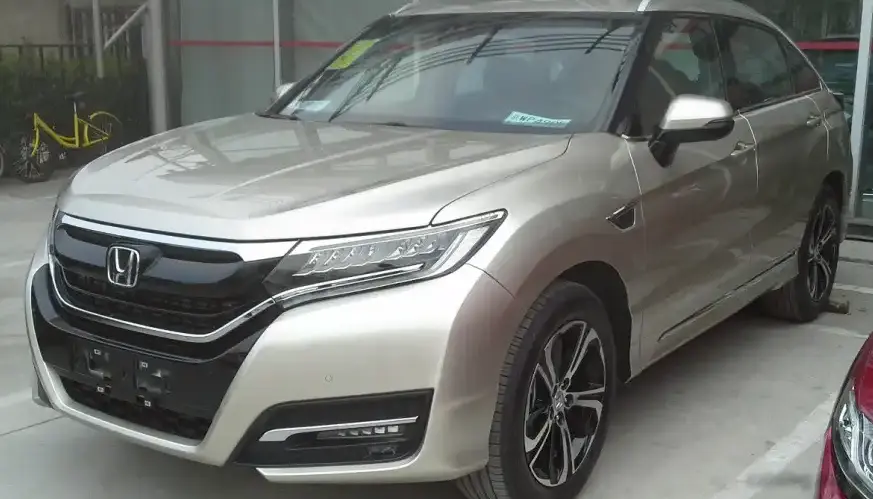
The Honda UR-V 370 Turbo, produced from 2017 to 2020, represents Honda’s entry into the mid-size crossover SUV segment, primarily targeted towards the Chinese automotive market. Positioned as a more premium offering than the CR-V available in North America, the UR-V aimed to provide a spacious and technologically advanced vehicle for growing families. This specific variant, equipped with the 2.0-liter K20C3 turbocharged engine and a nine-speed automatic transmission coupled with all-wheel drive, was a top-tier trim level within the UR-V lineup, emphasizing performance and refinement. It offered a step up in power and features compared to lower-spec models with naturally aspirated engines.
Technical Specifications
| Brand | Honda |
| Model | UR-V |
| Generation | UR-V |
| Type (Engine) | 370 Turbo (272 Hp) AWD Automatic |
| Start of production | 2017 |
| End of production | 2020 |
| Powertrain Architecture | Internal Combustion engine |
| Body type | SUV |
| Seats | 5 |
| Doors | 5 |
| Fuel consumption (combined) | 8.3 l/100 km (28.3 US mpg, 34 UK mpg, 12 km/l) |
| Fuel Type | Petrol (Gasoline) |
| Acceleration 0 – 100 km/h | 7.8 sec |
| Acceleration 0 – 62 mph | 7.8 sec |
| Acceleration 0 – 60 mph | 7.4 sec |
| Emission standard | Euro 5 |
| Weight-to-power ratio | 6.6 kg/Hp, 150.8 Hp/tonne |
| Weight-to-torque ratio | 4.9 kg/Nm, 205.1 Nm/tonne |
| Power | 272 Hp @ 6500 rpm |
| Power per litre | 136.3 Hp/l |
| Torque | 370 Nm @ 2250-4500 rpm (272.9 lb.-ft. @ 2250-4500 rpm) |
| Engine layout | Front, Transverse |
| Engine Model/Code | K20C3 |
| Engine displacement | 1996 cm3 (121.8 cu. in.) |
| Number of cylinders | 4 |
| Engine configuration | Inline |
| Compression ratio | 9.8:1 |
| Fuel injection system | Direct injection |
| Engine aspiration | Turbocharger, Intercooler |
| Valvetrain | DOHC, VTEC |
| Engine oil capacity | 5 l (5.28 US qt | 4.4 UK qt) |
| Coolant capacity | 5.93 l (6.27 US qt | 5.22 UK qt) |
| Kerb Weight | 1804 kg (3977.14 lbs.) |
| Length | 4825 mm (189.96 in.) |
| Width | 1942 mm (76.46 in.) |
| Height | 1670 mm (65.75 in.) |
| Wheelbase | 2820 mm (111.02 in.) |
| Minimum turning circle | 11.4 m (37.4 ft.) |
| Drive wheel | All wheel drive (4×4) |
| Number of gears | 9 |
| Gearbox type | Automatic transmission |
| Front suspension | Independent, McPherson with coil spring and anti-roll bar |
| Rear suspension | Independent multi-link suspension |
| Front brakes | Ventilated discs |
| Rear brakes | Disc |
| Assisting systems | ABS (Anti-lock braking system) |
| Steering type | Steering rack and pinion |
| Tires size | 245/55 R19 |
| Wheel rims size | 19 |
Powertrain & Engine Architecture
The heart of the UR-V 370 Turbo is the K20C3 2.0-liter inline-four cylinder engine. This engine is a member of Honda’s K-series family, known for its performance potential. The K20C3 utilizes direct injection and a single turbocharger with an intercooler to produce 272 horsepower at 6500 rpm and 370 Nm (272.9 lb.-ft.) of torque between 2250 and 4500 rpm. Honda’s Variable Timing and Lift Electronic Control (VTEC) technology is employed to optimize valve timing for both low-end drivability and high-end power. The engine is transversely mounted in the front of the vehicle. The nine-speed automatic transmission, sourced from ZF, provides smooth and relatively quick shifts. This transmission was chosen for its balance of efficiency and responsiveness, offering a wider gear ratio spread than a traditional six-speed automatic.
Driving Characteristics
The 272 hp and 370 Nm of torque delivered by the K20C3 engine, combined with the all-wheel-drive system, provide the UR-V 370 Turbo with brisk acceleration. The 0-60 mph time of around 7.4 seconds is respectable for a mid-size SUV. The nine-speed automatic transmission helps keep the engine in its optimal power band, providing good responsiveness during both city driving and highway cruising. Compared to lower-trim UR-V models with naturally aspirated engines, the 370 Turbo offers a significantly more engaging driving experience, with readily available power for overtaking and merging. While not a sports SUV, it provides a confident and capable driving experience. The all-wheel-drive system enhances traction and stability, particularly in inclement weather conditions.
Equipment & Trim Levels
The UR-V 370 Turbo was typically equipped with a high level of standard features. These included leather upholstery, power-adjustable front seats, a panoramic sunroof, a touchscreen infotainment system with navigation, and a suite of advanced driver-assistance systems (ADAS) such as adaptive cruise control, lane departure warning, and automatic emergency braking. Optional extras often included premium audio systems, ventilated front seats, and a 360-degree camera system. The interior design focused on providing a comfortable and spacious environment for passengers, with a modern and upscale aesthetic.
Chassis & Braking
The UR-V utilizes an independent suspension setup at all four corners. The front suspension employs McPherson struts with coil springs and an anti-roll bar, while the rear features a multi-link suspension. This configuration provides a good balance of ride comfort and handling. The vehicle is equipped with ventilated disc brakes at the front and solid disc brakes at the rear. The anti-lock braking system (ABS) is standard, enhancing braking performance and stability. The steering system is a rack and pinion setup, providing precise and responsive steering feel.
Market Reception & Comparison
The Honda UR-V 370 Turbo was generally well-received in the Chinese market, praised for its spacious interior, comfortable ride, and strong performance. Critics noted that it offered a compelling alternative to other mid-size SUVs, such as the Toyota Highlander and the Ford Edge. Compared to the lower-trim UR-V models, the 370 Turbo commanded a higher price but offered a significant upgrade in performance and features. Fuel economy, at 8.3 l/100 km, was considered average for its class. Reliability was generally good, consistent with Honda’s reputation for building durable vehicles.
Legacy
The Honda UR-V, while not sold in North America or Europe, established Honda as a significant player in the Chinese mid-size SUV market. The K20C3 engine, with its turbocharging and direct injection technology, proved to be a reliable and capable powerplant. On the used car market, the UR-V 370 Turbo holds its value relatively well, due to its desirable combination of performance, features, and Honda’s brand reputation. Maintenance costs are generally reasonable, although sourcing parts outside of China can sometimes be challenging. The UR-V represents a unique chapter in Honda’s global product strategy, tailored specifically to the demands of the Chinese automotive consumer.