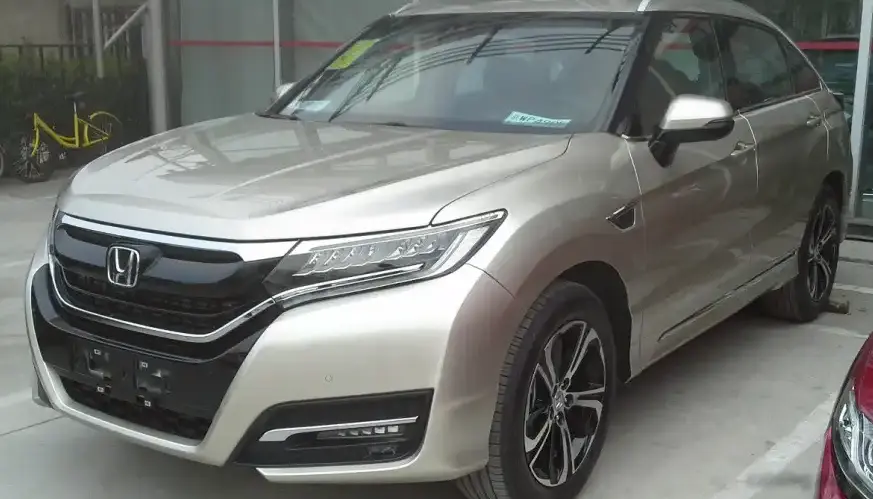
The Honda UR-V (facelift 2020) 370 Turbo, equipped with a 272 horsepower engine and all-wheel drive paired with a 9-speed automatic transmission, represents a significant offering in Honda’s SUV lineup, primarily targeted towards the Chinese automotive market. Introduced as part of a mid-cycle refresh, this variant aimed to provide a more premium and performance-oriented experience within the UR-V range. Production began in 2020, building upon the foundation of the first-generation UR-V, which itself was a larger, more spacious alternative to the CR-V, designed specifically to cater to the preferences of Chinese consumers who favored larger vehicles. This model occupies a space between mainstream family SUVs and more luxurious offerings.
Technical Specifications
| Brand | Honda |
| Model | UR-V |
| Generation | UR-V (facelift 2020) |
| Type (Engine) | 370 Turbo (272 Hp) AWD Automatic |
| Start of production | 2020 |
| Powertrain Architecture | Internal Combustion engine |
| Body type | SUV |
| Seats | 5 |
| Doors | 5 |
| Fuel consumption (combined) | 8.7 l/100 km (27 US mpg, 32.5 UK mpg, 11.5 km/l) |
| Fuel Type | Petrol (Gasoline) |
| Acceleration 0 – 100 km/h | 8 sec |
| Acceleration 0 – 62 mph | 8 sec |
| Acceleration 0 – 60 mph | 7.6 sec |
| Emission standard | China VI |
| Weight-to-power ratio | 6.9 kg/Hp, 145.5 Hp/tonne |
| Weight-to-torque ratio | 5.1 kg/Nm, 197.9 Nm/tonne |
| Power | 272 Hp @ 6500 rpm |
| Power per litre | 136.3 Hp/l |
| Torque | 370 Nm @ 2250-4500 rpm (272.9 lb.-ft. @ 2250-4500 rpm) |
| Engine layout | Front, Transverse |
| Engine Model/Code | K20C3 |
| Engine displacement | 1996 cm3 (121.8 cu. in.) |
| Number of cylinders | 4 |
| Engine configuration | Inline |
| Compression ratio | 9.8:1 |
| Fuel injection system | Direct injection |
| Engine aspiration | Turbocharger, Intercooler |
| Valvetrain | DOHC, VTEC |
| Engine oil capacity | 5 l (5.28 US qt | 4.4 UK qt) |
| Coolant capacity | 5.93 l (6.27 US qt | 5.22 UK qt) |
| Kerb Weight | 1870-1880 kg (4122.64 – 4144.69 lbs.) |
| Length | 4856 mm (191.18 in.) |
| Width | 1942 mm (76.46 in.) |
| Height | 1675 mm (65.94 in.) |
| Wheelbase | 2820 mm (111.02 in.) |
| Minimum turning circle | 11.4 m (37.4 ft.) |
| Drivetrain Architecture | All wheel drive (4×4) |
| Number of gears | 9 |
| Gearbox type | Automatic transmission |
| Front suspension | Independent, McPherson with coil spring and anti-roll bar |
| Rear suspension | Independent multi-link spring suspension with stabilizer |
| Front brakes | Ventilated discs |
| Rear brakes | Disc |
| Tire size | 245/55 R19 103H |
| Wheel rims size | 19 |
Powertrain & Engine Architecture
The heart of the UR-V 370 Turbo is the K20C3 engine, a 2.0-liter turbocharged inline-four cylinder powerplant. This engine utilizes direct injection technology, enhancing fuel efficiency and power delivery. The turbocharger, coupled with an intercooler, provides increased air density for improved combustion. The engine also features Honda’s Variable Valve Timing and Lift Electronic Control (VTEC) system, optimizing valve timing for both low-end torque and high-rpm power. The 9-speed automatic transmission is a crucial component, designed to efficiently manage the engine’s output and provide smooth gear changes. This transmission is geared towards balancing performance with fuel economy, offering a wide range of ratios to keep the engine in its optimal power band.
Driving Characteristics
The 272 hp and 370 Nm (272.9 lb-ft) of torque delivered by the K20C3 engine, combined with the all-wheel-drive system, provide the UR-V 370 Turbo with brisk acceleration. The 0-60 mph time of around 7.6 seconds is respectable for a vehicle of this size and class. The 9-speed automatic transmission contributes to a comfortable driving experience, with generally smooth shifts. Compared to lower-powered UR-V variants, such as those equipped with naturally aspirated engines, the 370 Turbo offers a significantly more responsive and engaging driving experience. While not a sports SUV, it provides ample power for overtaking and highway cruising. The all-wheel-drive system enhances stability and traction, particularly in adverse weather conditions.
Equipment & Trim Levels
The UR-V 370 Turbo, typically positioned as a higher trim level, came standard with a comprehensive suite of features. These generally included leather upholstery, a panoramic sunroof, a touchscreen infotainment system with navigation, and a suite of advanced driver-assistance systems (ADAS) such as adaptive cruise control, lane keeping assist, and automatic emergency braking. Optional extras often included premium audio systems, upgraded interior trim materials, and additional safety features. The interior design focused on providing a comfortable and spacious cabin, with attention paid to material quality and overall refinement.
Chassis & Braking
The UR-V utilizes an independent suspension setup, with McPherson struts at the front and a multi-link system at the rear. This configuration is designed to provide a comfortable ride while maintaining good handling characteristics. Stabilizer bars are included both front and rear to reduce body roll during cornering. The braking system consists of ventilated discs at the front and solid discs at the rear, providing adequate stopping power for the vehicle’s weight and performance. Anti-lock braking system (ABS) is standard, enhancing safety and control during emergency braking situations.
Market Reception & Comparison
The Honda UR-V 370 Turbo was generally well-received in the Chinese market, where it competed with other mid-size SUVs from both domestic and international manufacturers. Critics praised its spacious interior, comfortable ride, and strong performance. Fuel economy, at 8.7 l/100 km, was considered reasonable for a vehicle of its size and power. Compared to lower-powered UR-V variants, the 370 Turbo offered a more premium and engaging driving experience, justifying its higher price point. However, some reviewers noted that the infotainment system could be improved in terms of user interface and responsiveness.
Legacy
The Honda UR-V 370 Turbo, while primarily a China-market vehicle, represents a significant step in Honda’s SUV offerings. The K20C3 engine, with its turbocharging and direct injection technology, showcases Honda’s commitment to improving engine efficiency and performance. The 9-speed automatic transmission, while not without its critics, provides a smooth and efficient driving experience. In the used car market, the UR-V 370 Turbo holds its value relatively well, due to its strong performance, spacious interior, and comprehensive feature set. Long-term reliability appears to be generally good, consistent with Honda’s reputation for building durable and dependable vehicles.