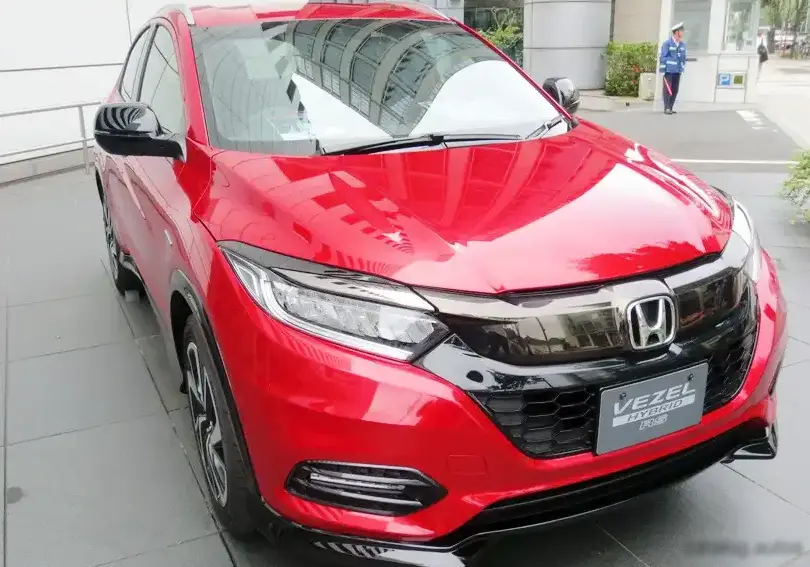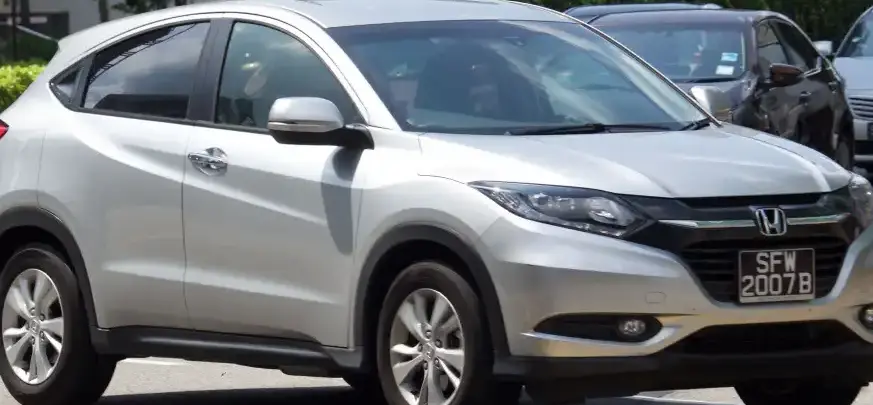
The Honda Vezel 1.5 i-VTEC (131 Hp) CVT, marketed as the Honda HR-V in many regions including North America, represents a key variant within the first generation of the Vezel (RU series) produced between 2014 and 2018. Positioned as a mainstream offering within the lineup, this model aimed to provide a balance of fuel efficiency, practicality, and affordability in the burgeoning subcompact SUV segment. It was a crucial model for Honda, particularly in the Asian market, where subcompact SUVs were gaining significant popularity. The Vezel, built on Honda’s Global Small Platform, offered a unique blend of hatchback versatility and SUV styling.
Technical Specifications
| Brand | Honda |
| Model | Vezel |
| Generation | Vezel |
| Type (Engine) | 1.5 i-VTEC (131 Hp) CVT |
| Start of production | 2014 |
| End of production | 2018 |
| Powertrain Architecture | Internal Combustion engine |
| Body type | SUV |
| Seats | 5 |
| Doors | 5 |
| Fuel consumption (combined) | 4.9 l/100 km (48 US mpg, 57.6 UK mpg, 20.4 km/l) |
| Fuel Type | Petrol (Gasoline) |
| Weight-to-power ratio | 9 kg/Hp, 111 Hp/tonne |
| Weight-to-torque ratio | 7.6 kg/Nm, 131.4 Nm/tonne |
| Power | 131 Hp @ 6600 rpm |
| Power per litre | 87.6 Hp/l |
| Torque | 155 Nm @ 4600 rpm (114.32 lb.-ft. @ 4600 rpm) |
| Engine layout | Front, Transverse |
| Engine Model/Code | L15B |
| Engine displacement | 1496 cm3 (91.29 cu. in.) |
| Number of cylinders | 4 |
| Engine configuration | Inline |
| Cylinder Bore | 73 mm (2.87 in.) |
| Piston Stroke | 89.4 mm (3.52 in.) |
| Compression ratio | 11.5:1 |
| Number of valves per cylinder | 4 |
| Fuel injection system | Direct injection |
| Engine aspiration | Naturally aspirated engine |
| Valvetrain | DOHC, i-VTEC |
| Engine oil capacity | 3.3 l (3.49 US qt | 2.9 UK qt) |
| Coolant | 3.63 l (3.84 US qt | 3.19 UK qt) |
| Kerb Weight | 1180-1190 kg (2601.45 – 2623.5 lbs.) |
| Fuel tank capacity | 40 l (10.57 US gal | 8.8 UK gal) |
| Length | 4295 mm (169.09 in.) |
| Width | 1770 mm (69.69 in.) |
| Height | 1605 mm (63.19 in.) |
| Wheelbase | 2610 mm (102.76 in.) |
| Front track | 1535 mm (60.43 in.) |
| Rear track | 1540 mm (60.63 in.) |
| Ride height (ground clearance) | 185 mm (7.28 in.) |
| Minimum turning circle | 10.6 m (34.78 ft.) |
| Drivetrain Architecture | Front wheel drive |
| Number of gears and type of gearbox | automatic transmission CVT |
| Front suspension | Independent type McPherson |
| Rear suspension | Torsion |
| Front brakes | Ventilated discs |
| Rear brakes | Disc |
| Assisting systems | ABS (Anti-lock braking system) |
| Steering type | Steering rack and pinion |
| Power steering | Electric Steering |
| Tires size | 215/60 R16 95H |
| Wheel rims size | 16 |
Powertrain & Engine Architecture
The heart of the Vezel 1.5 i-VTEC CVT is the L15B engine, a 1.5-liter inline-four cylinder gasoline engine. This engine is part of Honda’s Earth Dreams Technology series, focusing on efficiency and reduced emissions. The L15B utilizes direct injection, enhancing fuel atomization and combustion efficiency. The engine features a double overhead camshaft (DOHC) valvetrain with Honda’s intelligent Variable Valve Timing and Lift Electronic Control (i-VTEC) system. This system allows for variable valve timing and lift, optimizing engine performance across a wider RPM range. The CVT (Continuously Variable Transmission) was chosen for its smooth operation and contribution to fuel economy. Unlike traditional automatic transmissions with fixed gear ratios, a CVT provides a virtually infinite number of ratios within its range, keeping the engine operating at its most efficient point.
Driving Characteristics
The 131 horsepower and 155 Nm (114 lb-ft) of torque delivered by the L15B engine, coupled with the CVT, resulted in adequate, though not particularly sporty, performance. Acceleration was linear and predictable, prioritizing fuel efficiency over outright speed. The CVT’s programming was tuned for economy, meaning the engine would often hold lower RPMs during gentle acceleration. Compared to the higher-output 1.8-liter engine offered in some markets, the 1.5L felt noticeably less powerful, especially when fully loaded or tackling steep inclines. However, the CVT minimized any harshness during gear changes, providing a comfortable driving experience. The CVT’s ratios were optimized for city driving, making it a pleasant daily commuter.
Equipment & Trim Levels
The 1.5 i-VTEC CVT trim typically included standard features such as air conditioning, power windows and locks, a basic audio system with USB connectivity, and ABS brakes. Higher trim levels, often denoted with suffixes like “S” or “G”, added features like alloy wheels, a touchscreen infotainment system, a rearview camera, and automatic climate control. Interior upholstery was generally cloth, with options for leather in higher trims. Safety features included multiple airbags and stability control. Optional extras often included a sunroof, navigation system, and upgraded audio systems.
Chassis & Braking
The Vezel’s chassis utilized a McPherson strut front suspension and a torsion beam rear suspension. This setup provided a good balance of ride comfort and handling. The torsion beam rear suspension was a cost-effective solution that minimized complexity while still offering acceptable handling characteristics. Braking consisted of ventilated discs at the front and solid discs at the rear. ABS (Anti-lock Braking System) was standard, enhancing braking performance and safety. The electric power steering provided light and easy steering, making it well-suited for urban driving.
Market Reception & Comparison
The Honda Vezel 1.5 i-VTEC CVT was generally well-received by critics for its fuel efficiency, spacious interior, and practical design. However, some reviewers noted the engine’s lack of outright power, particularly when compared to competitors offering larger displacement engines. The CVT transmission was praised for its smoothness but criticized by some for its lack of engagement. Compared to other trims in the Vezel lineup, the 1.5L CVT offered the most affordable entry point, making it attractive to budget-conscious buyers. Its fuel economy was superior to the 1.8L variants, but at the expense of performance.
Legacy
The L15B engine, in general, has proven to be a reliable and durable powerplant. The CVT transmission, while requiring regular fluid changes, has also demonstrated reasonable longevity when properly maintained. In the used car market, the Vezel 1.5 i-VTEC CVT remains a popular choice due to its affordability, fuel efficiency, and Honda’s reputation for reliability. Common issues reported by owners include occasional CVT shuddering and minor electrical glitches, but these are generally not major concerns. The first-generation Vezel established Honda as a major player in the subcompact SUV segment, paving the way for subsequent generations and similar models from other manufacturers.