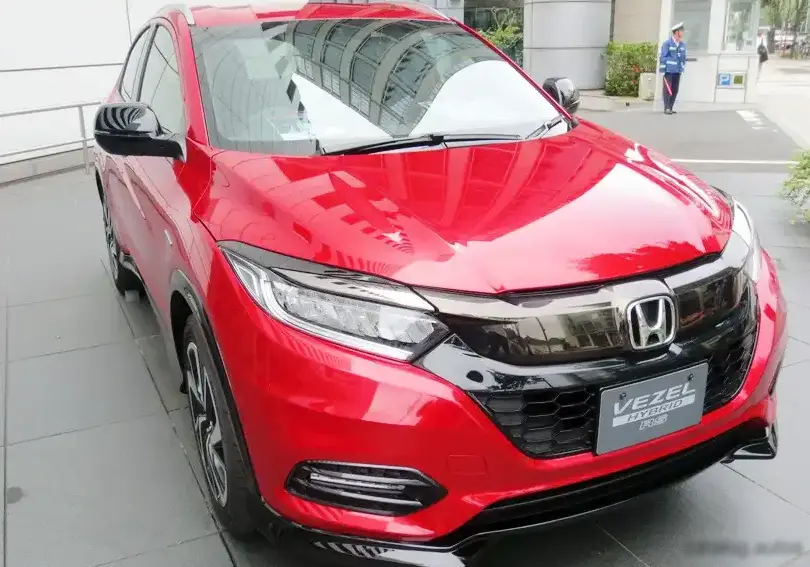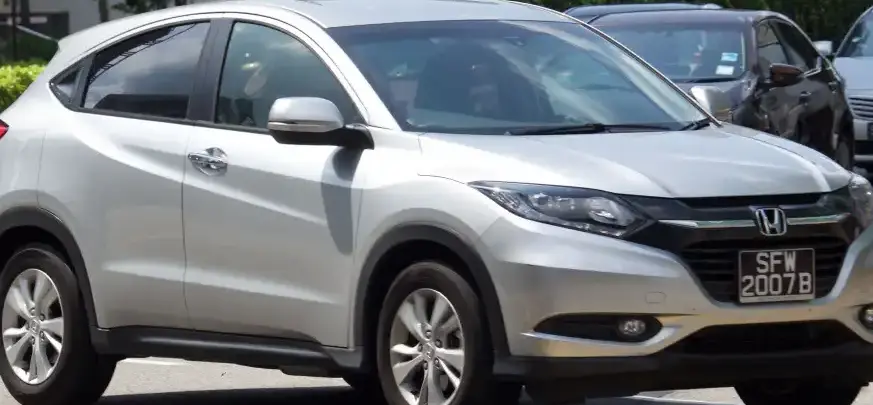
The Honda Vezel 1.5 i-VTEC Hybrid DCT, known as the Honda HR-V in many markets including North America, represents Honda’s entry into the subcompact crossover SUV segment. Introduced in Japan and other Asian markets in 2014, and arriving in North America as a 2016 model, this generation (RU series) of the Vezel/HR-V quickly gained popularity for its surprisingly spacious interior, fuel efficiency, and modern styling. The 1.5 i-VTEC Hybrid variant, specifically, was positioned as a premium offering within the lineup, appealing to buyers seeking enhanced fuel economy and a more refined driving experience. Production of this specific configuration ran from 2014 to 2018, with minor updates occurring throughout its lifespan.
Technical Specifications
| Brand | Honda |
| Model | Vezel |
| Generation | Vezel |
| Type (Engine) | 1.5 i-VTEC (152 Hp) Hybrid DCT |
| Start of production | 2014 |
| End of production | 2018 |
| Powertrain Architecture | FHEV (Full Hybrid Electric Vehicle) |
| Body type | SUV |
| Seats | 5 |
| Doors | 5 |
| Fuel consumption (combined) | 3.7-4.3 l/100 km (63.6 – 54.7 US mpg, 76.3 – 65.7 UK mpg, 27 – 23.3 km/l) |
| Fuel Type | Petrol (Gasoline) |
| Weight-to-power ratio | 8.4 kg/Hp, 119.7 Hp/tonne |
| Weight-to-torque ratio | 6.7 kg/Nm, 149.6 Nm/tonne |
| Electric motor power | 30 Hp @ 1313-2000 rpm (118.01 lb.-ft. @ 0-1313 rpm) |
| Electric motor type | Synchronous |
| System power | 152 Hp @ 6600 rpm (190 Nm @ 1000-4600 rpm / 140.14 lb.-ft. @ 1000-4600 rpm) |
| Internal combustion engine power | 132 Hp @ 6600 rpm (156 Nm @ 4600 rpm / 115.06 lb.-ft. @ 4600 rpm) |
| Engine layout | Front, Transverse |
| Engine Model/Code | LEB |
| Engine displacement | 1496 cm3 (91.29 cu. in.) |
| Number of cylinders | 4 |
| Engine configuration | Inline |
| Cylinder Bore | 73 mm (2.87 in.) |
| Piston Stroke | 89.4 mm (3.52 in.) |
| Compression ratio | 11.5:1 |
| Number of valves per cylinder | 4 |
| Fuel injection system | Multi-port manifold injection |
| Engine aspiration | Naturally aspirated engine |
| Valvetrain | DOHC, i-VTEC |
| Engine oil capacity | 3.3 l (3.49 US qt | 2.9 UK qt) |
| Coolant capacity | 3.6 l (3.8 US qt | 3.17 UK qt) |
| Kerb Weight | 1270-1320 kg (2799.87 – 2910.1 lbs.) |
| Fuel tank capacity | 40 l (10.57 US gal | 8.8 UK gal) |
| Length | 4295 mm (169.09 in.) |
| Width | 1770 mm (69.69 in.) |
| Height | 1605 mm (63.19 in.) |
| Wheelbase | 2610 mm (102.76 in.) |
| Front track | 1535 mm (60.43 in.) |
| Rear track | 1540 mm (60.63 in.) |
| Ride height (ground clearance) | 185 mm (7.28 in.) |
| Minimum turning circle | 10.6 m (34.78 ft.) |
| Drivetrain Architecture | Front wheel drive, FHEV |
| Number of gears | 7 |
| Gearbox type | Automatic transmission DCT |
| Front suspension | Independent type McPherson |
| Rear suspension | Torsion |
| Front brakes | Ventilated discs |
| Rear brakes | Disc |
| Steering type | Steering rack and pinion |
| Power steering | Electric Steering |
| Tires size | 215/60 R16 95H; 215/55 R17 94V |
| Wheel rims size | 16; 17 |
Introduction
The Honda Vezel 1.5 i-VTEC Hybrid DCT, launched in 2014, was a key component of Honda’s strategy to capture a larger share of the growing subcompact SUV market. Built on the Global Small Platform (GSP), also known internally as the 1HX0/A3 platform, the Vezel aimed to offer a compelling blend of practicality, efficiency, and technology. The hybrid variant distinguished itself through its Intelligent Multi-Mode Drive (i-MMD) system, a sophisticated full hybrid setup that prioritized fuel economy without sacrificing driveability. In markets where it was sold as the HR-V, it quickly became a popular choice for urban commuters and small families.
Powertrain & Engine Architecture
At the heart of the Vezel 1.5 i-VTEC Hybrid is Honda’s LEB engine, a 1.5-liter inline-four cylinder gasoline engine. This engine, producing 132 horsepower and 156 Nm (115 lb-ft) of torque, is coupled with Honda’s i-MMD hybrid system. The i-MMD system utilizes a 30 horsepower electric motor and a lithium-ion battery pack to provide supplemental power and enable electric-only driving under certain conditions. The system intelligently switches between electric, gasoline, and combined power modes, optimizing for efficiency and performance. The engine employs Honda’s direct injection technology and a DOHC i-VTEC valvetrain for improved combustion efficiency and power delivery. The Dual Clutch Transmission (DCT) with seven virtual gears provides smooth and responsive shifting. The DCT is integral to the i-MMD system, allowing for seamless transitions between power sources.
Driving Characteristics
The 1.5 i-VTEC Hybrid DCT offers a noticeably different driving experience compared to the non-hybrid versions of the Vezel. While the total system output of 152 horsepower isn’t dramatically higher than the standard 1.8-liter gasoline engine, the electric motor provides instant torque, resulting in brisk acceleration from a standstill. The DCT contributes to a smooth and refined driving experience, although some drivers noted a slight hesitation during low-speed maneuvers. The i-MMD system prioritizes fuel efficiency, and the vehicle frequently operates in electric-only mode during city driving. On the highway, the engine seamlessly engages to provide sufficient power for overtaking and maintaining speed. Compared to the manual transmission versions, the DCT offers greater convenience, but some enthusiasts missed the engagement of a traditional manual gearbox.
Equipment & Trim Levels
The 1.5 i-VTEC Hybrid DCT was typically offered in higher trim levels, often designated as “Modulo” or “RS” depending on the market. Standard features included automatic climate control, a touchscreen infotainment system with Bluetooth connectivity, and a multi-function steering wheel. Higher trims added features such as leather upholstery, a sunroof, and advanced safety systems like Honda Sensing, which included adaptive cruise control and lane departure warning. Interior upholstery was generally a combination of fabric and leatherette, with a focus on comfort and durability. Optional extras included navigation systems, premium audio systems, and alloy wheels.
Chassis & Braking
The Vezel 1.5 i-VTEC Hybrid utilizes a McPherson strut front suspension and a torsion beam rear suspension. This setup provides a comfortable ride quality while maintaining reasonable handling characteristics. Due to the added weight of the hybrid components, the suspension was slightly tuned to provide better stability. The braking system consists of ventilated discs on the front wheels and solid discs on the rear. Anti-lock braking system (ABS) and electronic brake-force distribution (EBD) were standard features. The steering is an electric power steering system, providing light and precise steering feel.
Market Reception & Comparison
The Honda Vezel 1.5 i-VTEC Hybrid DCT was generally well-received by automotive critics. Reviewers praised its fuel efficiency, spacious interior, and comfortable ride. However, some criticized its slightly underwhelming performance compared to competitors with more powerful engines. Compared to the standard 1.8-liter gasoline version, the hybrid offered significantly better fuel economy but came at a higher price point. The hybrid also weighed approximately 100-150 kg more than the non-hybrid models. Against rivals like the Toyota C-HR and Nissan Juke, the Vezel Hybrid stood out for its practicality and fuel efficiency.
Legacy
The Honda Vezel 1.5 i-VTEC Hybrid DCT has proven to be a reliable and durable vehicle. The i-MMD hybrid system has a good reputation for longevity, and the LEB engine is known for its robustness. In the used car market, these models hold their value relatively well, particularly those with lower mileage and a well-maintained service history. While the hybrid battery pack may eventually require replacement, the cost of replacement has decreased over time. The Vezel 1.5 i-VTEC Hybrid DCT remains a popular choice for buyers seeking a fuel-efficient and practical subcompact SUV.