
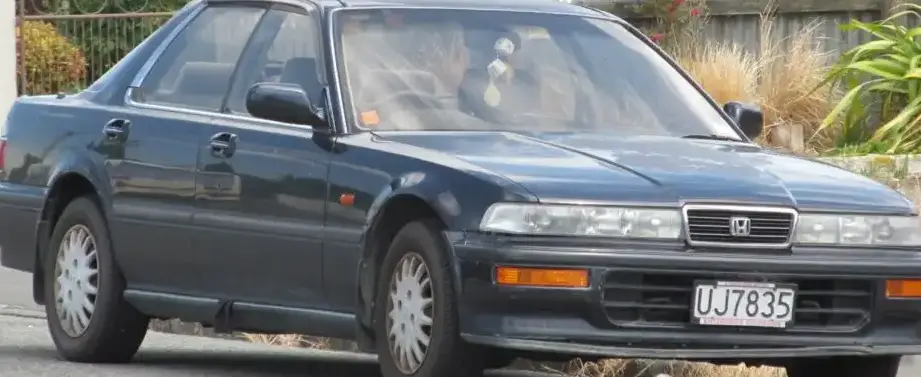
The Honda Vigor (CB5) 2.0i 20V G, produced between 1989 and 1995, represented a significant step forward for Honda in the mid-size sedan segment. Positioned above the Accord in the Japanese domestic market (JDM), the Vigor aimed to offer a more refined and sporty driving experience. While not officially sold in the United States, the CB5 Vigor was a popular grey market import, appealing to enthusiasts seeking a well-equipped and relatively uncommon Japanese vehicle. It was part of Honda’s broader strategy to offer a range of vehicles catering to different customer preferences, utilizing the CB5 chassis code for this generation.
Technical Specifications
| Brand | Honda |
| Model | Vigor |
| Generation | Vigor (CB5) |
| Type (Engine) | 2.0i 20V G (165 Hp) |
| Start of production | 1989 year |
| End of production | 1995 year |
| Powertrain Architecture | Internal Combustion engine |
| Body type | Sedan |
| Seats | 5 |
| Doors | 4 |
| Fuel consumption (economy) – combined | 7.3 l/100 km |
| Fuel consumption (economy) – combined | 32.2 US mpg |
| Fuel consumption (economy) – combined | 38.7 UK mpg |
| Fuel consumption (economy) – combined | 13.7 km/l |
| Fuel Type | Petrol (Gasoline) |
| Maximum speed | 200 km/h |
| Maximum speed | 124.27 mph |
| Weight-to-power ratio | 8.2 kg/Hp |
| Weight-to-power ratio | 121.3 Hp/tonne |
| Weight-to-torque ratio | 7.3 kg/Nm |
| Weight-to-torque ratio | 136.8 Nm/tonne |
| Power | 165 Hp @ 6700 rpm |
| Power per litre | 82.7 Hp/l |
| Torque | 186 Nm @ 4000 rpm |
| Torque | 137.19 lb.-ft. @ 4000 rpm |
| Engine layout | Front, Longitudinal |
| Engine displacement | 1996 cm3 |
| Engine displacement | 121.8 cu. in. |
| Number of cylinders | 5 |
| Engine configuration | Inline |
| Cylinder Bore | 82 mm |
| Cylinder Bore | 3.23 in. |
| Piston Stroke | 75.6 mm |
| Piston Stroke | 2.98 in. |
| Compression ratio | 9.7:1 |
| Number of valves per cylinder | 4 |
| Fuel injection system | Multi-port manifold injection |
| Engine aspiration | Naturally aspirated engine |
| Valvetrain | OHC |
| Kerb Weight | 1360 kg |
| Kerb Weight | 2998.29 lbs. |
| Trunk (boot) space – minimum | 440 l |
| Trunk (boot) space – minimum | 15.54 cu. ft. |
| Fuel tank capacity | 65 l |
| Fuel tank capacity | 17.17 US gal |
| Fuel tank capacity | 14.3 UK gal |
| Length | 4830 mm |
| Length | 190.16 in. |
| Width | 1775 mm |
| Width | 69.88 in. |
| Height | 1375 mm |
| Height | 54.13 in. |
| Wheelbase | 2805 mm |
| Wheelbase | 110.43 in. |
| Front track | 1520 mm |
| Front track | 59.84 in. |
| Rear (Back) track | 1510 mm |
| Rear (Back) track | 59.45 in. |
| Drivetrain Architecture | The Internal combustion engine (ICE) drives the front wheels of the vehicle. |
| Drive wheel | Front wheel drive |
| Number of gears and type of gearbox | 5 gears, manual transmission |
| Front suspension | Coil spring |
| Rear suspension | Coil spring |
| Front brakes | Ventilated discs |
| Rear brakes | Disc |
| Assisting systems | ABS (Anti-lock braking system) |
| Steering type | Steering rack and pinion |
| Power steering | Hydraulic Steering |
| Tires size | 195/60 R15 H |
Powertrain & Engine Architecture
The heart of the Vigor 2.0i 20V G is the Honda G20A inline-five cylinder engine. This engine, identifiable by its unique firing order, was a key differentiator for the Vigor. The 1996 cc engine featured a single overhead camshaft (OHC) valvetrain with four valves per cylinder, contributing to its relatively high output for its displacement. Multi-port fuel injection ensured precise fuel delivery, optimizing both performance and efficiency. The engine produced 165 horsepower at 6700 rpm and 186 Nm (137 lb-ft) of torque at 4000 rpm. The engine’s longitudinal mounting and front-wheel drive configuration were typical for Honda’s higher-end models of the era. The CB5 Vigor came exclusively with a 5-speed manual transmission, offering drivers a direct connection to the engine’s power.
Driving Characteristics
The Vigor 2.0i 20V G offered a refined and engaging driving experience. The inline-five engine provided a smooth and linear power delivery, making it suitable for both daily commuting and spirited driving. While not a high-revving engine like some of Honda’s VTEC counterparts, the G20A offered ample torque throughout the rev range. The 5-speed manual transmission allowed for precise gear selection, maximizing the engine’s potential. The front-wheel drive layout provided good traction in most conditions, although torque steer could be noticeable under hard acceleration. The Vigor’s suspension, tuned for comfort and stability, provided a composed ride, even on uneven surfaces.
Equipment & Trim Levels
The Vigor 2.0i 20V G was well-equipped for its time. Standard features typically included power windows, power locks, air conditioning, and a high-quality audio system. The interior featured comfortable cloth upholstery and a well-designed dashboard layout. Optional extras could include a sunroof, upgraded audio systems, and alloy wheels. The Vigor’s interior was generally considered to be more spacious and refined than that of the Accord, reflecting its positioning as a more premium vehicle.
Chassis & Braking
The Vigor CB5 utilized a front-engine, front-wheel-drive layout with independent coil spring suspension at all four corners. The front suspension featured MacPherson struts, while the rear employed a multi-link setup. This configuration provided a good balance between ride comfort and handling precision. Braking duties were handled by ventilated discs at the front and solid discs at the rear, providing adequate stopping power. An Anti-lock Braking System (ABS) was standard, enhancing safety and control during emergency braking situations. The Vigor’s chassis was designed to provide a stable and predictable driving experience, even at higher speeds.
Market Reception & Comparison
The Honda Vigor was generally well-received by automotive critics in Japan. It was praised for its refined interior, comfortable ride, and smooth engine. However, some critics noted that its styling was somewhat conservative compared to other vehicles in its class. Compared to the Accord, the Vigor offered a more luxurious and sporty driving experience, but at a higher price point. It also differed from the Accord in terms of its engine configuration, with the Vigor’s inline-five providing a unique character. The Vigor’s fuel economy was respectable for its class, averaging around 7.3 l/100 km (32.2 US mpg).
Legacy
The Honda Vigor CB5, while not a mainstream model in many markets, has gained a following among enthusiasts for its unique character and reliability. The G20A engine is known for its durability and relatively simple maintenance requirements. Today, well-maintained examples of the Vigor are becoming increasingly collectible. The Vigor’s inline-five engine and refined driving experience set it apart from other vehicles of its era, solidifying its place as a unique and memorable offering from Honda. Its relative rarity and unique engine configuration contribute to its appeal in the used car market.
