
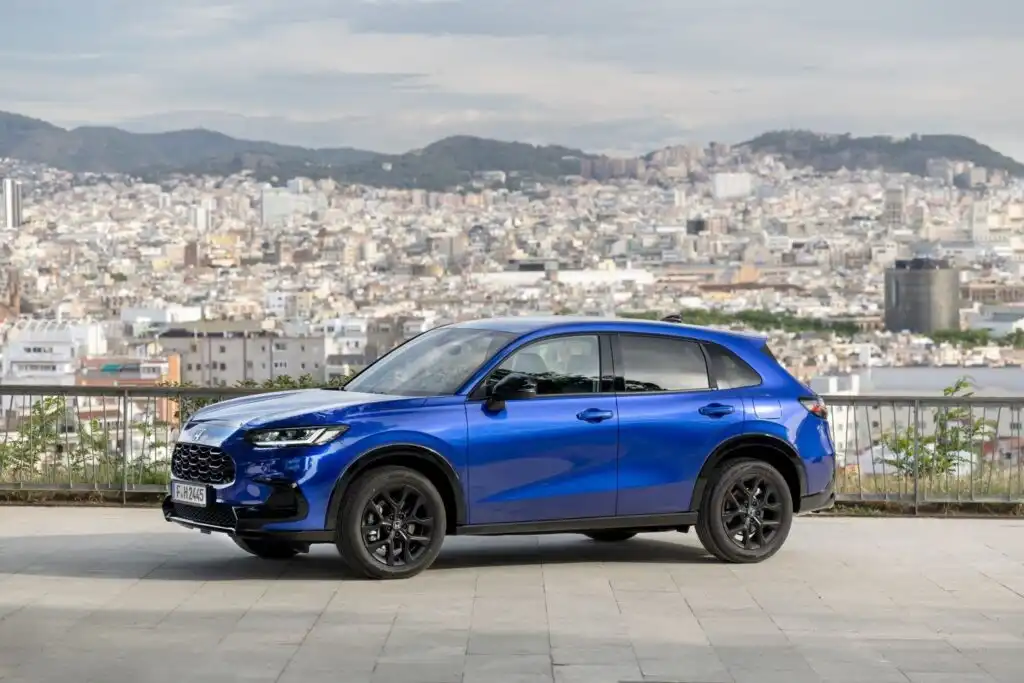
The Honda ZR-V 2.0 e:HEV 4WD e-CVT, launched in April 2023, represents Honda’s entry into the compact crossover SUV segment with a focus on hybrid efficiency and all-weather capability. Positioned as a versatile and technologically advanced option, the ZR-V slots above the HR-V and below the CR-V in Honda’s North American lineup. This particular variant, combining a 2.0-liter inline-four engine with Honda’s e:HEV full hybrid system and an e-CVT transmission, aims to deliver a balance of performance, fuel economy, and refined driving experience. The ZR-V is primarily targeted towards buyers seeking a practical, fuel-efficient, and well-equipped small SUV for daily commuting and family use.
Technical Specifications
| Brand | Honda |
| Model | ZR-V |
| Type (Engine) | 2.0 (184 Hp) e:HEV 4WD e-CVT |
| Start of production | April, 2023 |
| Powertrain Architecture | FHEV (Full Hybrid Electric Vehicle) |
| Body type | SUV, Crossover |
| Seats | 5 |
| Doors | 5 |
| Fuel consumption (urban) | 5.1-5.2 l/100 km (46.1 – 45.2 US mpg) |
| Fuel consumption (extra urban) | 4.7 l/100 km (50 US mpg) |
| Fuel consumption (combined) | 4.6-4.7 l/100 km (51.1 – 50 US mpg) |
| Fuel Type | Petrol (Gasoline) |
| Weight-to-power ratio | 8.8 kg/Hp |
| Weight-to-torque ratio | 5.1 kg/Nm |
| Battery technology | Lithium-ion (Li-Ion) |
| Battery location | Under the rear seats |
| Electric motor power | 184 Hp @ 5000-6000 rpm |
| Electric motor torque | 315 Nm @ 0-2000 rpm (232.33 lb.-ft. @ 0-2000 rpm) |
| Electric motor model/code | H4 |
| System power | 184 Hp @ 5000-6000 rpm |
| System torque | 315 Nm @ 0-2000 rpm (232.33 lb.-ft. @ 0-2000 rpm) |
| Internal combustion engine power | 141 Hp @ 6000 rpm |
| Internal combustion engine torque | 182 Nm @ 4500 rpm (134.24 lb.-ft. @ 4500 rpm) |
| Engine layout | Front, Transverse |
| Engine Model/Code | LFC |
| Engine displacement | 1993 cm3 (121.62 cu. in.) |
| Number of cylinders | 4 |
| Engine configuration | Inline |
| Cylinder Bore | 81 mm (3.19 in.) |
| Piston Stroke | 96.7 mm (3.81 in.) |
| Compression ratio | 13.9:1 |
| Number of valves per cylinder | 4 |
| Fuel injection system | Direct injection |
| Engine aspiration | Naturally aspirated engine |
| Valvetrain | DOHC |
| Engine oil capacity | 4 l (4.23 US qt | 3.52 UK qt) |
| Coolant capacity | 5.72 l (6.04 US qt | 5.03 UK qt) |
| Kerb Weight | 1610-1630 kg (3549.44 – 3593.53 lbs.) |
| Fuel tank capacity | 57 l (15.06 US gal | 12.54 UK gal) |
| Length | 4570 mm (179.92 in.) |
| Width | 1840 mm (72.44 in.) |
| Height | 1620 mm (63.78 in.) |
| Wheelbase | 2655 mm (104.53 in.) |
| Front track | 1590 mm (62.6 in.) |
| Rear track | 1605 mm (63.19 in.) |
| Ride height (ground clearance) | 190 mm (7.48 in.) |
| Minimum turning circle | 11 m (36.09 ft.) |
| Drivetrain Architecture | ICE and electric motor drive front wheels, rear wheels driven via clutch |
| Drive wheel | All wheel drive (4×4) |
| Number of gears | automatic transmission e-CVT |
| Front suspension | Independent type McPherson |
| Rear suspension | Independent multi-link suspension |
| Front brakes | Disc |
| Rear brakes | Disc |
| Steering type | Steering rack and pinion |
| Power steering | Electric Steering |
| Tires size | 225/55 R18 98H |
| Wheel rims size | 7.0J x 18 |
Powertrain & Engine Architecture
The ZR-V 2.0 e:HEV utilizes Honda’s fourth-generation e:HEV system. This system doesn’t rely on traditional gear changes but instead employs a sophisticated power split device (e-CVT) to seamlessly blend power from the 1.993-liter inline-four cylinder engine (LFC) and the electric motor. The engine itself features direct injection and a high 13.9:1 compression ratio, contributing to its efficiency. The electric motor, integrated into the e-CVT, provides instant torque and assists the engine during acceleration. The system intelligently switches between EV-only mode, hybrid mode, and engine-only mode depending on driving conditions and battery charge. The lithium-ion battery, located under the rear seats, provides energy storage for the electric motor. The e-CVT itself isn’t a traditional continuously variable transmission; it’s a planetary gearset that allows for a smooth and efficient transfer of power without fixed gear ratios.
Driving Characteristics
The 184-horsepower combined output of the engine and electric motor delivers adequate performance for everyday driving. While not overtly sporty, the ZR-V offers responsive acceleration, particularly in hybrid mode where the electric motor fills in torque gaps. The e-CVT provides a smooth, linear power delivery, lacking the stepped feel of a conventional automatic transmission. Compared to a manual transmission version (not offered in the US market), the e-CVT prioritizes efficiency and ease of use over driver engagement. The all-wheel-drive system provides enhanced traction in inclement weather, making the ZR-V a confident performer in various conditions. The focus is on a comfortable and refined driving experience rather than outright performance.
Equipment & Trim Levels
The ZR-V 2.0 e:HEV 4WD typically comes well-equipped, even in its base trim. Standard features generally include a touchscreen infotainment system with Apple CarPlay and Android Auto compatibility, Honda Sensing suite of safety and driver-assistance technologies (including adaptive cruise control and lane keeping assist), automatic climate control, and LED headlights. Higher trim levels add features such as leather upholstery, a premium audio system, a power liftgate, and blind-spot monitoring. Interior materials are generally of good quality, with a focus on practicality and durability.
Chassis & Braking
The ZR-V utilizes a MacPherson strut front suspension and a multi-link rear suspension, providing a comfortable ride and predictable handling. The suspension is tuned for everyday use, prioritizing comfort over sporty handling. All-wheel drive is standard, enhancing stability and traction. The braking system consists of disc brakes on all four wheels, providing adequate stopping power. Anti-lock braking system (ABS) and electronic brake-force distribution (EBD) are standard safety features.
Market Reception & Comparison
The Honda ZR-V has been generally well-received by automotive critics, praised for its fuel efficiency, comfortable ride, and spacious interior. Compared to other compact crossovers like the Toyota Corolla Cross and Mazda CX-5, the ZR-V stands out with its standard hybrid powertrain and sophisticated e-CVT transmission. Some reviewers have noted that the engine can be somewhat noisy under hard acceleration. Fuel economy is a key selling point, consistently achieving impressive MPG figures in real-world testing. Reliability is expected to be strong, consistent with Honda’s reputation.
Legacy
The Honda ZR-V represents Honda’s commitment to electrification and fuel efficiency. The e:HEV system, while relatively new to the US market, has proven reliable in other Honda models globally. The ZR-V’s combination of practicality, efficiency, and technology positions it as a strong contender in the competitive compact crossover segment. As the automotive industry continues to shift towards electric and hybrid vehicles, the ZR-V is likely to become a significant model in Honda’s lineup, and its powertrain is expected to remain durable and maintain good resale value in the used car market.
