
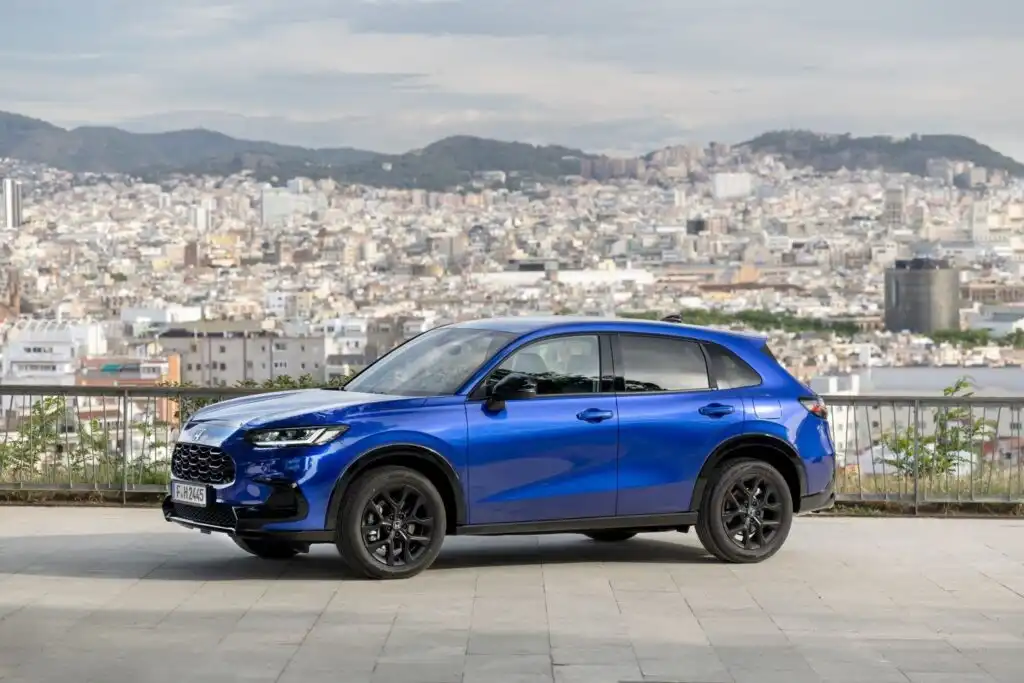
The Honda ZR-V 2.0 e:HEV, launched in April 2023, represents Honda’s entry into the competitive compact crossover SUV segment. Positioned as a technologically advanced and fuel-efficient option, the ZR-V utilizes Honda’s e:HEV full hybrid system. This variant, equipped with a 2.0-liter gasoline engine and an electric motor, delivers a combined system output of 184 horsepower and is exclusively paired with an electronically controlled continuously variable transmission (e-CVT). The ZR-V slots into Honda’s lineup above the HR-V and below the CR-V, offering a balance of practicality, efficiency, and modern features for the North American market.
Technical Specifications
| Brand | Honda |
| Model | ZR-V |
| Generation | ZR-V |
| Type (Engine) | 2.0 (184 Hp) e:HEV e-CVT |
| Start of production | April, 2023 |
| Powertrain Architecture | FHEV (Full Hybrid Electric Vehicle) |
| Body type | SUV, Crossover |
| Seats | 5 |
| Doors | 5 |
| Fuel consumption (urban) | 5.1-5.2 l/100 km (46.1 – 45.2 US mpg) |
| Fuel consumption (extra urban) | 4.6 l/100 km (51.1 US mpg) |
| Fuel consumption (combined) | 4.5 l/100 km (52.3 US mpg) |
| Fuel Type | Petrol (Gasoline) |
| Weight-to-power ratio | 8.5 kg/Hp |
| Weight-to-torque ratio | 5 kg/Nm |
| Battery technology | Lithium-ion (Li-Ion) |
| Battery location | Under the rear seats |
| Electric motor power | 184 Hp @ 5000-6000 rpm |
| Electric motor torque | 315 Nm @ 0-2000 rpm (232.33 lb.-ft. @ 0-2000 rpm) |
| Electric motor model/code | H4 |
| Electric motor location | Integrated into the transmission |
| Electric motor type | Synchronous |
| System power | 184 Hp @ 5000-6000 rpm |
| System torque | 315 Nm @ 0-2000 rpm (232.33 lb.-ft. @ 0-2000 rpm) |
| Internal combustion engine power | 141 Hp @ 6000 rpm |
| Internal combustion engine torque | 182 Nm @ 4500 rpm (134.24 lb.-ft. @ 4500 rpm) |
| Engine layout | Front, Transverse |
| Engine Model/Code | LFC |
| Engine displacement | 1993 cm3 (121.62 cu. in.) |
| Number of cylinders | 4 |
| Engine configuration | Inline |
| Cylinder Bore | 81 mm (3.19 in.) |
| Piston Stroke | 96.7 mm (3.81 in.) |
| Compression ratio | 13.9:1 |
| Number of valves per cylinder | 4 |
| Fuel injection system | Direct injection |
| Engine aspiration | Naturally aspirated engine |
| Valvetrain | DOHC |
| Engine oil capacity | 4 l (4.23 US qt | 3.52 UK qt) |
| Coolant capacity | 5.72 l (6.04 US qt | 5.03 UK qt) |
| Kerb Weight | 1560-1580 kg (3439.21 – 3483.3 lbs.) |
| Fuel tank capacity | 57 l (15.06 US gal | 12.54 UK gal) |
| Length | 4570 mm (179.92 in.) |
| Width | 1840 mm (72.44 in.) |
| Height | 1620 mm (63.78 in.) |
| Wheelbase | 2655 mm (104.53 in.) |
| Front track | 1590 mm (62.6 in.) |
| Rear track | 1605 mm (63.19 in.) |
| Ride height (ground clearance) | 190 mm (7.48 in.) |
| Minimum turning circle | 11 m (36.09 ft.) |
| Drivetrain | Front wheel drive |
| Gearbox | automatic transmission e-CVT |
| Front suspension | Independent type McPherson |
| Rear suspension | Independent multi-link suspension |
| Front brakes | Disc |
| Rear brakes | Disc |
| Tires size | 225/55 R18 98H |
| Wheel rims size | 7.0J x 18 |
INTRODUCTION
The Honda ZR-V 2.0 e:HEV, introduced in 2023, is a compact crossover SUV designed to appeal to buyers seeking a fuel-efficient and technologically advanced vehicle. Built on the Honda Global Small Platform, it shares its underpinnings with the Honda Civic. The ZR-V aims to bridge the gap between the subcompact HR-V and the larger CR-V, offering a more spacious and refined experience than the HR-V while remaining more accessible than the CR-V. The e:HEV powertrain is central to the ZR-V’s appeal, providing a blend of gasoline engine efficiency and electric motor responsiveness.
Powertrain & Engine Architecture
The ZR-V 2.0 e:HEV utilizes Honda’s fourth-generation e:HEV system. The core of the powertrain is a 2.0-liter, naturally aspirated inline-four cylinder engine (code LFC) producing 141 horsepower and 134 lb-ft of torque. This engine operates on the Atkinson cycle, prioritizing fuel efficiency over outright power. The engine is paired with two electric motors – a propulsion motor and a generator motor – integrated into a single unit. The system intelligently switches between electric, hybrid, and engine power modes depending on driving conditions. The e-CVT (electronically controlled continuously variable transmission) doesn’t have traditional gears; instead, it uses a planetary gearset to seamlessly blend power from the engine and electric motors. The lithium-ion battery, located under the rear seats, provides energy storage for the electric motors. The system prioritizes electric drive at lower speeds and during light loads, switching to hybrid mode for increased acceleration and engine operation for highway cruising.
Driving Characteristics
The ZR-V 2.0 e:HEV delivers a smooth and refined driving experience. The e-CVT provides seamless acceleration, eliminating the stepped gear changes of a traditional automatic transmission. While the combined system output of 184 horsepower is adequate for everyday driving, it doesn’t offer the brisk acceleration of some competitors with turbocharged engines. The electric motors provide instant torque, making the ZR-V feel responsive in city driving. The hybrid system contributes to excellent fuel economy, particularly in urban environments. The ZR-V’s suspension is tuned for comfort, providing a compliant ride over most road surfaces. Compared to a hypothetical ZR-V with a conventional automatic transmission and the same 2.0-liter engine, the e-CVT version offers improved fuel efficiency and a smoother driving experience, albeit with a slightly less engaging feel.
Equipment & Trim Levels
The ZR-V 2.0 e:HEV typically comes well-equipped, even in its base trim. Standard features generally include a 7-inch touchscreen infotainment system with Apple CarPlay and Android Auto compatibility, Honda Sensing suite of safety and driver-assistance technologies (including adaptive cruise control and lane-keeping assist), automatic climate control, and LED headlights. Higher trim levels add features such as a larger 9-inch touchscreen, wireless phone charging, a premium audio system, leather upholstery, and a power liftgate. Interior upholstery is typically cloth in lower trims and leather in higher trims. Dashboard configurations are modern and minimalist, with a focus on ease of use.
Chassis & Braking
The ZR-V utilizes a MacPherson strut front suspension and a multi-link rear suspension, providing a comfortable and controlled ride. The chassis is designed to minimize weight and maximize rigidity. All ZR-V models are equipped with disc brakes on all four wheels, providing ample stopping power. Anti-lock braking system (ABS) and electronic brake-force distribution (EBD) are standard features. The ZR-V’s steering is electric power-assisted, offering light and precise control. Stabilizer bars are fitted to both the front and rear suspension to reduce body roll during cornering.
Market Reception & Comparison
The Honda ZR-V 2.0 e:HEV has been generally well-received by automotive critics, who praise its fuel efficiency, comfortable ride, and spacious interior. Some reviewers have noted that the engine can feel underpowered during aggressive acceleration. Compared to other compact crossovers, the ZR-V stands out with its standard hybrid powertrain and Honda’s reputation for reliability. Fuel economy figures consistently rank among the best in its class. The ZR-V’s pricing is competitive, positioning it as a value-oriented option within the segment.
Legacy
The long-term reliability of the ZR-V’s e:HEV powertrain remains to be fully established, but Honda’s hybrid systems have a strong track record of durability. The e-CVT transmission is known for its smooth operation and relatively low maintenance requirements. As the ZR-V enters the used car market, it is expected to hold its value well due to its fuel efficiency and Honda’s brand reputation. The ZR-V represents Honda’s commitment to electrification and its continued focus on providing practical and efficient vehicles for everyday drivers.
