
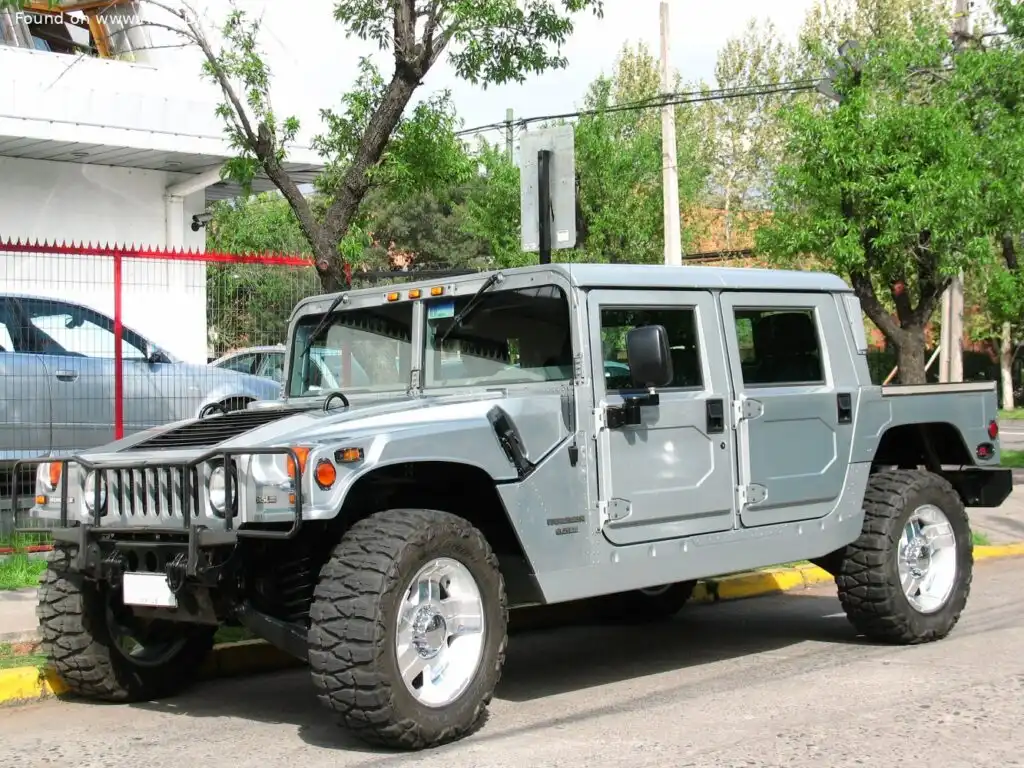
The Hummer H1, specifically the 5.7 V8 (193 Hp) 4×4 Automatic variant produced between 1995 and 1997, represents the initial civilian iteration of the High Mobility Multipurpose Wheeled Vehicle (HMMWV), originally developed for military use. This model marked a significant departure from conventional civilian vehicles, offering unparalleled off-road capability and a distinctive, imposing presence. The H1 I generation, as it’s often designated, laid the foundation for the Hummer brand’s subsequent expansion into the consumer market, establishing a niche for itself as a luxury off-roader. It was a bold statement, and a direct descendant of a vehicle designed for the rigors of combat, adapted – and somewhat softened – for civilian life.
Technical Specifications
| Brand | Hummer |
| Model | H1 |
| Generation | H1 I |
| Type (Engine) | 5.7 V8 (193 Hp) 4×4 Automatic |
| Start of production | 1995 |
| End of production | 1997 |
| Powertrain Architecture | Internal Combustion engine |
| Body type | Off-road vehicle |
| Seats | 4 |
| Doors | 4 |
| Fuel Type | Petrol (Gasoline) |
| Maximum speed | 134 km/h (83.26 mph) |
| Weight-to-power ratio | 16.3 kg/Hp, 61.5 Hp/tonne |
| Weight-to-torque ratio | 7 kg/Nm, 143.3 Nm/tonne |
| Power | 193 Hp @ 4000 rpm |
| Power per litre | 33.7 Hp/l |
| Torque | 450 Nm @ 2400 rpm (331.9 lb.-ft. @ 2400 rpm) |
| Engine layout | Front, Longitudinal |
| Engine displacement | 5733 cm3 (349.85 cu. in.) |
| Number of cylinders | 8 |
| Engine configuration | V-engine |
| Cylinder Bore | 101.6 mm (4 in.) |
| Piston Stroke | 88.39 mm (3.48 in.) |
| Number of valves per cylinder | 2 |
| Fuel injection system | Multi-port manifold injection |
| Engine aspiration | Naturally aspirated engine |
| Kerb Weight | 3140 kg (6922.52 lbs.) |
| Fuel tank capacity | 160 l (42.27 US gal | 35.2 UK gal) |
| Length | 4686 mm (184.49 in.) |
| Width | 2197 mm (86.5 in.) |
| Height | 1905 mm (75 in.) |
| Wheelbase | 3302 mm (130 in.) |
| Front track | 1819 mm (71.61 in.) |
| Rear track | 1819 mm (71.61 in.) |
| Ride height (ground clearance) | 406 mm (15.98 in.) |
| Drag coefficient (Cd) | 0.7 |
| Minimum turning circle | 16.2 m (53.15 ft.) |
| Approach angle | 72° |
| Departure angle | 37.5° |
| Ramp-over angle | 29° |
| Drive wheel | All wheel drive (4×4) |
| Number of gears | 4 |
| Gearbox type | automatic transmission |
| Front brakes | Ventilated discs |
| Rear brakes | Ventilated discs |
Powertrain & Engine Architecture
The 1995-1997 Hummer H1 was powered by a 5.7-liter (349.85 cubic inch) Chevrolet small-block V8 engine. This engine, internally designated as the L05, produced 193 horsepower at 4000 rpm and 331.9 lb-ft of torque at 2400 rpm. It featured a cast iron block and cylinder heads, a two-bolt main bearing cap design, and a hydraulic lifter camshaft. Fuel delivery was managed by a multi-port fuel injection system. The engine’s longitudinal mounting and robust construction were essential for handling the demands of off-road driving and the vehicle’s substantial weight. The H1 utilized a 4-speed automatic transmission (likely a 4L60E) chosen for its durability and relative simplicity, prioritizing reliability over outright performance. While not the most technologically advanced transmission of the era, it was well-suited to the engine’s torque characteristics and the intended application.
Driving Characteristics
The H1’s driving experience was unique, to say the least. The combination of the 5.7L V8 and the 4-speed automatic resulted in adequate, but not exhilarating, acceleration. The vehicle’s immense weight (over 6,900 lbs) significantly impacted its responsiveness. The automatic transmission, while reliable, had relatively wide gear ratios, meaning the engine often operated at higher RPMs during highway cruising. Off-road, however, the H1 truly excelled. The four-wheel drive system, coupled with its high ground clearance and impressive approach/departure angles, allowed it to traverse terrain that was impassable for most other vehicles. The steering, while somewhat vague, provided sufficient control, and the robust suspension absorbed impacts effectively. Compared to potential upgrades like a diesel engine, the V8 offered a more familiar driving experience for American consumers, but at the cost of fuel economy.
Equipment & Trim Levels
The early H1s were relatively spartan in terms of luxury features, reflecting their military origins. Standard equipment included air conditioning, power windows and locks, and basic cloth upholstery. The interior was functional rather than opulent. Options included leather upholstery, upgraded sound systems, and a rear bench seat, increasing passenger capacity to five. The H1 did not offer a wide range of trim levels; customization was largely limited to optional accessories and aftermarket modifications. The focus was on capability and durability, rather than lavish appointments.
Chassis & Braking
The H1’s chassis was a heavy-duty, body-on-frame construction, designed to withstand extreme stresses. It featured a solid front and rear axle, providing exceptional strength and articulation. The suspension utilized leaf springs in the rear and coil springs in the front. Braking was accomplished via ventilated disc brakes on all four wheels, providing adequate stopping power considering the vehicle’s weight. However, the H1’s high center of gravity and substantial mass meant that braking distances were considerably longer than those of more conventional vehicles.
Market Reception & Comparison
The Hummer H1 was met with a mixture of fascination and skepticism upon its release. Critics acknowledged its unparalleled off-road capability but questioned its practicality and fuel economy. The V8 engine, while providing sufficient power, was criticized for its thirst for gasoline. Compared to other large SUVs of the time, the H1 was significantly more expensive and less refined. However, its unique appeal and distinctive styling attracted a dedicated following, particularly among those who valued off-road performance and a bold statement. The H1’s target audience was not the average commuter; it was aimed at enthusiasts and those seeking a vehicle that could handle virtually any terrain.
Legacy
The 1995-1997 Hummer H1, with its 5.7L V8 and automatic transmission, holds a significant place in automotive history. It established the Hummer brand and paved the way for the H2 and H3 models. While the early H1s were relatively simple machines, they were exceptionally durable and capable. Today, they are highly sought after by collectors and off-road enthusiasts. The 5.7L V8, while not known for its fuel efficiency, is generally considered a reliable engine, and parts availability is reasonably good. The H1’s enduring appeal lies in its unique combination of military heritage, off-road prowess, and distinctive styling. It remains a symbol of rugged individualism and a testament to American automotive engineering.
