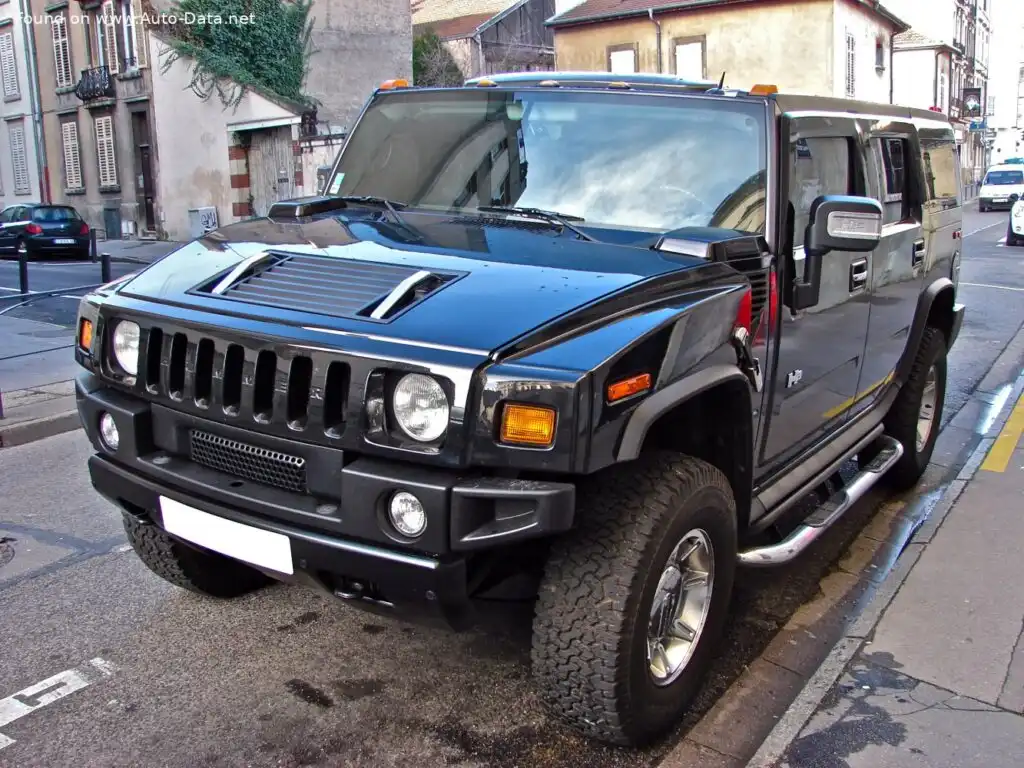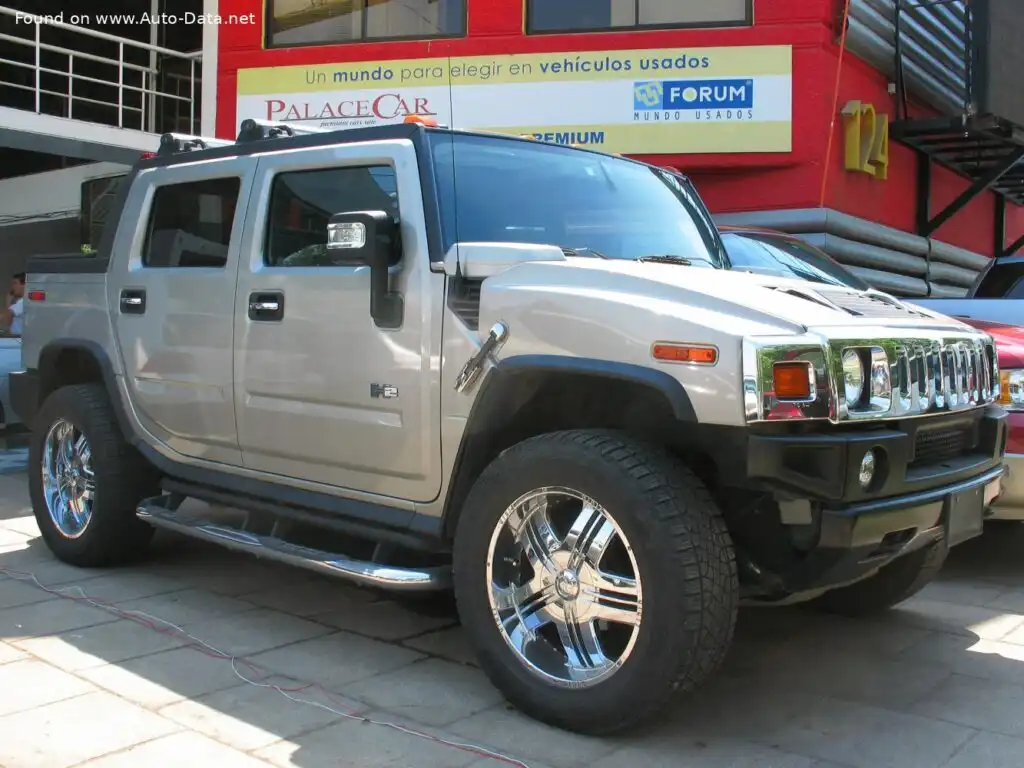
The Hummer H2 SUT 6.0i V8, produced from 2004 to 2007, represented a unique offering in the burgeoning SUV market. As a Sport Utility Truck (SUT), it combined the off-road capability and bold styling of the H2 SUV with the practicality of a pickup truck bed. Positioned as a premium, luxury-oriented vehicle, the H2 SUT aimed to appeal to buyers seeking a statement vehicle capable of both on-road comfort and off-road adventures. It was built on a modified version of the GMT825 platform, shared with Chevrolet and GMC trucks, but heavily modified to provide Hummer’s signature high ground clearance and robust four-wheel-drive system. This variant, equipped with the 6.0-liter V8 engine and a four-speed automatic transmission, was the standard powertrain offering for the SUT model.
Technical Specifications
| Brand | Hummer |
| Model | H2 |
| Generation | H2 SUT |
| Type (Engine) | 6.0i V8 (329 Hp) 4×4 Automatic |
| Start of production | 2004 |
| End of production | 2007 |
| Powertrain Architecture | Internal Combustion engine |
| Body type | Off-road vehicle, Pick-up |
| Seats | 4 |
| Doors | 4 |
| Fuel consumption (urban) | 30 l/100 km (7.8 US mpg, 9.4 UK mpg, 3.3 km/l) |
| Fuel consumption (extra urban) | 15 l/100 km (15.7 US mpg, 18.8 UK mpg, 6.7 km/l) |
| Fuel consumption (combined) | 22 l/100 km (10.7 US mpg, 12.8 UK mpg, 4.5 km/l) |
| Fuel Type | Petrol (Gasoline) |
| Maximum speed | 158 km/h (98.18 mph) |
| Weight-to-power ratio | 8.8 kg/Hp, 113.1 Hp/tonne |
| Weight-to-torque ratio | 5.9 kg/Nm, 169.8 Nm/tonne |
| Power | 329 Hp @ 5200 rpm |
| Power per litre | 55.1 Hp/l |
| Torque | 494 Nm @ 4000 rpm (364.36 lb.-ft. @ 4000 rpm) |
| Engine layout | Front, Longitudinal |
| Engine Model/Code | LQ4 |
| Engine displacement | 5967 cm3 (364.13 cu. in.) |
| Number of cylinders | 8 |
| Engine configuration | V-engine |
| Cylinder Bore | 101.6 mm (4 in.) |
| Piston Stroke | 92 mm (3.62 in.) |
| Compression ratio | 9.4:1 |
| Number of valves per cylinder | 2 |
| Fuel injection system | Multi-port manifold injection |
| Engine aspiration | Naturally aspirated engine |
| Valvetrain | OHV |
| Engine oil capacity | 5.7 l (6.02 US qt | 5.02 UK qt) |
| Coolant | 16.3 l (17.22 US qt | 14.34 UK qt) |
| Kerb Weight | 2909 kg (6413.25 lbs.) |
| Max. weight | 3901 kg (8600.23 lbs.) |
| Max load | 992 kg (2186.99 lbs.) |
| Trunk (boot) space – minimum | 623 l (22 cu. ft.) |
| Trunk (boot) space – maximum | 1492 l (52.69 cu. ft.) |
| Fuel tank capacity | 121 l (31.96 US gal | 26.62 UK gal) |
| Length | 5170 mm (203.54 in.) |
| Width | 2063 mm (81.22 in.) |
| Height | 2080 mm (81.89 in.) |
| Wheelbase | 3118 mm (122.76 in.) |
| Front track | 1763 mm (69.41 in.) |
| Rear (Back) track | 1763 mm (69.41 in.) |
| Ride height (ground clearance) | 255 mm (10.04 in.) |
| Drag coefficient (Cd) | 0.6 |
| Minimum turning circle (turning diameter) | 13.2 m (43.31 ft.) |
| Approach angle | 40.4° |
| Departure angle | 36.5° |
| Ramp-over (brakeover) angle | 25.8° |
| Drive wheel | All wheel drive (4×4) |
| Number of gears and type of gearbox | 4 gears, automatic transmission |
| Front suspension | Torsion |
| Rear suspension | Rigid axle suspension |
| Front brakes | Ventilated discs |
| Rear brakes | Ventilated discs |
| Assisting systems | ABS (Anti-lock braking system) |
| Tires size | 315/70 R17 |
| Wheel rims size | 17 |
Powertrain & Engine Architecture
The heart of the H2 SUT 6.0i was the LQ4, a 5.967-liter (364 cubic inch) V8 engine. This engine, part of General Motors’ Vortec family, featured cast iron block and aluminum cylinder heads. It utilized a traditional overhead valve (OHV) valvetrain with two valves per cylinder. Fuel delivery was managed by a multi-port fuel injection system, providing adequate, though not cutting-edge, performance. The engine produced 329 horsepower at 5200 rpm and 494 lb-ft of torque at 4000 rpm. The four-speed automatic transmission (4L60-E) was chosen for its durability and ability to handle the engine’s torque output. While not known for its fuel efficiency, the transmission provided smooth shifts and adequate performance for everyday driving and towing. The transmission was electronically controlled, adapting shift points based on throttle position and vehicle speed.
Driving Characteristics
The H2 SUT 6.0i offered a driving experience that prioritized comfort and capability over outright sportiness. The 6.0-liter V8 provided ample low-end torque, making it well-suited for towing and off-road driving. Acceleration was adequate, but the vehicle’s substantial weight (over 6,400 pounds) limited its responsiveness. The four-speed automatic transmission, while reliable, lacked the efficiency and responsiveness of more modern transmissions with additional gears. Compared to potential upgrades like a diesel engine, the 6.0L V8 offered a more refined and quieter driving experience, but at the cost of fuel economy. The SUT’s suspension, while designed for off-road use, provided a relatively comfortable ride on paved roads, though body roll was noticeable during cornering.
Equipment & Trim Levels
The H2 SUT 6.0i came standard with a relatively high level of equipment, reflecting its premium positioning. Standard features included leather upholstery, power-adjustable front seats, automatic climate control, a premium sound system, and alloy wheels. Optional extras included a sunroof, navigation system, upgraded audio, and various off-road accessories such as a winch and skid plates. The interior design was robust and functional, with large, easy-to-use controls. The SUT’s unique feature was, of course, the pickup bed, which offered a decent amount of cargo space and could be equipped with a bed liner and tie-down points.
Chassis & Braking
The H2 SUT’s chassis was a body-on-frame construction, providing a robust foundation for off-road use. The front suspension utilized a torsion bar setup, while the rear featured a solid axle with leaf springs. This configuration provided good articulation for off-road driving, but could result in a somewhat bumpy ride on uneven surfaces. Braking duties were handled by ventilated disc brakes on all four wheels, assisted by an anti-lock braking system (ABS). The large tires (315/70 R17) provided good grip on various surfaces, but also contributed to the vehicle’s substantial weight and rolling resistance.
Market Reception & Comparison
The Hummer H2 SUT received mixed reviews from automotive critics. While praised for its bold styling, off-road capability, and comfortable interior, it was often criticized for its poor fuel economy, cumbersome size, and relatively high price. Compared to other full-size SUVs of the time, the H2 SUT offered a more distinctive and rugged image, but at a significant premium. The 6.0-liter V8 engine provided adequate power, but its fuel consumption was considerably higher than that of smaller, more efficient engines. Reliability was generally considered average, with some owners reporting issues with the electrical system and various mechanical components.
Legacy
The Hummer H2 SUT, while short-lived, left a lasting impression on the automotive landscape. It represented a unique blend of luxury, capability, and bold styling. Today, the H2 SUT is a sought-after vehicle among collectors and enthusiasts, particularly those who appreciate its distinctive design and off-road prowess. The 6.0-liter V8 engine and 4L60-E transmission are generally considered reliable, but require regular maintenance to ensure longevity. Parts availability is generally good, though some components may be becoming increasingly difficult to find. The H2 SUT remains a symbol of a bygone era, when large, powerful SUVs were at the peak of their popularity.