
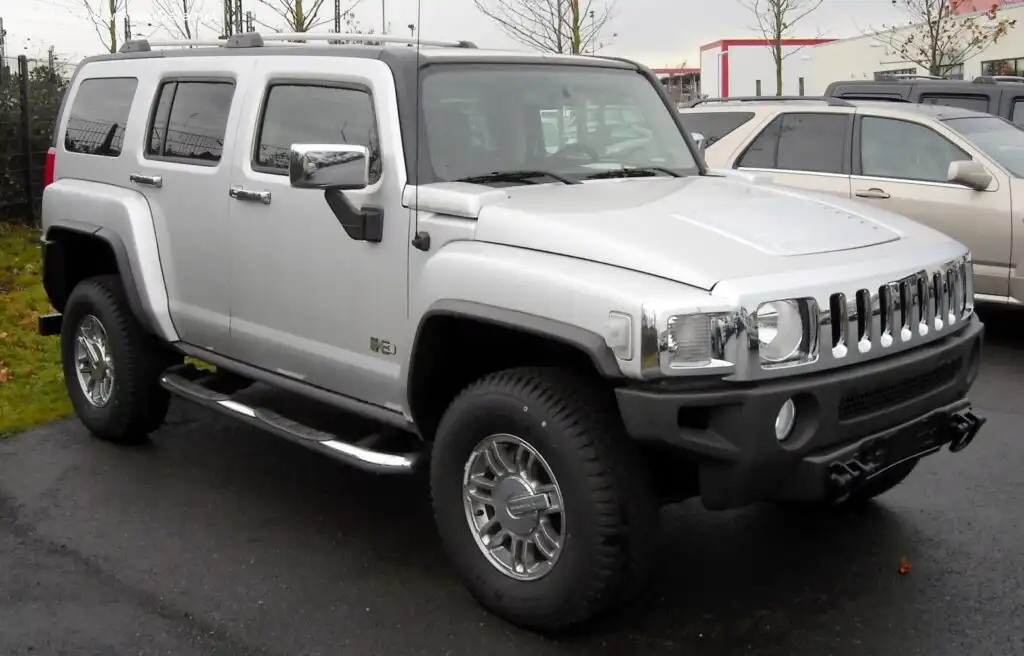
The Hummer H3 3.5i 20V, produced from 2005 to 2007, represented General Motors’ attempt to capture a segment of the off-road SUV market with a more manageable and fuel-efficient vehicle than the larger H1 and H2. Positioned as the entry-level model within the H3 lineup, the 3.5i offered a balance between capability and affordability. It was designed to appeal to buyers seeking the Hummer brand’s rugged image without the substantial size and running costs of its predecessors. The H3 was built on a modified version of the GM Colorado/Canyon mid-size truck platform, marking a significant departure from the previous Hummer models’ unique chassis designs.
Technical Specifications
| Brand | Hummer |
| Model | H3 |
| Generation | H3 |
| Type (Engine) | 3.5i 20V (223 Hp) 4×4 |
| Start of production | 2005 |
| End of production | 2007 |
| Powertrain Architecture | Internal Combustion engine |
| Body type | Off-road vehicle, SUV |
| Seats | 5 |
| Doors | 5 |
| Fuel consumption (urban) | 14.7 l/100 km (16 US mpg, 19.2 UK mpg, 6.8 km/l) |
| Fuel consumption (extra urban) | 11.8 l/100 km (19.9 US mpg, 23.9 UK mpg, 8.5 km/l) |
| Fuel consumption (combined) | 13.8 l/100 km (17 US mpg, 20.5 UK mpg, 7.2 km/l) |
| Fuel Type | Petrol (Gasoline) |
| Maximum speed | 158 km/h (98.18 mph) |
| Weight-to-power ratio | 9.6 kg/Hp, 104.6 Hp/tonne |
| Weight-to-torque ratio | 7 kg/Nm, 143.1 Nm/tonne |
| Power | 223 Hp @ 5600 rpm |
| Power per litre | 64.5 Hp/l |
| Torque | 305 Nm @ 2800 rpm (224.96 lb.-ft. @ 2800 rpm) |
| Maximum engine speed | 6300 rpm |
| Engine layout | Front, Longitudinal |
| Engine Model/Code | L52 |
| Engine displacement | 3460 cm3 (211.14 cu. in.) |
| Number of cylinders | 5 |
| Engine configuration | Inline |
| Cylinder Bore | 93 mm (3.66 in.) |
| Piston Stroke | 102 mm (4.02 in.) |
| Compression ratio | 10:1 |
| Number of valves per cylinder | 4 |
| Fuel injection system | Multi-port manifold injection |
| Engine aspiration | Naturally aspirated engine |
| Valvetrain | DOHC |
| Engine oil capacity | 5.7 l (6.02 US qt | 5.02 UK qt) |
| Coolant | 9.5 l (10.04 US qt | 8.36 UK qt) |
| Kerb Weight | 2132 kg (4700.26 lbs.) |
| Max. weight | 2654 kg (5851.07 lbs.) |
| Max load | 522 kg (1150.81 lbs.) |
| Trunk (boot) space – minimum | 835 l (29.49 cu. ft.) |
| Trunk (boot) space – maximum | 1575 l (55.62 cu. ft.) |
| Fuel tank capacity | 87 l (22.98 US gal | 19.14 UK gal) |
| Length | 4742 mm (186.69 in.) |
| Width | 1897 mm (74.69 in.) |
| Height | 1872 mm (73.7 in.) |
| Wheelbase | 2842 mm (111.89 in.) |
| Front track | 1651 mm (65 in.) |
| Rear (Back) track | 1664 mm (65.51 in.) |
| Ride height (ground clearance) | 216 mm (8.5 in.) |
| Drag coefficient (Cd) | 0.55 |
| Minimum turning circle (turning diameter) | 11.3 m (37.07 ft.) |
| Drive wheel | All wheel drive (4×4) |
| Number of gears and type of gearbox | 5 gears, manual transmission |
| Front suspension | Torsion |
| Rear suspension | Leaf spring |
| Front brakes | Ventilated discs |
| Rear brakes | Disc |
| Assisting systems | ABS (Anti-lock braking system) |
| Tires size | 265/75 R16 |
| Wheel rims size | 16 |
Powertrain & Engine Architecture
The H3 3.5i was powered by the L52, a 3.5-liter inline-five cylinder engine. This engine was part of GM’s Atlas family of engines, known for its robust construction and relatively simple design. The L52 featured a cast iron block and aluminum cylinder heads, incorporating a double overhead camshaft (DOHC) valvetrain with four valves per cylinder. Fuel delivery was handled by a multi-port fuel injection system. The engine produced 223 horsepower at 5600 rpm and 225 lb-ft of torque at 2800 rpm. The five-speed manual transmission was the standard offering, providing direct control over the engine’s power. The engine’s longitudinal mounting allowed for a traditional front-engine, rear-wheel-drive layout with four-wheel drive capability.
Driving Characteristics
The 3.5i with the manual transmission offered adequate performance for everyday driving, but it wasn’t particularly quick. Acceleration was reasonable, but the engine felt strained at higher speeds. The five-speed manual transmission provided a decent spread of gears, allowing drivers to keep the engine in its optimal power band. Compared to the optional 5.3-liter V8 engine available in other H3 trims, the 3.5i felt noticeably less powerful. However, the 3.5i’s lighter weight and more balanced chassis contributed to better handling and a more comfortable ride on paved roads. The 4×4 system provided good traction in off-road situations, but the H3’s relatively long wheelbase limited its maneuverability in tight trails.
Equipment & Trim Levels
The base H3 3.5i came standard with features such as air conditioning, power windows and locks, and an AM/FM stereo. Interior upholstery was typically cloth, and the dashboard featured a straightforward layout with easy-to-read gauges. Optional extras included a premium sound system, leather upholstery, sunroof, and upgraded off-road packages with features like skid plates and heavy-duty suspension components. The H3’s interior, while functional, was criticized for its use of low-quality plastics and somewhat dated design.
Chassis & Braking
The H3’s chassis was based on a modified version of the GM Colorado/Canyon mid-size truck platform. It featured a torsion bar front suspension and a leaf spring rear suspension. The front suspension provided a comfortable ride on paved roads, while the leaf spring rear suspension was designed to handle heavier loads and provide good off-road capability. Braking duties were handled by ventilated discs at the front and solid discs at the rear. Anti-lock brakes (ABS) were standard. The H3’s relatively high center of gravity and body-on-frame construction contributed to noticeable body roll during cornering.
Market Reception & Comparison
The H3 3.5i was generally well-received by critics as a more accessible and practical alternative to the larger H1 and H2. However, its fuel economy was a common complaint, averaging around 17 mpg in combined driving. Compared to other SUVs in its class, the H3 3.5i offered a unique combination of off-road capability and rugged styling. The V8-powered H3 models offered significantly more performance, but at the cost of increased fuel consumption and a higher price tag. The 3.5i appealed to buyers who prioritized fuel efficiency and affordability over outright power.
Legacy
The Hummer H3, including the 3.5i variant, has developed a modest following among enthusiasts. The L52 engine is generally considered to be reliable, although regular maintenance is essential. Common issues include oil leaks and sensor failures. The H3’s body-on-frame construction and robust drivetrain make it a capable off-road vehicle, and its unique styling continues to attract attention. On the used car market, the H3 3.5i is relatively affordable, making it an attractive option for buyers seeking a rugged and distinctive SUV. However, potential buyers should be aware of the H3’s relatively poor fuel economy and dated interior.
