
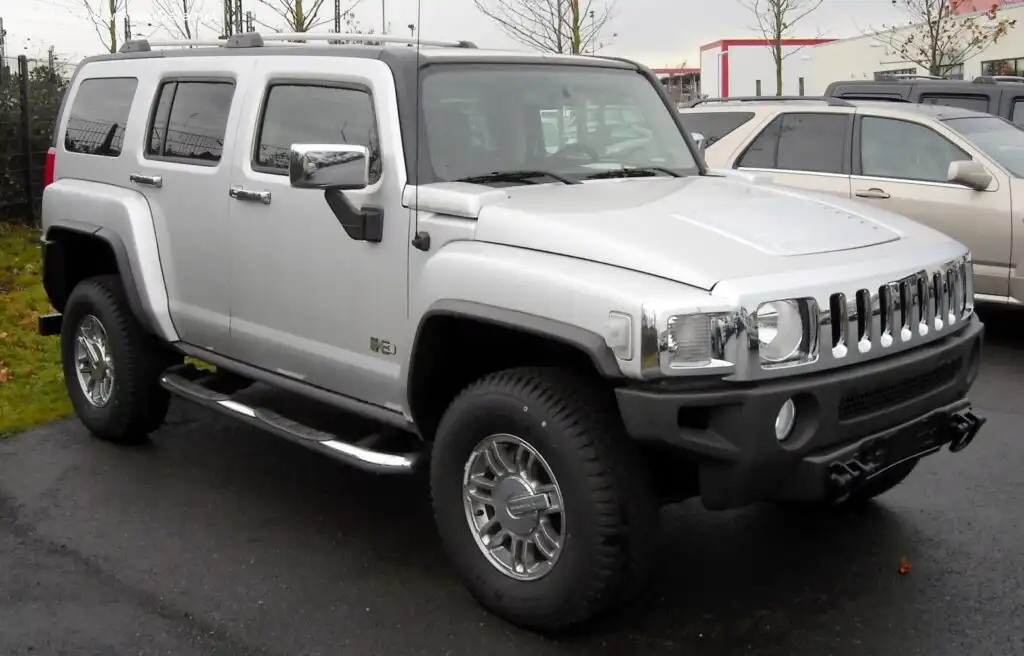
The Hummer H3 3.7i 20V, produced from 2006 to 2009, represented a significant downsize and repositioning of the Hummer brand. Following General Motors’ acquisition of Hummer, the H3 was intended to be a more accessible and fuel-efficient offering compared to the larger H1 and H2 models. Built on a modified version of the GM Colorado/Canyon mid-size truck platform, the H3 aimed to retain the brand’s rugged image while appealing to a broader customer base. The 3.7i variant, equipped with the 3.7-liter inline-five engine and a four-speed automatic transmission, served as a core model within the H3 lineup, balancing capability with relative affordability.
Technical Specifications
| Brand | Hummer |
| Model | H3 |
| Generation | H3 |
| Type | 3.7i 20V (245 Hp) 4×4 Automatic |
| Start of production | 2006 |
| End of production | 2009 |
| Powertrain Architecture | Internal Combustion engine |
| Body type | Off-road vehicle, SUV |
| Seats | 5 |
| Doors | 5 |
| Fuel consumption (urban) | 15.7 l/100 km (15 US mpg, 18 UK mpg, 6.4 km/l) |
| Fuel consumption (extra urban) | 12.4 l/100 km (19 US mpg, 22.8 UK mpg, 8.1 km/l) |
| Fuel consumption (combined) | 13.8 l/100 km (17 US mpg, 20.5 UK mpg, 7.2 km/l) |
| Fuel Type | Petrol (Gasoline) |
| Maximum speed | 158 km/h (98.18 mph) |
| Weight-to-power ratio | 8.7 kg/Hp, 114.9 Hp/tonne |
| Weight-to-torque ratio | 6.5 kg/Nm, 153.8 Nm/tonne |
| Power | 245 Hp @ 5600 rpm |
| Power per litre | 67.1 Hp/l |
| Torque | 328 Nm @ 4600 rpm (241.92 lb.-ft. @ 4600 rpm) |
| Maximum engine speed | 6300 rpm |
| Engine layout | Front, Longitudinal |
| Engine Model/Code | LLR |
| Engine displacement | 3653 cm3 (222.92 cu. in.) |
| Number of cylinders | 5 |
| Engine configuration | Inline |
| Cylinder Bore | 95.5 mm (3.76 in.) |
| Piston Stroke | 102 mm (4.02 in.) |
| Compression ratio | 10:1 |
| Number of valves per cylinder | 4 |
| Fuel injection system | Multi-port manifold injection |
| Engine aspiration | Naturally aspirated engine |
| Valvetrain | DOHC, CVVT |
| Engine oil capacity | 5.7 l (6.02 US qt | 5.02 UK qt) |
| Coolant capacity | 9.5 l (10.04 US qt | 8.36 UK qt) |
| Kerb Weight | 2132 kg (4700.26 lbs.) |
| Max. weight | 2654 kg (5851.07 lbs.) |
| Max load | 522 kg (1150.81 lbs.) |
| Trunk (boot) space – minimum | 835 l (29.49 cu. ft.) |
| Trunk (boot) space – maximum | 1575 l (55.62 cu. ft.) |
| Fuel tank capacity | 87 l (22.98 US gal | 19.14 UK gal) |
| Length | 4742 mm (186.69 in.) |
| Width | 1897 mm (74.69 in.) |
| Height | 1872 mm (73.7 in.) |
| Wheelbase | 2842 mm (111.89 in.) |
| Front track | 1651 mm (65 in.) |
| Rear track | 1664 mm (65.51 in.) |
| Ride height (ground clearance) | 216 mm (8.5 in.) |
| Drag coefficient (Cd) | 0.55 |
| Minimum turning circle | 11.3 m (37.07 ft.) |
| Drive wheel | All wheel drive (4×4) |
| Number of gears | 4 |
| Gearbox type | automatic transmission |
| Front suspension | Torsion |
| Rear suspension | Leaf spring |
| Front brakes | Ventilated discs |
| Rear brakes | Disc |
| Assisting systems | ABS (Anti-lock braking system) |
| Tires size | 265/75 R16 |
| Wheel rims size | 16 |
Powertrain & Engine Architecture
The heart of the H3 3.7i was the LLR 3.7-liter inline-five engine. This engine, part of GM’s Atlas family, was notable for its unusual configuration. It featured a cast iron block, aluminum cylinder heads, and dual overhead camshafts (DOHC) with variable valve timing (CVVT) on both intake and exhaust valves. The multi-port fuel injection system delivered fuel directly to each cylinder. The engine produced 245 horsepower at 5600 rpm and 328 lb-ft of torque at 4600 rpm. This output was considered adequate for the H3’s weight, but not particularly strong compared to some of its V6-powered competitors. The engine was mated to a four-speed automatic transmission, a somewhat dated design by the mid-2000s, but chosen for its durability and cost-effectiveness. The transmission’s gear ratios were optimized for low-end torque, aiding in off-road situations, but at the expense of high-speed acceleration.
Driving Characteristics
The H3 3.7i Automatic offered a comfortable, if not particularly sporty, driving experience. The four-speed automatic transmission, while reliable, lacked the responsiveness of more modern transmissions with additional gears. Acceleration was adequate for everyday driving, but passing maneuvers required planning. The inline-five engine delivered a distinctive sound and a broad torque curve, making it well-suited for off-road crawling and navigating challenging terrain. The automatic transmission’s shift points were programmed to prioritize fuel economy and smooth operation, sometimes feeling hesitant during aggressive driving. Compared to the manual transmission-equipped H3s, the automatic version felt noticeably slower and less engaging. The H3’s off-road capabilities were its strong suit, with the 4×4 system providing ample traction in various conditions.
Equipment & Trim Levels
The H3 3.7i typically came standard with features such as air conditioning, power windows and locks, a CD player, and basic cloth upholstery. Higher trim levels, such as the Adventure and Alpha packages, added features like leather seats, upgraded audio systems, automatic climate control, and a sunroof. Optional extras included a navigation system, premium sound systems, and various off-road accessories like skid plates and tow hooks. The interior design was functional and rugged, reflecting the H3’s off-road focus. The dashboard layout was straightforward, with large, easy-to-read gauges. The rear seats offered decent legroom, but the overall interior space was somewhat limited compared to larger SUVs.
Chassis & Braking
The H3’s chassis was based on a modified version of the GM mid-size truck platform, featuring a body-on-frame construction. The front suspension utilized torsion bars, while the rear suspension employed leaf springs. This setup provided a comfortable ride on paved roads, but also allowed for significant wheel articulation off-road. The H3 3.7i came equipped with ventilated disc brakes at the front and solid discs at the rear. An anti-lock braking system (ABS) was standard. The H3’s relatively heavy weight and modest braking power meant that stopping distances were longer than those of some competitors. The standard tire size was 265/75R16, providing a good balance of on-road comfort and off-road traction.
Market Reception & Comparison
The Hummer H3 3.7i received mixed reviews from automotive critics. While its off-road capabilities and distinctive styling were praised, its fuel economy and somewhat dated four-speed automatic transmission were often criticized. Compared to the H3’s other engine options, such as the 5.3-liter V8, the 3.7-liter inline-five offered significantly lower performance but better fuel economy. The 3.7i was positioned as the entry-level H3, appealing to buyers who prioritized affordability and fuel efficiency over outright power. Its fuel economy, averaging around 17 mpg combined, was still relatively poor compared to other SUVs in its class. Reliability was generally considered average, with some reports of minor issues with the engine and transmission.
Legacy
The Hummer H3 3.7i, despite its relatively short production run, has developed a following among off-road enthusiasts and Hummer fans. The LLR inline-five engine, while not known for its exceptional performance, has proven to be reasonably durable with proper maintenance. On the used car market, H3 3.7i models are generally affordable, making them an attractive option for buyers seeking a capable and distinctive SUV. However, potential buyers should be aware of the vehicle’s relatively poor fuel economy and the limitations of the four-speed automatic transmission. The H3’s rugged styling and off-road capabilities continue to appeal to those seeking a vehicle that can handle both on-road and off-road adventures.
