
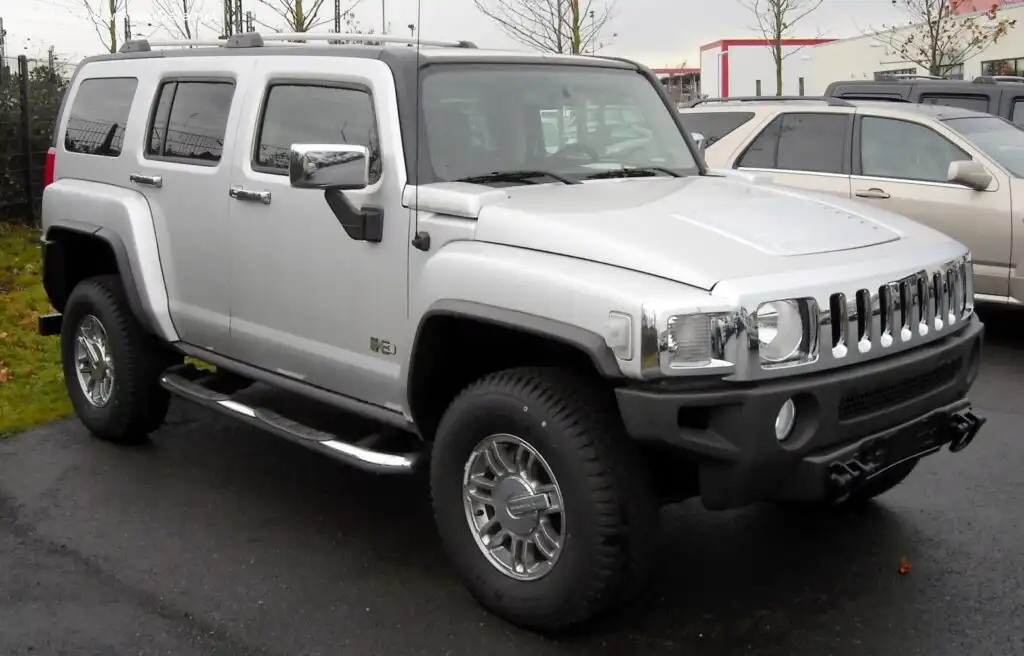
The Hummer H3 5.3i V8, produced from 2007 to 2010, represented a significant downsize and refinement of the Hummer brand’s image. While the larger H1 and H2 catered to a niche market seeking extreme off-road capability and imposing presence, the H3 aimed for broader appeal, offering a more manageable size and improved on-road manners. The 5.3i V8 4×4 Automatic variant occupied the upper echelon of the H3 lineup, providing a substantial power upgrade over the base 2.7L four-cylinder engine and serving as the primary choice for buyers prioritizing performance and towing capacity. It was built on the GMT355 platform, shared with the Chevrolet Colorado and GMC Canyon mid-size trucks, marking a departure from the previous Hummer’s unique chassis designs.
Technical Specifications
| Brand | Hummer |
| Model | H3 |
| Generation | H3 |
| Type (Engine) | 5.3i V8 (305 Hp) 4×4 Automatic |
| Start of production | 2007 |
| End of production | 2010 |
| Powertrain Architecture | Internal Combustion engine |
| Body type | Off-road vehicle, SUV |
| Seats | 5 |
| Doors | 5 |
| Fuel consumption (economy) – urban | 18.1 l/100 km (13 US mpg, 15.6 UK mpg, 5.5 km/l) |
| Fuel consumption (economy) – extra urban | 14.7 l/100 km (16 US mpg, 19.2 UK mpg, 6.8 km/l) |
| Fuel consumption (economy) – combined | 16.8 l/100 km (14 US mpg, 16.8 UK mpg, 6 km/l) |
| Fuel Type | Petrol (Gasoline) |
| Maximum speed | 160 km/h (99.42 mph) |
| Weight-to-power ratio | 7.2 kg/Hp, 138.3 Hp/tonne |
| Weight-to-torque ratio | 5.1 kg/Nm, 196.7 Nm/tonne |
| Power | 305 Hp @ 5200 rpm |
| Power per litre | 57.3 Hp/l |
| Torque | 434 Nm @ 4000 rpm (320.1 lb.-ft. @ 4000 rpm) |
| Maximum engine speed | 6000 rpm |
| Engine layout | Front, Longitudinal |
| Engine Model/Code | LH8 |
| Engine displacement | 5327 cm3 (325.07 cu. in.) |
| Number of cylinders | 8 |
| Engine configuration | V-engine |
| Cylinder Bore | 96 mm (3.78 in.) |
| Piston Stroke | 92 mm (3.62 in.) |
| Compression ratio | 9.9:1 |
| Number of valves per cylinder | 2 |
| Fuel injection system | Multi-port manifold injection |
| Engine aspiration | Naturally aspirated engine |
| Valvetrain | OHV |
| Engine oil capacity | 5.7 l (6.02 US qt | 5.02 UK qt) |
| Coolant | 13.5 l (14.27 US qt | 11.88 UK qt) |
| Kerb Weight | 2206 kg (4863.4 lbs.) |
| Max. weight | 2728 kg (6014.21 lbs.) |
| Max load | 522 kg (1150.81 lbs.) |
| Trunk (boot) space – minimum | 835 l (29.49 cu. ft.) |
| Trunk (boot) space – maximum | 1575 l (55.62 cu. ft.) |
| Fuel tank capacity | 87 l (22.98 US gal | 19.14 UK gal) |
| Length | 4742 mm (186.69 in.) |
| Width | 1897 mm (74.69 in.) |
| Height | 1893 mm (74.53 in.) |
| Wheelbase | 2842 mm (111.89 in.) |
| Front track | 1651 mm (65 in.) |
| Rear (Back) track | 1664 mm (65.51 in.) |
| Ride height (ground clearance) | 216 mm (8.5 in.) |
| Drag coefficient (Cd) | 0.55 |
| Minimum turning circle (turning diameter) | 11.3 m (37.07 ft.) |
| Drive wheel | All wheel drive (4×4) |
| Number of gears and type of gearbox | 4 gears, automatic transmission |
| Front suspension | Torsion |
| Rear suspension | Leaf spring |
| Front brakes | Ventilated discs |
| Rear brakes | Disc |
| Assisting systems | ABS (Anti-lock braking system) |
| Tires size | 265/75 R16 |
| Wheel rims size | 16 |
Powertrain & Engine Architecture
The heart of the H3 5.3i was the LH8, a 5.3-liter (325 cubic inch) V8 engine. This engine, a member of General Motors’ Small-Block family, was known for its robust construction and relatively simple design. It featured a cast iron block with aluminum cylinder heads, and utilized a traditional overhead valve (OHV) valvetrain with two valves per cylinder. Fuel delivery was handled by a multi-port fuel injection system, providing adequate atomization for efficient combustion. The engine produced 305 horsepower at 5200 rpm and 320 lb-ft of torque at 4000 rpm. The 4L80-E four-speed automatic transmission was the sole transmission option for the 5.3L engine. This transmission, while reliable, was somewhat dated by the late 2000s, lacking the efficiency and smoothness of newer transmissions with more gears.
Driving Characteristics
The combination of the 5.3L V8 and the 4L80-E automatic provided the H3 with respectable acceleration and towing capability. While not a sports car, the H3 5.3i could reach 60 mph in around 7.5 seconds. The automatic transmission’s gear ratios were geared more towards low-end torque and towing than outright speed. Compared to the base 2.7L four-cylinder, the V8 offered a significantly more relaxed driving experience, particularly when fully loaded or tackling steep inclines. The four-speed automatic, however, did contribute to higher fuel consumption and a less refined feel compared to vehicles with more modern transmissions. The H3’s truck-based chassis provided a comfortable ride on paved roads, but its body-on-frame construction resulted in noticeable body roll during cornering.
Equipment & Trim Levels
The H3 5.3i typically came standard with features such as air conditioning, power windows and locks, a CD player, and basic cloth upholstery. Higher trim levels, such as the Alpha and Omega, added features like leather seats, premium audio systems, automatic climate control, and upgraded interior trim. Optional extras included a sunroof, navigation system, and various off-road packages with features like skid plates and locking differentials. The H3’s interior design was functional but lacked the sophistication of some competitors. The dashboard layout was straightforward, with large, easy-to-read gauges.
Chassis & Braking
The H3’s chassis was based on a modified version of the GMT355 platform, featuring a body-on-frame construction. The front suspension utilized torsion bars, while the rear suspension employed leaf springs. This setup provided a good balance of ride comfort and off-road capability. The H3 5.3i came equipped with ventilated disc brakes at the front and solid discs at the rear. Anti-lock brakes (ABS) were standard. The H3’s relatively heavy weight and truck-based chassis meant that braking performance was adequate but not exceptional.
Market Reception & Comparison
The Hummer H3 5.3i V8 was generally well-received by critics, who praised its powerful engine and improved on-road manners compared to the H1 and H2. However, its fuel economy was a common criticism, with combined fuel consumption averaging around 14 mpg. Compared to other SUVs in its class, such as the Jeep Grand Cherokee and Toyota 4Runner, the H3 offered a more distinctive styling and a more rugged image. However, it lacked the refinement and fuel efficiency of some competitors. The 5.3L V8 was considered a more desirable option than the base 2.7L four-cylinder, offering a significant performance upgrade for a relatively modest price increase.
Legacy
The Hummer H3, and particularly the 5.3i V8 variant, has developed a modest following among enthusiasts. The LH8 V8 engine is known for its reliability and relatively simple maintenance requirements. However, the H3’s fuel economy and dated automatic transmission can be drawbacks for some buyers. Today, well-maintained H3 5.3i models can be found on the used car market at relatively affordable prices, appealing to those seeking a unique and capable SUV with a distinctive style. The H3 represents a transitional period for the Hummer brand, attempting to broaden its appeal while retaining its core off-road identity.
