
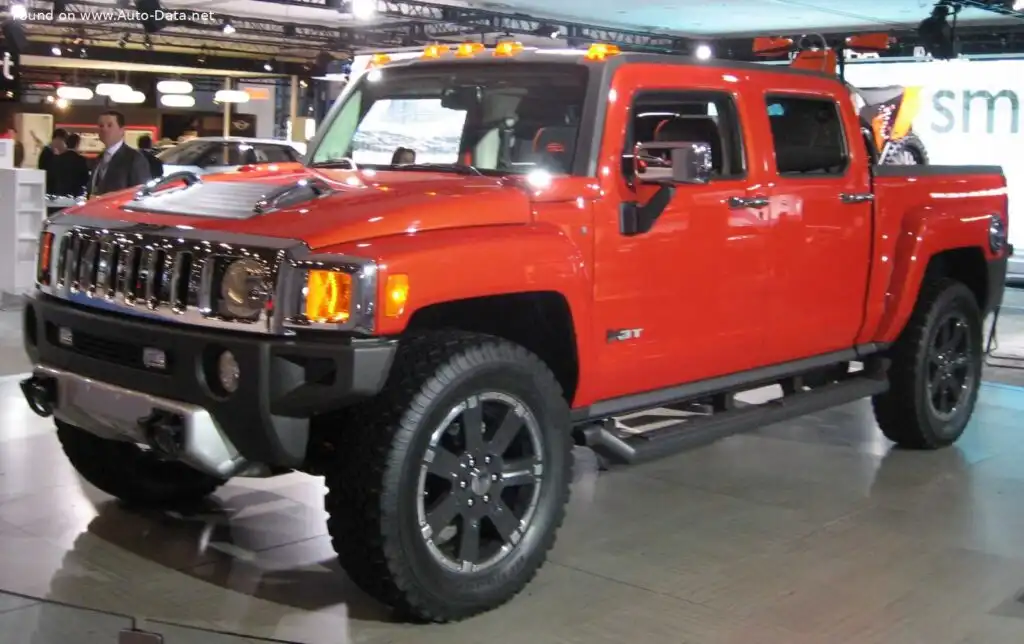
The Hummer H3T 3.7i 20V (242 Hp) 4×4 Automatic, produced from 2008 to 2010, represented a unique offering in the mid-size pickup truck segment. As a derivative of the Hummer H3 SUV, the H3T aimed to blend the brand’s iconic off-road capability with the practicality of a pickup bed. It was positioned as a more versatile alternative to the H3, appealing to buyers who needed both passenger space and cargo hauling capacity. The H3T was a late addition to the Hummer lineup, arriving shortly before the brand’s eventual discontinuation following General Motors’ bankruptcy. It utilized the GM GMT355 platform, shared with the Chevrolet Colorado and GMC Canyon, but with Hummer-specific styling and off-road enhancements.
Technical Specifications
| Brand | Hummer |
| Model | H3 |
| Generation | H3T |
| Type | 3.7i 20V (242 Hp) 4×4 Automatic |
| Start of production | 2008 |
| End of production | 2010 |
| Powertrain Architecture | Internal Combustion engine |
| Body type | Off-road vehicle, Pick-up |
| Seats | 4 |
| Doors | 4 |
| Fuel consumption (urban) | 16.8 l/100 km (14 US mpg) |
| Fuel consumption (extra urban) | 13.1 l/100 km (18 US mpg) |
| Fuel consumption (combined) | 14.7 l/100 km (16 US mpg) |
| Fuel Type | Petrol (Gasoline) |
| Maximum speed | 158 km/h (98.18 mph) |
| Weight-to-power ratio | 9.2 kg/Hp |
| Weight-to-torque ratio | 6.8 kg/Nm |
| Power | 242 Hp @ 5600 rpm |
| Power per litre | 66.2 Hp/l |
| Torque | 327 Nm @ 4600 rpm (241.18 lb.-ft. @ 4600 rpm) |
| Maximum engine speed | 6300 rpm |
| Engine layout | Front, Longitudinal |
| Engine Model/Code | LLR |
| Engine displacement | 3653 cm3 (222.92 cu. in.) |
| Number of cylinders | 5 |
| Engine configuration | Inline |
| Cylinder Bore | 95.5 mm (3.76 in.) |
| Piston Stroke | 102 mm (4.02 in.) |
| Compression ratio | 10:1 |
| Number of valves per cylinder | 4 |
| Fuel injection system | Multi-port manifold injection |
| Engine aspiration | Naturally aspirated engine |
| Valvetrain | DOHC, CVVT |
| Engine oil capacity | 5.7 l (6.02 US qt | 5.02 UK qt) |
| Coolant capacity | 9.5 l (10.04 US qt | 8.36 UK qt) |
| Kerb Weight | 2238 kg (4933.95 lbs.) |
| Max. weight | 2722 kg (6000.98 lbs.) |
| Max load | 484 kg (1067.04 lbs.) |
| Fuel tank capacity | 102 l (26.95 US gal | 22.44 UK gal) |
| Length | 5403 mm (212.72 in.) |
| Width | 1905 mm (75 in.) |
| Height | 1831 mm (72.09 in.) |
| Wheelbase | 2842 mm (111.89 in.) |
| Front track | 1651 mm (65 in.) |
| Rear track | 1664 mm (65.51 in.) |
| Ride height (ground clearance) | 242 mm (9.53 in.) |
| Drag coefficient (Cd) | 0.55 |
| Minimum turning circle | 13.3 m (43.64 ft.) |
| Approach angle | 37.1° |
| Departure angle | 30.9° |
| Ramp-over angle | 19° |
| Drive wheel | All wheel drive (4×4) |
| Number of gears | 4 |
| Gearbox type | automatic transmission |
| Front suspension | Torsion |
| Rear suspension | Leaf spring |
| Front brakes | Ventilated discs |
| Rear brakes | Disc |
| Assisting systems | ABS (Anti-lock braking system) |
| Tires size | 265/75 R16 |
| Wheel rims size | 16 |
Powertrain & Engine Architecture
The H3T 3.7i was powered by General Motors’ 3.7-liter LLR inline-five engine. This engine, a relatively uncommon configuration, was designed to offer a balance between power and fuel efficiency. It featured a cast iron block and aluminum cylinder heads, incorporating dual overhead camshafts (DOHC) and variable valve timing (CVVT) for improved performance and emissions. The LLR utilized multi-port fuel injection, delivering fuel directly to the intake ports. The engine produced 242 horsepower at 5600 rpm and 327 lb-ft of torque at 4600 rpm. The engine was paired exclusively with a four-speed automatic transmission (4L60-E), chosen for its durability and suitability for off-road driving. While not the most modern transmission, it provided adequate performance for the H3T’s intended use.
Driving Characteristics
The 3.7-liter engine and four-speed automatic combination in the H3T delivered adequate, but not exhilarating, performance. Acceleration was reasonable for everyday driving, but the H3T wasn’t particularly quick. The automatic transmission’s gear ratios were geared more towards low-end torque for off-roading than rapid acceleration. Compared to the available manual transmission, the automatic resulted in a slight decrease in fuel economy and a less engaging driving experience. The H3T’s weight, exceeding 4,900 pounds, also contributed to its less-than-sporty feel. However, the powertrain proved capable of handling moderate towing duties and navigating challenging off-road terrain. The 4×4 system, with its low-range gearing, was a key asset in these situations.
Equipment & Trim Levels
The H3T was generally well-equipped, even in its base form. Standard features included air conditioning, power windows and locks, a CD player with MP3 compatibility, and cloth upholstery. Higher trim levels, such as the Adventure and Alpha, added features like leather seats, a premium sound system, automatic climate control, and upgraded interior trim. Optional extras included a sunroof, navigation system, and various off-road packages with features like a locking rear differential and skid plates. The interior design was rugged and functional, reflecting the H3T’s off-road focus. The dashboard layout was straightforward, with large, easy-to-use controls.
Chassis & Braking
The H3T’s chassis was built on a body-on-frame construction, providing a robust foundation for off-road use. The front suspension utilized a torsion bar setup, while the rear featured leaf springs. This configuration prioritized durability and load-carrying capacity over ride comfort. Braking duties were handled by ventilated discs at the front and solid discs at the rear. An anti-lock braking system (ABS) was standard. The H3T’s relatively high ground clearance (9.53 inches) and aggressive approach and departure angles (37.1° and 30.9° respectively) contributed to its off-road prowess. The standard tire size was 265/75R16, providing ample grip on various surfaces.
Market Reception & Comparison
The H3T received mixed reviews from automotive critics. While its off-road capability and unique styling were praised, its fuel economy and on-road ride quality were often criticized. Compared to other mid-size pickups like the Toyota Tacoma and Nissan Frontier, the H3T offered a more distinctive look and a more focused off-road experience, but it lacked the refinement and fuel efficiency of its Japanese competitors. The 3.7-liter engine and automatic transmission combination was considered adequate but not particularly competitive in terms of performance or fuel economy. The H3T’s relatively short production run and the impending demise of the Hummer brand also impacted its market reception.
Legacy
The Hummer H3T, particularly the 3.7i 20V Automatic variant, has developed a niche following among off-road enthusiasts and Hummer aficionados. While not known for exceptional reliability, the LLR engine and 4L60-E transmission are generally considered durable with proper maintenance. Common issues include oil leaks and sensor failures. On the used car market, H3Ts tend to be relatively affordable, making them an attractive option for those seeking a capable and distinctive off-road vehicle. However, potential buyers should be aware of the H3T’s poor fuel economy and the challenges of finding parts due to the brand’s discontinuation. The H3T remains a unique and recognizable vehicle, representing a brief but memorable chapter in the history of the Hummer brand.
