
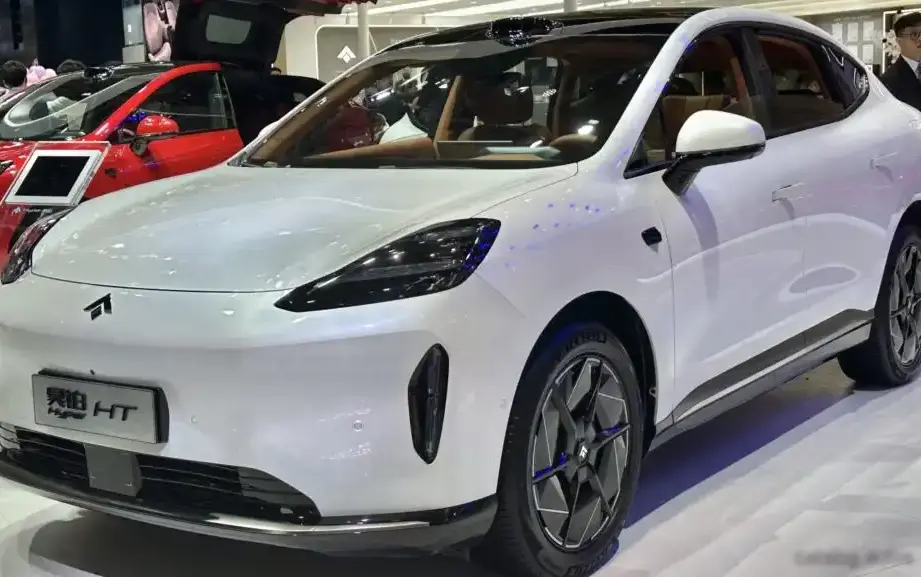
The Hyper HT 70 kWh, producing 245 horsepower, represents a significant entry into the burgeoning electric SUV market. Introduced in November 2023 and produced through August 2024, this model is positioned as a mid-range offering within the Hyper HT lineup. It’s a fully electric vehicle (BEV) designed to appeal to consumers seeking a balance of range, performance, and practicality in a five-passenger, five-door SUV configuration. The HT leverages a dedicated electric vehicle platform, prioritizing interior space and efficient energy management.
Technical Specifications
| Brand | Hyper |
| Model | HT |
| Generation | HT |
| Type (Engine) | 70 kWh (245 Hp) |
| Start of production | November, 2023 |
| End of production | August, 2024 |
| Powertrain Architecture | BEV (Electric Vehicle) |
| Body type | SUV |
| Seats | 5 |
| Doors | 5 |
| Fuel Type | Electricity |
| Acceleration 0 – 100 km/h | 6.8 sec |
| Acceleration 0 – 62 mph | 6.8 sec |
| Acceleration 0 – 60 mph | 6.5 sec |
| Maximum speed | 183 km/h (113.71 mph) |
| Weight-to-power ratio | 8.5 kg/Hp, 117.2 Hp/tonne |
| Weight-to-torque ratio | 5.9 kg/Nm, 169.9 Nm/tonne |
| Gross battery capacity | 70 kWh |
| Battery technology | Lithium iron phosphate (LiFePO4) |
| Battery location | Below the floor |
| All-electric range (CLTC) | 550 km (341.75 mi) |
| Average Energy consumption (CLTC) | 13.9 kWh/100 km (22.37 kWh/100 mi) |
| MPGe | 151 |
| km/kWh | 7.2 |
| mi/kWh | 4.5 |
| Electric motor power | 245 Hp |
| Electric motor Torque | 355 Nm (261.83 lb.-ft.) |
| Electric motor model/code | TZ184XYA0202 |
| Electric motor location | Rear axle, Transverse |
| Electric motor type | Synchronous |
| System power | 245 Hp |
| System torque | 355 Nm (261.83 lb.-ft.) |
| Kerb Weight | 2090-2130 kg (4607.66 – 4695.85 lbs.) |
| Max. weight | 2580 kg (5687.93 lbs.) |
| Max load | 450-490 kg (992.08 – 1080.27 lbs.) |
| Trunk (boot) space – minimum | 670 l (23.66 cu. ft.) |
| Trunk (boot) space – maximum | 1802 l (63.64 cu. ft.) |
| Length | 4935 mm (194.29 in.) |
| Width | 1920 mm (75.59 in.) |
| Height | 1700 mm (66.93 in.) |
| Wheelbase | 2935 mm (115.55 in.) |
| Front track | 1640 mm (64.57 in.) |
| Rear (Back) track | 1660 mm (65.35 in.) |
| Minimum turning circle | 11.2 m (36.75 ft.) |
| Approach angle | 18° |
| Departure angle | 23° |
| Drivetrain Architecture | One electric motor drives the rear wheels. |
| Drive wheel | Rear wheel drive |
| Number of gears | 1 |
| Gearbox type | automatic transmission |
| Front suspension | Coil spring, Double wishbone, Transverse stabilizer |
| Rear suspension | Independent multi-link spring suspension with stabilizer |
| Front brakes | Ventilated discs |
| Rear brakes | Ventilated discs |
| Assisting systems | ABS (Anti-lock braking system) |
| Steering type | Steering rack and pinion |
| Power steering | Electric Steering |
| Tires size | 245/55 R19 |
| Wheel rims size | 19 |
Powertrain & Engine Architecture
The Hyper HT 70 kWh utilizes a single, rear-mounted synchronous electric motor producing 245 horsepower and 355 Nm (261.83 lb.-ft.) of torque. The motor, designated TZ184XYA0202, is powered by a 70 kWh Lithium Iron Phosphate (LiFePO4) battery pack located under the vehicle floor. This battery chemistry is known for its thermal stability and longer lifespan compared to some other lithium-ion formulations, though it typically offers slightly lower energy density. The vehicle employs a single-speed automatic transmission, typical of most BEVs, delivering instant torque to the rear wheels. The powertrain is designed for efficiency, with a CLTC-rated energy consumption of 13.9 kWh per 100 kilometers (22.37 kWh per 100 miles).
Driving Characteristics
The rear-wheel-drive configuration of the HT 70 kWh provides a balanced driving experience. Acceleration from 0 to 60 mph is achieved in approximately 6.5 seconds, making it competitive within its segment. The single-speed transmission offers seamless acceleration, and the instant torque delivery characteristic of electric motors provides responsive performance. While not as quick as some dual-motor, all-wheel-drive EVs, the HT 70 kWh offers a comfortable and engaging driving experience for everyday use. The rear-wheel drive setup can exhibit some oversteer under hard acceleration, but the electronic stability control system mitigates this effectively.
Equipment & Trim Levels
The Hyper HT 70 kWh comes standard with a comprehensive suite of features, including a touchscreen infotainment system, digital instrument cluster, automatic climate control, and a range of advanced driver-assistance systems (ADAS) such as automatic emergency braking and lane-keeping assist. Interior upholstery is typically a combination of cloth and synthetic leather, with higher trims offering full leather options. Optional extras include a panoramic sunroof, premium audio system, and ventilated front seats. The HT prioritizes practicality with a spacious interior and a versatile cargo area, offering 670 liters (23.66 cu. ft.) of space with the rear seats up and 1802 liters (63.64 cu. ft.) with them folded down.
Chassis & Braking
The HT utilizes a coil spring, double wishbone suspension setup at the front and an independent multi-link spring suspension at the rear, both incorporating a transverse stabilizer bar. This configuration provides a comfortable ride and good handling characteristics. Ventilated disc brakes are used on all four wheels, providing ample stopping power. The vehicle is equipped with an Anti-lock Braking System (ABS) and Electronic Stability Control (ESC) as standard safety features. The relatively low center of gravity, thanks to the underfloor battery pack, contributes to the vehicle’s stability and handling.
Market Reception & Comparison
The Hyper HT 70 kWh was generally well-received by critics, who praised its spacious interior, comfortable ride, and competitive range. Its CLTC-rated range of 550 km (341.75 mi) is competitive within its price bracket. Compared to other trims in the HT lineup, the 70 kWh model offers a significant step up in range and performance compared to lower-capacity battery options. However, it is positioned below higher-performance, dual-motor variants. Fuel economy, expressed as 151 MPGe, is also competitive with other electric SUVs in the market.
Legacy
The Hyper HT 70 kWh represents a significant step for Hyper in establishing itself as a player in the electric vehicle market. The LiFePO4 battery technology used in this model is expected to provide long-term reliability and durability. As a relatively recent model, the HT 70 kWh is still establishing its reputation in the used car market, but early indications suggest strong demand due to its combination of range, practicality, and value. The vehicle’s relatively simple powertrain, with fewer moving parts than a traditional internal combustion engine vehicle, is expected to contribute to lower maintenance costs over its lifespan.
