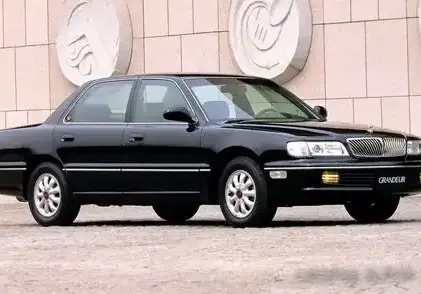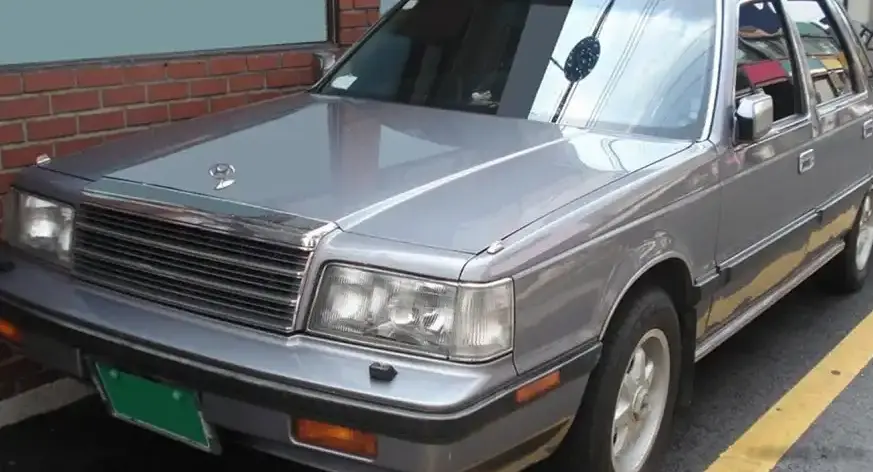
The Hyundai Grandeur I, known as the Azera in some export markets, represented a significant step forward for the South Korean automaker. Introduced in 1989 and produced through 1992, the Grandeur was Hyundai’s first truly large, domestically-developed sedan, aimed at establishing the brand as a competitor to established Japanese and American manufacturers. The 3.0i V6 Automatic variant, detailed here, occupied a premium position within the initial Grandeur lineup, offering a blend of comfort, performance, and features intended to appeal to a growing middle class in South Korea and, to a lesser extent, export markets. It was built on the Hyundai’s then-new platform, showcasing their ambition to move beyond simple license-built vehicles.
Technical Specifications
| Brand | Hyundai |
| Model | Grandeur/Azera |
| Generation | Grandeur I (L) |
| Type (Engine) | 3.0i V6 (164 Hp) Automatic |
| Start of production | 1989 |
| End of production | 1992 |
| Powertrain Architecture | Internal Combustion engine |
| Body type | Sedan |
| Seats | 5 |
| Doors | 4 |
| Fuel consumption (urban) | 14 l/100 km (16.8 US mpg, 20.2 UK mpg, 7.1 km/l) |
| Fuel consumption (extra urban) | 11 l/100 km (21.4 US mpg, 25.7 UK mpg, 9.1 km/l) |
| Fuel consumption (combined) | 12.3 l/100 km (19.1 US mpg, 23 UK mpg, 8.1 km/l) |
| Fuel Type | Petrol (Gasoline) |
| Acceleration 0 – 100 km/h | 10.7 sec |
| Acceleration 0 – 62 mph | 10.7 sec |
| Acceleration 0 – 60 mph | 10.2 sec |
| Maximum speed | 200 km/h (124.27 mph) |
| Weight-to-power ratio | 9.3 kg/Hp, 107.9 Hp/tonne |
| Weight-to-torque ratio | 6.6 kg/Nm, 152 Nm/tonne |
| Power | 164 Hp @ 5000 rpm |
| Power per litre | 55.2 Hp/l |
| Torque | 231 Nm @ 2500 rpm (170.38 lb.-ft. @ 2500 rpm) |
| Engine layout | Front, Transverse |
| Engine displacement | 2972 cm3 (181.36 cu. in.) |
| Number of cylinders | 6 |
| Engine configuration | V-engine |
| Cylinder Bore | 91.1 mm (3.59 in.) |
| Piston Stroke | 76 mm (2.99 in.) |
| Compression ratio | 8.9:1 |
| Number of valves per cylinder | 2 |
| Fuel injection system | Multi-port manifold injection |
| Engine aspiration | Naturally aspirated engine |
| Valvetrain | SOHC |
| Kerb Weight | 1520 kg (3351.03 lbs.) |
| Trunk (boot) space | 460 l (16.24 cu. ft.) |
| Fuel tank capacity | 72 l (19.02 US gal, 15.84 UK gal) |
| Length | 4865 mm (191.54 in.) |
| Width | 1725 mm (67.91 in.) |
| Height | 1430 mm (56.3 in.) |
| Wheelbase | 2690 mm (105.91 in.) |
| Front track | 1455 mm (57.28 in.) |
| Rear track | 1405 mm (55.31 in.) |
| Drag coefficient (Cd) | 0.42 |
| Minimum turning circle | 11.6 m (38.06 ft.) |
| Drivetrain Architecture | Front wheel drive |
| Number of gears | 4 |
| Gearbox type | Automatic transmission |
| Front suspension | Independent coil spring |
| Front brakes | Ventilated discs |
| Rear brakes | Disc |
| Tires size | 205/60 R14 |
Powertrain & Engine Architecture
The heart of the Grandeur I 3.0i was the Mitsubishi-sourced 6G72 V6 engine. This 2.97-liter (181.36 cubic inches) engine featured a single overhead camshaft (SOHC) valvetrain with two valves per cylinder. The engine utilized multi-port fuel injection, a relatively modern feature for the time, contributing to improved fuel efficiency and smoother power delivery. Producing 164 horsepower at 5000 rpm and 231 Nm (170.38 lb-ft) of torque at 2500 rpm, the engine was designed for relaxed cruising rather than outright performance. The engine was transversely mounted in the front of the vehicle. The four-speed automatic transmission, also sourced from Mitsubishi, was chosen to complement the engine’s characteristics, prioritizing comfort and ease of use over sporty responsiveness. This transmission was not known for its particularly quick shifts, but it was generally reliable.
Driving Characteristics
The 3.0i V6 Automatic Grandeur offered a comfortable, if not particularly exhilarating, driving experience. The automatic transmission, while smooth, resulted in a noticeable delay in response compared to the available manual transmission. Acceleration to 60 mph took around 10.2 seconds, which was adequate for the time but not competitive with sportier sedans. The focus was clearly on providing a refined and quiet ride, suitable for long distances. The relatively tall gear ratios in the automatic transmission prioritized fuel economy at highway speeds, but could feel somewhat strained during aggressive acceleration. The front-wheel-drive layout contributed to predictable handling, but lacked the dynamic capabilities of rear-wheel-drive competitors.
Equipment & Trim Levels
The 3.0i V6 Automatic trim represented a well-equipped version of the Grandeur I. Standard features typically included power windows, power locks, air conditioning, and a basic audio system. Interior upholstery was generally cloth, though leather options were available. The dashboard layout was functional and straightforward, reflecting the design sensibilities of the late 1980s. Optional extras could include a sunroof, upgraded audio systems, and alloy wheels. The Grandeur aimed to provide a level of luxury previously unseen in Korean-produced vehicles.
Chassis & Braking
The Grandeur I utilized an independent coil spring suspension in the front, providing a comfortable ride. The rear suspension employed a semi-independent setup. Braking consisted of ventilated discs in the front and solid discs in the rear. While adequate for everyday driving, the braking system wasn’t particularly powerful by contemporary standards. The car rode on 205/60 R14 tires, which provided a reasonable balance of ride comfort and handling. Stabilizer bars were included to reduce body roll during cornering, but the car’s weight and front-wheel-drive layout limited its overall agility.
Market Reception & Comparison
The Grandeur I was generally well-received in South Korea, where it quickly became a popular choice among government officials and affluent families. Critics praised its spacious interior, comfortable ride, and relatively modern features. However, some reviewers noted the engine’s lack of outright power and the automatic transmission’s sluggishness. Compared to the smaller 2.0-liter four-cylinder Grandeur models, the 3.0i V6 offered significantly more refinement and performance, but at a higher price point. It was positioned as a direct competitor to Japanese sedans like the Toyota Camry and Honda Accord, offering a similar level of comfort and features at a potentially lower price.
Legacy
The Hyundai Grandeur I 3.0i V6 Automatic holds a significant place in Hyundai’s history as the model that established the brand as a serious automotive manufacturer. While the 6G72 engine and Mitsubishi transmission proved generally reliable, age and mileage can lead to issues such as oil leaks and transmission wear. Today, well-maintained examples are becoming increasingly collectible, particularly in South Korea. The Grandeur I represents a pivotal moment in the evolution of the Korean automotive industry, demonstrating Hyundai’s ambition and ability to produce a competitive large sedan. The car’s relative simplicity makes it a viable project for enthusiasts, and parts availability, while not extensive, is still reasonable.