
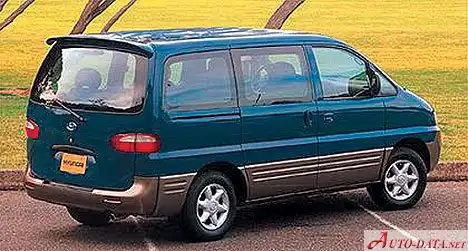
The Hyundai H-1, marketed as the Starex in some markets, is a multipurpose vehicle (MPV) produced by the South Korean manufacturer Hyundai. The first generation, known as the H-1, was introduced in 1997, with a significant refresh and the introduction of the “I” designation (H-1 I Starex) occurring in 2001. This article focuses specifically on the 2.4-liter, four-wheel-drive (4WD) variant of the H-1 I Starex produced between 2001 and 2007, equipped with a 110 horsepower engine. This configuration was primarily aimed at markets requiring a robust, all-weather vehicle capable of carrying passengers and cargo, particularly in regions with challenging road conditions. The H-1 Starex filled a niche as a practical and affordable people mover, often serving as a commercial vehicle for businesses and families alike.
Technical Specifications
| Brand | Hyundai |
| Model | H-1 |
| Generation | H-1 I Starex |
| Type (Engine) | 2.4 i 4WD (110 Hp) |
| Start of production | 2001 |
| End of production | 2007 |
| Powertrain Architecture | Internal Combustion engine |
| Body type | Minivan |
| Seats | 7 |
| Doors | 4 |
| Fuel consumption (urban) | 17.6 l/100 km (13.4 US mpg) |
| Fuel consumption (extra urban) | 10.6 l/100 km (22.2 US mpg) |
| Fuel Type | Petrol (Gasoline) |
| Acceleration 0 – 100 km/h | 22.3 sec |
| Acceleration 0 – 62 mph | 22.3 sec |
| Acceleration 0 – 60 mph | 21.2 sec |
| Maximum speed | 148 km/h (91.96 mph) |
| Weight-to-power ratio | 17.7 kg/Hp |
| Weight-to-torque ratio | 10.8 kg/Nm |
| Power | 110 Hp @ 4500 rpm |
| Torque | 181 Nm @ 2300 rpm (133.5 lb.-ft. @ 2300 rpm) |
| Engine layout | Front, Longitudinal |
| Engine displacement | 2351 cm3 (143.47 cu. in.) |
| Number of cylinders | 4 |
| Engine configuration | Inline |
| Cylinder Bore | 86.5 mm (3.41 in.) |
| Piston Stroke | 100 mm (3.94 in.) |
| Compression ratio | 8.5:1 |
| Number of valves per cylinder | 2 |
| Fuel injection system | Multi-port manifold injection |
| Engine aspiration | Naturally aspirated |
| Engine oil capacity | 4.3 l (4.54 US qt | 3.78 UK qt) |
| Kerb Weight | 1950 kg (4299.01 lbs.) |
| Max. weight | 2740 kg (6040.67 lbs.) |
| Max load | 790 kg (1741.65 lbs.) |
| Trunk (boot) space – minimum | 364 l (12.85 cu. ft.) |
| Trunk (boot) space – maximum | 3295 l (116.36 cu. ft.) |
| Fuel tank capacity | 65 l (17.17 US gal | 14.3 UK gal) |
| Length | 4695 mm (184.84 in.) |
| Width | 1820 mm (71.65 in.) |
| Height | 1900 mm (74.8 in.) |
| Wheelbase | 2810 mm (110.63 in.) |
| Front track | 1570 mm (61.81 in.) |
| Rear track | 1545 mm (60.83 in.) |
| Drive wheel | All wheel drive (4×4) |
| Number of gears | 5 |
| Gearbox type | Manual transmission |
| Front suspension | Double wishbone |
| Rear suspension | Leaf spring |
| Front brakes | Ventilated discs |
| Rear brakes | Disc |
| Assisting systems | ABS (Anti-lock braking system) |
| Steering type | Steering rack and pinion |
| Power steering | Hydraulic |
| Tires size | 195/80 R14 |
Powertrain & Engine Architecture
The heart of the H-1 I Starex 2.4 i 4WD is the Hyundai G4JS engine, a 2.4-liter inline-four cylinder gasoline engine. This engine utilizes a naturally aspirated configuration and a multi-port fuel injection system. The G4JS produces 110 horsepower at 4,500 rpm and 181 Nm (133.5 lb-ft) of torque at 2,300 rpm. The engine features a single overhead camshaft (SOHC) design with two valves per cylinder. The 4WD system is typically part-time, allowing the driver to switch between two-wheel drive and four-wheel drive modes as needed. The five-speed manual transmission was the standard offering for this variant, providing a direct connection between the engine and the drivetrain. The longitudinal engine layout was a common design choice for rear-wheel-drive and all-wheel-drive vehicles of this era.
Driving Characteristics
The 2.4-liter engine and five-speed manual transmission combination in the H-1 I Starex 4WD offered a balance between usability and affordability. Acceleration was modest, with a 0-100 km/h (0-62 mph) time of around 22.3 seconds. The engine’s torque peak at 2,300 rpm provided adequate pulling power for everyday driving and hauling loads, but it wasn’t designed for spirited performance. Compared to potential higher-output engine options (which weren’t widely available in the 4WD configuration), this variant prioritized fuel economy and durability over outright speed. The manual transmission allowed for greater driver control, but the gear ratios were tuned for practicality rather than performance. The 4WD system provided enhanced traction in slippery conditions, making it suitable for rural areas or inclement weather.
Equipment & Trim Levels
The H-1 I Starex 2.4 i 4WD typically came with a relatively basic level of equipment, reflecting its positioning as a workhorse vehicle. Standard features generally included power steering, air conditioning, and a basic audio system. Interior upholstery was typically vinyl or a durable cloth material. The seven-seat configuration was standard, with flexible seating arrangements allowing for increased cargo space. Optional extras could include power windows, central locking, and upgraded audio systems. Trim levels varied depending on the market, but generally focused on adding convenience features rather than significant performance upgrades.
Chassis & Braking
The H-1 I Starex utilized a body-on-frame construction, providing a robust and durable chassis. The front suspension employed a double wishbone setup, while the rear suspension utilized a leaf spring design. This combination offered a comfortable ride quality, particularly when carrying loads. The braking system consisted of ventilated discs on the front wheels and discs on the rear wheels. An Anti-lock Braking System (ABS) was included as a standard safety feature. The relatively simple suspension and braking systems were designed for reliability and ease of maintenance.
Market Reception & Comparison
The Hyundai H-1 I Starex 2.4 i 4WD was generally well-received in markets where a practical, affordable, and all-weather MPV was needed. Critics praised its spacious interior, robust construction, and capable 4WD system. However, the engine’s performance was often criticized as being underpowered, especially when fully loaded. Compared to other MPVs available at the time, the H-1 Starex offered a compelling value proposition, particularly for those prioritizing functionality over luxury. Fuel economy was reasonable for a vehicle of its size and weight, but not exceptional. Reliability was generally good, although maintenance costs could be higher due to the vehicle’s relatively simple mechanical design.
Legacy
The Hyundai H-1 I Starex 2.4 i 4WD has proven to be a durable and reliable vehicle, with many examples still in use today. The G4JS engine is known for its longevity, although regular maintenance is essential to ensure its continued operation. In the used car market, these vehicles are often sought after for their practicality and affordability. While not a performance icon, the H-1 I Starex 2.4 i 4WD remains a testament to Hyundai’s ability to produce robust and functional vehicles that meet the needs of a diverse range of customers. Its simple design and readily available parts contribute to its continued appeal as a workhorse vehicle for families and businesses alike.
