
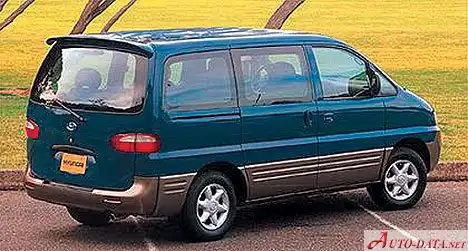
The Hyundai H-1, marketed as the Starex in some markets, is a multipurpose vehicle (MPV) produced by the South Korean manufacturer Hyundai. The first generation, known as the H-1, was introduced in 1997, with a significant refresh and the designation H-1 I Starex arriving in 2002. This article focuses specifically on the 2.5 TD variant with 99 horsepower, produced between 2002 and 2007. This version of the Starex was primarily aimed at utility and family transport in markets where large MPVs were popular, offering a relatively affordable and practical option. It occupied a position as the base engine option within the H-1 lineup, catering to buyers prioritizing functionality over outright performance.
Technical Specifications
| Brand | Hyundai |
| Model | H-1 |
| Generation | H-1 I Starex |
| Type (Engine) | 2.5 TD (99 Hp) |
| Start of production | 2002 |
| End of production | 2007 |
| Powertrain Architecture | Internal Combustion engine |
| Body type | Minivan |
| Seats | 7 |
| Doors | 4 |
| Fuel consumption (combined) | 9.6 l/100 km (24.5 US mpg, 29.4 UK mpg, 10.4 km/l) |
| Fuel Type | Diesel |
| Maximum speed | 148 km/h (91.96 mph) |
| Weight-to-power ratio | 19.4 kg/Hp, 51.5 Hp/tonne |
| Weight-to-torque ratio | 8.5 kg/Nm, 117.1 Nm/tonne |
| Power | 99 Hp @ 3800 rpm |
| Power per litre | 40 Hp/l |
| Torque | 225 Nm @ 2000 rpm (165.95 lb.-ft. @ 2000 rpm) |
| Engine layout | Front, Longitudinal |
| Engine displacement | 2476 cm3 (151.09 cu. in.) |
| Number of cylinders | 4 |
| Engine configuration | Inline |
| Cylinder Bore | 91.1 mm (3.59 in.) |
| Piston Stroke | 95 mm (3.74 in.) |
| Compression ratio | 21:1 |
| Number of valves per cylinder | 2 |
| Fuel injection system | Precombustion chamber injection |
| Engine aspiration | Turbocharger, Intercooler |
| Valvetrain | OHC |
| Engine oil capacity | 6.1 l (6.45 US qt | 5.37 UK qt) |
| Kerb Weight | 1922 kg (4237.28 lbs.) |
| Max. weight | 2550 kg (5621.79 lbs.) |
| Max load | 628 kg (1384.5 lbs.) |
| Trunk (boot) space – minimum | 364 l (12.85 cu. ft.) |
| Trunk (boot) space – maximum | 3295 l (116.36 cu. ft.) |
| Fuel tank capacity | 65 l (17.17 US gal | 14.3 UK gal) |
| Length | 4695 mm (184.84 in.) |
| Width | 1820 mm (71.65 in.) |
| Height | 1885 mm (74.21 in.) |
| Wheelbase | 2810 mm (110.63 in.) |
| Front track | 1570 mm (61.81 in.) |
| Rear (Back) track | 1545 mm (60.83 in.) |
| Drivetrain Architecture | Rear wheel drive |
| Number of gears and type of gearbox | 5 gears, manual transmission |
| Front suspension | Double wishbone |
| Rear suspension | Leaf spring |
| Front brakes | Ventilated discs |
| Rear brakes | Drum |
| Assisting systems | ABS (Anti-lock braking system) |
| Steering type | Steering rack and pinion |
| Power steering | Hydraulic Steering |
| Tires size | 195/80 R14 |
Powertrain & Engine Architecture
The heart of this H-1 variant is a 2.5-liter inline-four cylinder diesel engine. Designated with engine codes such as D4BA, this engine utilizes a precombustion chamber injection system. This system, common in older diesel designs, involves injecting fuel into a small pre-chamber where it partially combusts, then ignites the main combustion chamber. This aids in smoother combustion and reduced engine noise compared to direct injection systems of the time. The engine is turbocharged and intercooled, boosting power output to 99 horsepower at 3800 rpm and 225 Nm (165.95 lb-ft) of torque at 2000 rpm. The five-speed manual transmission was the standard offering for this engine, providing a relatively simple and durable drivetrain. The engine is longitudinally mounted, driving the rear wheels.
Driving Characteristics
The 99 hp 2.5 TD engine in the H-1 I Starex delivered adequate, but not exhilarating, performance. Acceleration was modest, and fully loaded with passengers and cargo, the vehicle could feel strained, especially on inclines. The five-speed manual transmission helped to keep the engine in its optimal power band, but the relatively low horsepower meant that overtaking maneuvers required careful planning. Compared to the later, more powerful 2.5-liter common-rail diesel engines offered in the H-1, this version felt significantly less responsive. However, the lower power output also contributed to improved fuel economy compared to the higher-output variants. The rear-wheel-drive configuration provided a stable driving experience, but also meant that traction could be limited on slippery surfaces.
Equipment & Trim Levels
The 2.5 TD variant of the H-1 I Starex typically represented the entry-level trim. Standard equipment generally included basic cloth upholstery, a simple dashboard layout with analog gauges, and manual windows and door locks. Air conditioning was often an optional extra. The interior was designed for practicality and durability rather than luxury. Seating configurations varied, with options for seven to eight passengers depending on the specific market and configuration. Features like power windows, central locking, and upgraded audio systems were typically reserved for higher trim levels.
Chassis & Braking
The H-1 I Starex utilized a body-on-frame construction, providing a robust and durable chassis. The front suspension consisted of a double wishbone setup, while the rear suspension employed leaf springs. This combination prioritized load-carrying capacity and durability over refined ride quality. The braking system featured ventilated discs on the front wheels and drum brakes on the rear. Anti-lock Braking System (ABS) was included as a standard safety feature. The steering was a rack and pinion system with hydraulic power assistance, providing reasonable steering feel and maneuverability for a vehicle of its size.
Market Reception & Comparison
The 2.5 TD H-1 I Starex was generally well-received in markets where large MPVs were popular, particularly in Asia and parts of Europe. Critics praised its spacious interior, practicality, and relatively affordable price point. However, the engine was often criticized for its lack of refinement and modest power output. Compared to the more powerful 2.5-liter gasoline or later diesel variants, the 99 hp version offered less performance but better fuel economy. It was often seen as a workhorse vehicle, ideal for families or businesses needing to transport large numbers of people or significant amounts of cargo.
Legacy
The 2.5 TD engine in the H-1 I Starex, while not known for its cutting-edge technology, proved to be relatively reliable and durable. With proper maintenance, these engines could accumulate high mileage. In the used car market, this variant remains a popular choice for budget-conscious buyers seeking a spacious and practical MPV. However, potential buyers should be aware of the age-related issues common to older diesel engines, such as injector wear and turbocharger problems. The H-1 I Starex, in its various configurations, helped establish Hyundai as a significant player in the global MPV market, paving the way for future generations of Hyundai people carriers.
