
Technical Specifications
| Brand | Hyundai |
| Model | H-1 |
| Generation | H-1 I Starex |
| Type (Engine) | 2.5 TD LWB (101 Hp) |
| Start of production | 2002 |
| End of production | 2007 |
| Powertrain Architecture | Internal Combustion engine |
| Body type | Minivan |
| Seats | 9 |
| Doors | 4 |
| Fuel Type | Diesel |
| Maximum speed | 140 km/h (86.99 mph) |
| Weight-to-power ratio | 18.2 kg/Hp, 54.9 Hp/tonne |
| Power | 101 Hp @ 4000 rpm |
| Power per litre | 40.8 Hp/l |
| Engine layout | Front, Longitudinal |
| Engine displacement | 2476 cm3 (151.09 cu. in.) |
| Number of cylinders | 4 |
| Engine configuration | Inline |
| Cylinder Bore | 91.1 mm (3.59 in.) |
| Piston Stroke | 95 mm (3.74 in.) |
| Compression ratio | 21:1 |
| Number of valves per cylinder | 4 |
| Fuel injection system | Precombustion chamber injection |
| Engine aspiration | Turbocharger, Intercooler |
| Engine oil capacity | 6.1 l (6.45 US qt | 5.37 UK qt) |
| Kerb Weight | 1840 kg (4056.51 lbs.) |
| Max. weight | 2950 kg (6503.64 lbs.) |
| Max load | 1110 kg (2447.13 lbs.) |
| Trunk (boot) space – maximum | 4400 l (155.38 cu. ft.) |
| Fuel tank capacity | 65 l (17.17 US gal | 14.3 UK gal) |
| Length | 5035 mm (198.23 in.) |
| Width | 1820 mm (71.65 in.) |
| Height | 1965 mm (77.36 in.) |
| Wheelbase | 3080 mm (121.26 in.) |
| Front track | 1570 mm (61.81 in.) |
| Rear (Back) track | 1545 mm (60.83 in.) |
| Drivetrain Architecture | The Internal combustion engine (ICE) drives the rear wheels of the vehicle. |
| Drive wheel | Rear wheel drive |
| Number of gears and type of gearbox | 5 gears, manual transmission |
| Front suspension | Double wishbone |
| Rear suspension | Leaf spring |
| Front brakes | Ventilated discs |
| Rear brakes | Drum |
| Assisting systems | ABS (Anti-lock braking system) |
| Steering type | Steering rack and pinion |
| Power steering | Hydraulic Steering |
| Tires size | 195/80 R14 |
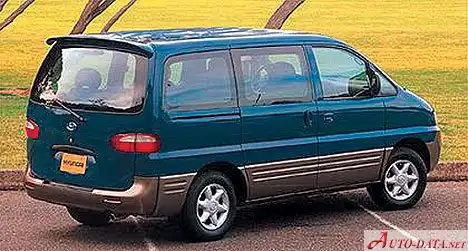
The Hyundai H-1, often marketed as the Starex in many international markets, is a van produced by the South Korean automaker Hyundai. The first generation H-1 debuted in 1997, but the significant redesign introduced in 2002, forming the H-1 I Starex, represents a substantial evolution of the platform. This article details the 2.5 TD LWB (101 horsepower) variant produced between 2002 and 2007, a configuration particularly popular in regions outside of North America where demand for large passenger and cargo vans remained strong. The long-wheelbase (LWB) version was specifically engineered to maximize interior volume, serving as a versatile vehicle for families, commercial businesses, and various transportation needs.
Powertrain & Engine Architecture
The 2.5 TD LWB (101 Hp) H-1 I Starex is powered by a 2.5-liter inline-four cylinder diesel engine. Depending on the specific market, this engine is identified by various internal codes. It employs a precombustion chamber injection system, a common technology for diesel engines of that era. This system injects fuel into a precombustion chamber, which then ignites the main cylinder charge, promoting more complete and efficient combustion. A turbocharger, coupled with an intercooler, is utilized to boost power output and improve fuel efficiency. The intercooler cools the compressed air from the turbocharger, increasing its density and further optimizing the combustion process. The engine generates 101 horsepower at 4000 rpm. The engine is mounted longitudinally in the front of the vehicle, transmitting power to the rear wheels.
Driving Characteristics
The 101 hp output, combined with the substantial weight of the long-wheelbase H-1, resulted in performance that was best described as adequate. Acceleration was not a primary strength, and the van was more suited for consistent cruising speeds rather than quick overtaking maneuvers. The standard five-speed manual transmission offered a reasonable range of gears, but frequent shifting was often necessary to maintain momentum, especially when the van was fully loaded. Compared to higher-output H-1 variants, or those equipped with automatic transmissions, this configuration prioritized fuel economy and long-term durability over outright performance. The rear-wheel-drive layout provided a stable driving experience, particularly when carrying a full passenger or cargo load, although handling could become less predictable on low-traction surfaces.
Equipment & Trim Levels
The 2.5 TD LWB (101 Hp) variant typically occupied a mid-range position within the H-1 I Starex lineup. Standard features generally included basic air conditioning, power steering, and an anti-lock braking system (ABS). Interior upholstery was typically vinyl or a durable cloth material. The dashboard layout was functional and practical, emphasizing usability over luxurious aesthetics. Optional extras could include power windows, central locking, and upgraded audio systems. The long-wheelbase configuration provided generous space for up to nine passengers, or a substantial cargo area with the rear seats folded or removed. The overall emphasis was on delivering a versatile and affordable transportation solution.
Chassis & Braking
The H-1 I Starex utilized a traditional body-on-frame construction, providing a robust and durable chassis. The front suspension consisted of a double wishbone setup, while the rear suspension employed a leaf spring arrangement. This combination offered a reasonable compromise between ride comfort and load-carrying capability. The front brakes were ventilated discs, providing adequate stopping power, while the rear brakes were drum brakes. The use of drum brakes on the rear axle was a cost-saving measure common in vehicles of this class. The steering system was a rack and pinion type with hydraulic power assistance, making maneuvering relatively easy despite the van’s considerable size.
Market Reception & Comparison
The H-1 I Starex 2.5 TD LWB (101 Hp) was generally well-received in markets where large passenger vans were in demand. Critics praised its spacious interior, robust construction, and relatively affordable price point. However, the engine’s modest power output and the somewhat utilitarian interior were frequently cited as drawbacks. Compared to other trims within the H-1 lineup, such as those equipped with more powerful engines or automatic transmissions, this variant offered a more economical option for buyers who prioritized fuel efficiency and practicality over performance and convenience. Its fuel economy was considered good for a vehicle of its size and type, and its relatively simple mechanical design contributed to reasonably low maintenance costs.
Legacy
The Hyundai H-1 I Starex 2.5 TD LWB (101 Hp) has proven to be a durable and reliable vehicle, with a significant number of examples still in operation today. The 2.5-liter diesel engine, while not exceptionally powerful, is known for its longevity and relatively straightforward maintenance requirements. Spare parts availability remains good in many regions. In the used car market, this variant represents an affordable and practical option for those seeking a spacious and versatile van. While it may not offer the refinement or performance of more modern vehicles, its robust construction and simple mechanical design continue to appeal to buyers looking for a dependable and hardworking vehicle.
