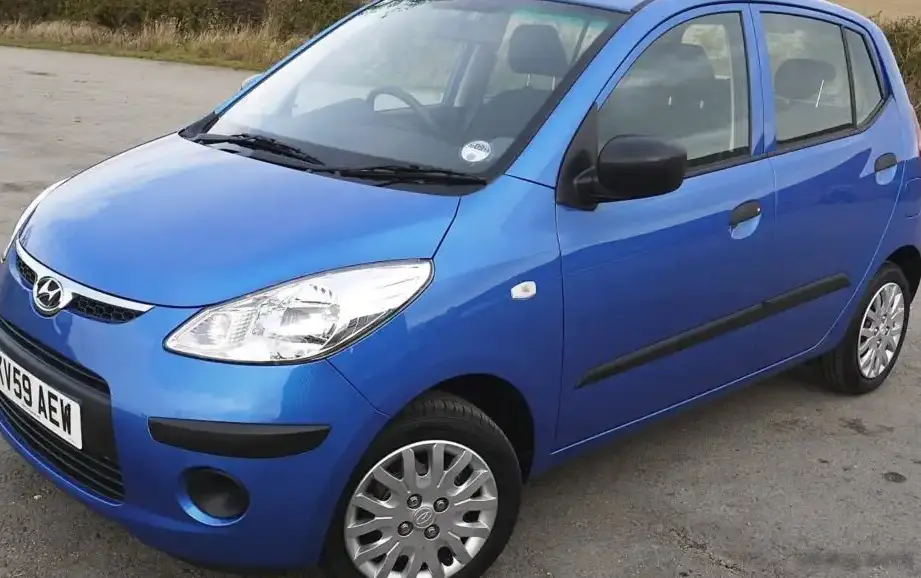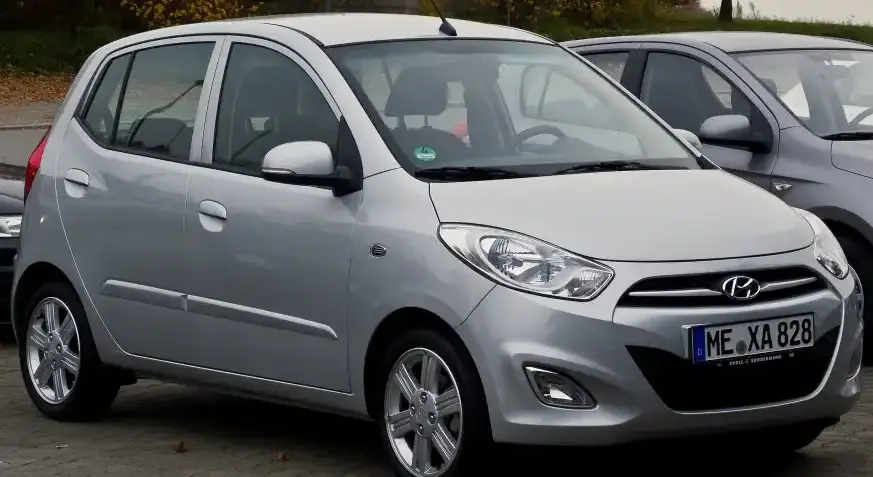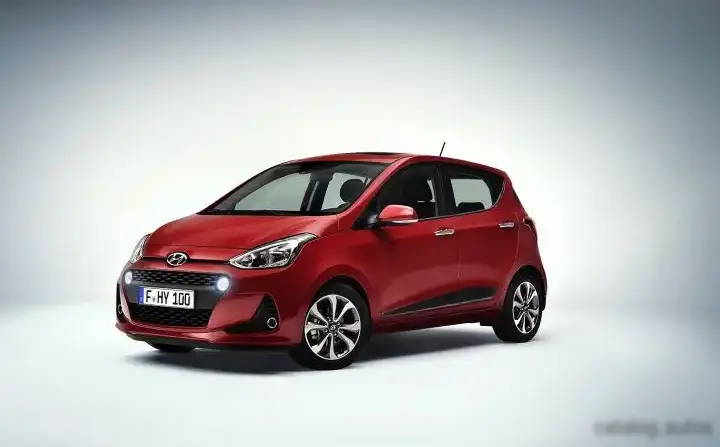
The Hyundai i10 II (facelift, introduced in 2016) 1.2-liter 87 horsepower variant was a key offering in Hyundai’s city car lineup, primarily targeted at the European market. Positioned as a practical and affordable option, this version of the i10 aimed to balance fuel efficiency with adequate performance for urban driving. Production of this specific configuration ran from 2016 until August 2018, falling within the broader lifecycle of the second-generation i10 (launched in 2013 and receiving a significant facelift in 2016). It was built on the HA3 platform, a dedicated small car architecture.
Technical Specifications
| Brand | Hyundai |
| Model | i10 |
| Generation | i10 II (facelift 2016) |
| Type (Engine) | 1.2 (87 Hp) |
| Start of production | 2016 |
| End of production | August, 2018 |
| Powertrain Architecture | Internal Combustion engine |
| Body type | Hatchback |
| Seats | 5 |
| Doors | 5 |
| Fuel consumption (urban) | 6.5 l/100 km (36.2 US mpg, 43.5 UK mpg, 15.4 km/l) |
| Fuel consumption (extra urban) | 4.1 l/100 km (57.4 US mpg, 68.9 UK mpg, 24.4 km/l) |
| Fuel consumption (combined) | 4.9 l/100 km (48 US mpg, 57.6 UK mpg, 20.4 km/l) |
| CO2 emissions | 114 g/km |
| Fuel Type | Petrol (Gasoline) |
| Acceleration 0 – 100 km/h | 12.3 sec |
| Acceleration 0 – 62 mph | 12.3 sec |
| Acceleration 0 – 60 mph | 11.7 sec |
| Maximum speed | 175 km/h (108.74 mph) |
| Emission standard | Euro 6 |
| Weight-to-power ratio | 11.7 kg/Hp, 85.6 Hp/tonne |
| Weight-to-torque ratio | 8.4 kg/Nm, 119.1 Nm/tonne |
| Power | 87 Hp @ 6000 rpm |
| Power per litre | 69.7 Hp/l |
| Torque | 121 Nm @ 4000 rpm (89.25 lb.-ft. @ 4000 rpm) |
| Engine layout | Front, Transverse |
| Engine Model/Code | G4LA |
| Engine displacement | 1248 cm3 (76.16 cu. in.) |
| Number of cylinders | 4 |
| Engine configuration | Inline |
| Cylinder Bore | 71 mm (2.8 in.) |
| Piston Stroke | 78.8 mm (3.1 in.) |
| Compression ratio | 10.5:1 |
| Number of valves per cylinder | 4 |
| Fuel injection system | Multi-port manifold injection |
| Engine aspiration | Naturally aspirated engine |
| Engine oil capacity | 3.6 l (3.8 US qt | 3.17 UK qt) |
| Kerb Weight | 1016 kg (2239.9 lbs.) |
| Max. weight | 1450 kg (3196.7 lbs.) |
| Max load | 434 kg (956.81 lbs.) |
| Trunk (boot) space – minimum | 252 l (8.9 cu. ft.) |
| Trunk (boot) space – maximum | 1046 l (36.94 cu. ft.) |
| Fuel tank capacity | 40 l (10.57 US gal | 8.8 UK gal) |
| Max. roof load | 60 kg (132.28 lbs.) |
| Length | 3665 mm (144.29 in.) |
| Width | 1660 mm (65.35 in.) |
| Height | 1500 mm (59.06 in.) |
| Wheelbase | 2385 mm (93.9 in.) |
| Front track | 1467 mm (57.76 in.) |
| Rear (Back) track | 1480 mm (58.27 in.) |
| Front overhang | 740 mm (29.13 in.) |
| Rear overhang | 540 mm (21.26 in.) |
| Ride height (ground clearance) | 149 mm (5.87 in.) |
| Drivetrain Architecture | Front wheel drive |
| Number of gears and type of gearbox | 5 gears, manual transmission |
| Front suspension | Independent type McPherson |
| Rear suspension | independent torsion suspension |
| Front brakes | Ventilated discs |
| Rear brakes | Disc |
| Assisting systems | ABS (Anti-lock braking system) |
| Steering type | Steering rack and pinion |
| Power steering | Electric Steering |
| Tires size | 175/65 R14; 185/55 R15 |
| Wheel rims size | 5.5J x 14; 6.0J x 15 |
INTRODUCTION
The Hyundai i10 II facelift, specifically the 1.2-liter 87 horsepower version, represented a significant step forward for Hyundai in the European city car segment. Introduced in 2016, this iteration of the i10 built upon the success of the original second-generation model, offering improved styling, enhanced safety features, and a more refined driving experience. It was designed to appeal to buyers seeking a compact, economical, and reliable vehicle for navigating congested urban environments. This trim level served as a sweet spot in the i10 range, offering a balance between affordability and usability.
Powertrain & Engine Architecture
At the heart of this i10 variant lies the Hyundai G4LA 1.2-liter inline-four cylinder gasoline engine. This engine, a member of Hyundai’s Kappa family, utilizes a multi-point fuel injection system and a timing chain for durability. The G4LA produces 87 horsepower at 6000 rpm and 121 Nm (89.25 lb-ft) of torque at 4000 rpm. The engine features a compression ratio of 10.5:1. The 1.2L engine was paired with a five-speed manual transmission in most markets, although a four-speed automatic transmission was also available, albeit less common. The automatic transmission, while providing convenience, did impact fuel economy and acceleration slightly. The engine is transversely mounted, driving the front wheels.
Driving Characteristics
The 1.2-liter i10 with the manual transmission offered adequate performance for city driving. Acceleration to 60 mph took around 11.7 seconds, and top speed was approximately 108.74 mph. While not particularly sporty, the engine provided sufficient power for merging into traffic and maintaining highway speeds. The five-speed manual gearbox was light and easy to use, enhancing the driving experience. The automatic transmission, while smooth, resulted in a noticeable decrease in responsiveness and a slightly slower 0-60 mph time of around 12.3 seconds. Gear ratios were optimized for fuel efficiency rather than outright performance. The i10’s light weight (around 1016 kg or 2239.9 lbs) helped to mitigate the effects of the relatively modest power output.
Equipment & Trim Levels
The 1.2-liter i10 typically came equipped with a reasonable level of standard features. These included air conditioning, power steering, central locking, electric front windows, and a basic audio system with USB connectivity. Higher trim levels, such as SE or Premium, added features like alloy wheels, fog lights, a touchscreen infotainment system, and Bluetooth connectivity. Interior upholstery was typically cloth, with a simple and functional dashboard layout. Optional extras included a panoramic sunroof and parking sensors.
Chassis & Braking
The i10 II utilized a McPherson strut front suspension and a torsion beam rear suspension. This setup provided a comfortable ride quality, well-suited for navigating uneven road surfaces. Front brakes were ventilated discs, while rear brakes were discs. ABS (Anti-lock Braking System) was standard. The steering was electrically assisted, providing light and precise control. The relatively lightweight construction of the i10 contributed to its nimble handling characteristics. Tire sizes varied depending on the trim level, with 175/65 R14 and 185/55 R15 being common options.
Market Reception & Comparison
The Hyundai i10 1.2-liter received generally positive reviews from automotive critics. It was praised for its affordability, fuel efficiency, and practicality. Compared to its rivals, such as the Kia Picanto, Volkswagen up!, and Fiat 500, the i10 offered a compelling value proposition. The 1.2-liter engine provided a good balance between performance and economy, although some reviewers noted that it could feel strained when fully loaded or driving uphill. The automatic transmission was often criticized for its sluggishness. Fuel economy figures of around 48 US mpg combined were competitive within its class. Reliability was also a strong point, with the i10 proving to be a dependable and trouble-free vehicle.
Legacy
The Hyundai i10 II (facelift) 1.2-liter 87 horsepower variant has proven to be a reliable and durable vehicle in the used car market. The G4LA engine is known for its longevity, and the i10’s simple construction makes it relatively easy and inexpensive to maintain. While not a performance car, it remains a popular choice for buyers seeking an affordable and economical city car. Common issues are generally minor, often related to wear and tear on components like the clutch and brakes. The availability of spare parts is good, and the i10 continues to hold its value reasonably well, making it a sensible purchase for budget-conscious buyers.