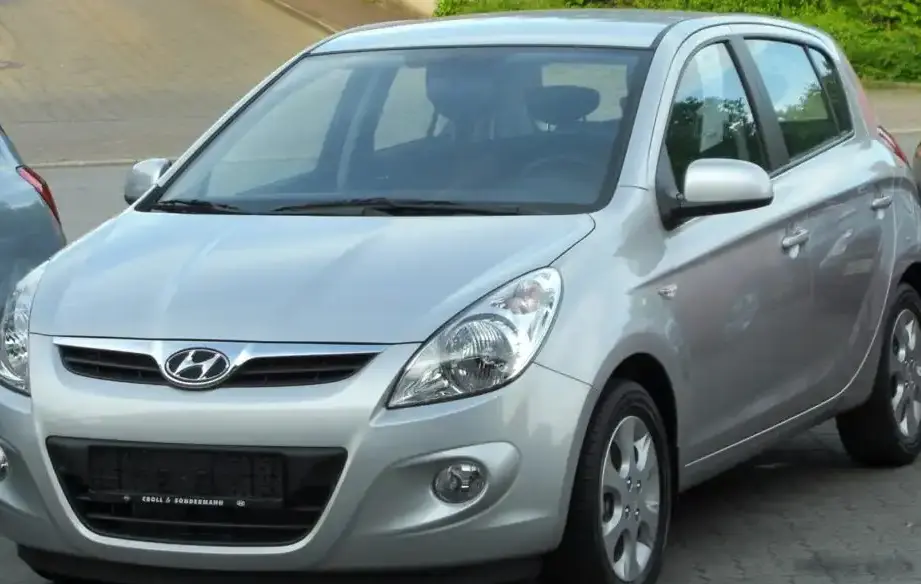
The Hyundai i20 I (PB) 1.4 CRDi 90 hp, produced between 2010 and 2012, represented an entry point into the first generation of Hyundai’s popular subcompact hatchback. Positioned within the PB series, which spanned from 2008 to 2014, this variant aimed to deliver fuel efficiency and reasonable performance for urban commuting and everyday driving. It served as a diesel-powered alternative to the gasoline-fueled i20 models, targeting buyers seeking lower running costs. The i20 PB was a significant model for Hyundai in the European market, helping to establish the brand as a competitor in the increasingly crowded small car segment.
Technical Specifications
| Brand | Hyundai |
| Model | i20 |
| Generation | i20 I (PB) |
| Type (Engine) | 1.4 CRDi (90 Hp) |
| Start of production | 2010 |
| End of production | 2012 |
| Powertrain Architecture | Internal Combustion engine |
| Body type | Hatchback |
| Seats | 5 |
| Doors | 5 |
| Fuel consumption (urban) | 5.5 l/100 km (42.8 US mpg, 51.4 UK mpg, 18.2 km/l) |
| Fuel consumption (extra urban) | 3.8 l/100 km (61.9 US mpg, 74.3 UK mpg, 26.3 km/l) |
| Fuel consumption (combined) | 4.4 l/100 km (53.5 US mpg, 64.2 UK mpg, 22.7 km/l) |
| Fuel Type | Diesel |
| Acceleration 0 – 100 km/h | 13.6 sec |
| Acceleration 0 – 62 mph | 13.6 sec |
| Acceleration 0 – 60 mph | 12.9 sec |
| Maximum speed | 171 km/h (106.25 mph) |
| Emission standard | Euro 4 |
| Weight-to-power ratio | 12.2 kg/Hp, 81.9 Hp/tonne |
| Weight-to-torque ratio | 5 kg/Nm, 200.2 Nm/tonne |
| Power | 90 Hp @ 4000 rpm |
| Power per litre | 64.5 Hp/l |
| Torque | 220 Nm @ 1750-2750 rpm (162.26 lb.-ft. @ 1750-2750 rpm) |
| Engine layout | Front, Transverse |
| Engine Model/Code | D4FC |
| Engine displacement | 1396 cm3 (85.19 cu. in.) |
| Number of cylinders | 4 |
| Engine configuration | Inline |
| Cylinder Bore | 75 mm (2.95 in.) |
| Piston Stroke | 79 mm (3.11 in.) |
| Compression ratio | 17:1 |
| Number of valves per cylinder | 4 |
| Fuel injection system | Diesel Commonrail |
| Engine aspiration | Turbocharger, Intercooler |
| Valvetrain | DOHC |
| Engine oil capacity | 5.3 l (5.6 US qt | 4.66 UK qt) |
| Coolant | 6.8 l (7.19 US qt | 5.98 UK qt) |
| Kerb Weight | 1099 kg (2422.88 lbs.) |
| Max. weight | 1635 kg (3604.56 lbs.) |
| Max load | 536 kg (1181.68 lbs.) |
| Trunk (boot) space – minimum | 295 l (10.42 cu. ft.) |
| Trunk (boot) space – maximum | 1060 l (37.43 cu. ft.) |
| Fuel tank capacity | 45 l (11.89 US gal | 9.9 UK gal) |
| Length | 3940 mm (155.12 in.) |
| Width | 1710 mm (67.32 in.) |
| Height | 1490 mm (58.66 in.) |
| Wheelbase | 2525 mm (99.41 in.) |
| Front track | 1487 mm (58.54 in.) |
| Rear (Back) track | 1485 mm (58.46 in.) |
| Ride height (ground clearance) | 150 mm (5.91 in.) |
| Drag coefficient (Cd) | 0.32 |
| Minimum turning circle | 10.4 m (34.12 ft.) |
| Drivetrain Architecture | ICE, Front wheel drive |
| Drive wheel | Front wheel drive |
| Number of gears | 5 |
| Gearbox type | Manual transmission |
| Front brakes | Ventilated discs |
| Rear brakes | Disc |
| Assisting systems | ABS (Anti-lock braking system) |
| Steering type | Steering rack and pinion |
| Power steering | Electric Steering |
| Tires size | 185/60 R15 |
| Wheel rims size | 15 |
INTRODUCTION
The Hyundai i20 I (PB) 1.4 CRDi 90 hp, launched in 2010, was a key variant within Hyundai’s first-generation i20 hatchback range. Built on the PB platform, it offered a diesel engine option aimed at maximizing fuel economy. This model was particularly important for Hyundai’s expansion in the European market, where diesel engines were – and continue to be – highly popular due to favorable taxation and fuel costs. The 1.4 CRDi 90 hp trim occupied the lower-mid range of the i20 lineup, offering a balance between affordability and efficiency. It sat below the more powerful diesel variants and above the base gasoline models.
Powertrain & Engine Architecture
At the heart of the i20 1.4 CRDi was the D4FC engine, a 1.4-liter inline-four cylinder diesel. This engine utilized a second-generation common rail direct injection system, delivering fuel at extremely high pressure for improved combustion efficiency and reduced emissions. The engine featured a turbocharger with an intercooler, boosting power output to 90 horsepower at 4000 rpm and 220 Nm (162 lb-ft) of torque between 1750 and 2750 rpm. The engine employed a double overhead camshaft (DOHC) valvetrain with four valves per cylinder. The 5-speed manual transmission was the standard gearbox for this variant, chosen for its efficiency and cost-effectiveness. The engine’s design prioritized fuel economy and low-end torque, making it well-suited for city driving.
Driving Characteristics
The i20 1.4 CRDi 90 hp offered a comfortable, if not particularly sporty, driving experience. Acceleration from 0 to 60 mph took around 12.9 seconds, and the top speed was 106.25 mph. The engine’s strong low-end torque made it easy to navigate urban traffic, with ample power for overtaking at lower speeds. However, the engine could feel strained at higher speeds or when fully loaded. Compared to the more powerful 1.6 CRDi variants, the 1.4 CRDi felt less responsive, but it compensated with superior fuel economy. The 5-speed manual transmission was smooth and precise, although the gear ratios were geared towards efficiency rather than performance. The relatively soft suspension provided a comfortable ride, but it also resulted in some body roll during cornering.
Equipment & Trim Levels
The i20 1.4 CRDi 90 hp typically came equipped with a reasonable level of standard features. These included air conditioning, power steering, electric front windows, a CD player with MP3 compatibility, and ABS brakes. Higher trim levels offered additional features such as alloy wheels, a trip computer, remote central locking, and a height-adjustable driver’s seat. Interior upholstery was typically cloth, with a functional and durable design. Optional extras included a sunroof, parking sensors, and upgraded audio systems. The dashboard layout was straightforward and user-friendly, with clearly labeled controls.
Chassis & Braking
The i20 1.4 CRDi utilized a front-wheel-drive layout with a MacPherson strut front suspension and a torsion beam rear suspension. The front brakes were ventilated discs, providing adequate stopping power, while the rear brakes were solid discs. The steering was a rack and pinion system with electric power assistance, offering light and precise steering feel. The suspension was tuned for comfort, prioritizing ride quality over handling precision. The car’s relatively light weight (1099 kg / 2422.88 lbs) helped to offset the modest power output, contributing to reasonable fuel economy and handling.
Market Reception & Comparison
The Hyundai i20 1.4 CRDi 90 hp was generally well-received by automotive critics as a practical and economical small car. It was praised for its fuel efficiency, comfortable ride, and competitive price. However, some reviewers noted its lack of outright performance and its somewhat basic interior. Compared to rivals such as the Ford Fiesta, Volkswagen Polo, and Renault Clio, the i20 offered a compelling value proposition, particularly for buyers prioritizing fuel economy and affordability. The 1.6 CRDi variants offered more performance, but at a higher price point and with slightly lower fuel economy. The gasoline-powered i20 models were cheaper to purchase but less fuel-efficient.
Legacy
The Hyundai i20 I (PB) 1.4 CRDi 90 hp has proven to be a relatively reliable and durable vehicle. The D4FC engine, while not without its potential issues (such as diesel particulate filter clogging), is generally considered to be robust and long-lasting. In the used car market, these i20s remain popular due to their affordability and fuel efficiency. They represent a good option for budget-conscious buyers seeking a practical and economical small car. However, potential buyers should be aware of the potential maintenance costs associated with diesel engines, such as DPF replacement and injector servicing. Overall, the i20 1.4 CRDi 90 hp played a significant role in establishing Hyundai as a major player in the European small car market.