Technical Specifications
| Brand | Hyundai |
| Model | i20 |
| Generation | i20 I (PB facelift 2012) |
| Type (Engine) | 1.4 16V (101 Hp) Automatic |
| Start of production | 2012 |
| End of production | 2014 |
| Powertrain Architecture | Internal Combustion engine |
| Body type | Hatchback |
| Seats | 5 |
| Doors | 5 |
| Fuel consumption (urban) | 7.7 l/100 km (30.5 US mpg) |
| Fuel consumption (extra urban) | 4.7 l/100 km (50 US mpg) |
| Fuel consumption (combined) | 5.8 l/100 km (40.6 US mpg) |
| Fuel Type | Petrol (Gasoline) |
| Acceleration 0 – 100 km/h | 12.9 sec |
| Acceleration 0 – 62 mph | 12.9 sec |
| Acceleration 0 – 60 mph | 12.3 sec |
| Maximum speed | 170 km/h (105.63 mph) |
| Emission standard | Euro 5 |
| Weight-to-power ratio | 10.2 kg/Hp |
| Weight-to-torque ratio | 7.5 kg/Nm |
| Power | 101 Hp @ 5500 rpm |
| Torque | 137 Nm @ 4200 rpm (101.05 lb.-ft. @ 4200 rpm) |
| Engine layout | Front, Transverse |
| Engine Model/Code | G4FA |
| Engine displacement | 1396 cm3 (85.19 cu. in.) |
| Number of cylinders | 4 |
| Engine configuration | Inline |
| Cylinder Bore | 77 mm (3.03 in.) |
| Piston Stroke | 74.9 mm (2.95 in.) |
| Compression ratio | 10.5:1 |
| Number of valves per cylinder | 4 |
| Fuel injection system | Multi-port manifold injection |
| Engine aspiration | Naturally aspirated engine |
| Valvetrain | DOHC |
| Engine oil capacity | 3.3 l (3.49 US qt | 2.9 UK qt) |
| Coolant capacity | 5.8 l (6.13 US qt | 5.1 UK qt) |
| Kerb Weight | 1028 kg (2266.35 lbs.) |
| Max. weight | 1565 kg (3450.23 lbs.) |
| Max load | 537 kg (1183.88 lbs.) |
| Trunk (boot) space – minimum | 295 l (10.42 cu. ft.) |
| Trunk (boot) space – maximum | 1060 l (37.43 cu. ft.) |
| Fuel tank capacity | 45 l (11.89 US gal | 9.9 UK gal) |
| Length | 3940 mm (155.12 in.) |
| Width | 1710 mm (67.32 in.) |
| Height | 1490 mm (58.66 in.) |
| Wheelbase | 2525 mm (99.41 in.) |
| Front track | 1503 mm (59.17 in.) |
| Rear track | 1501 mm (59.09 in.) |
| Minimum turning circle | 10.4 m (34.12 ft.) |
| Drivetrain Architecture | Front wheel drive |
| Number of gears | 4 |
| Gearbox type | Automatic transmission |
| Front suspension | Independent type McPherson |
| Rear suspension | Independent coil spring |
| Front brakes | Ventilated discs |
| Rear brakes | Disc |
| Assisting systems | ABS (Anti-lock braking system) |
| Steering type | Steering rack and pinion |
| Power steering | Electric Steering |
| Tires size | 175/70 R14 |
| Wheel rims size | 5.5J x 14 |
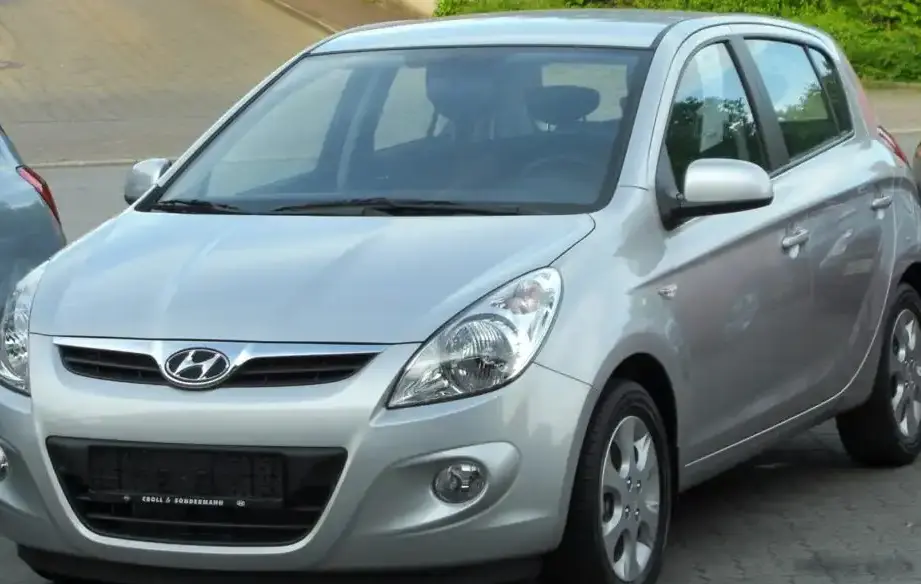
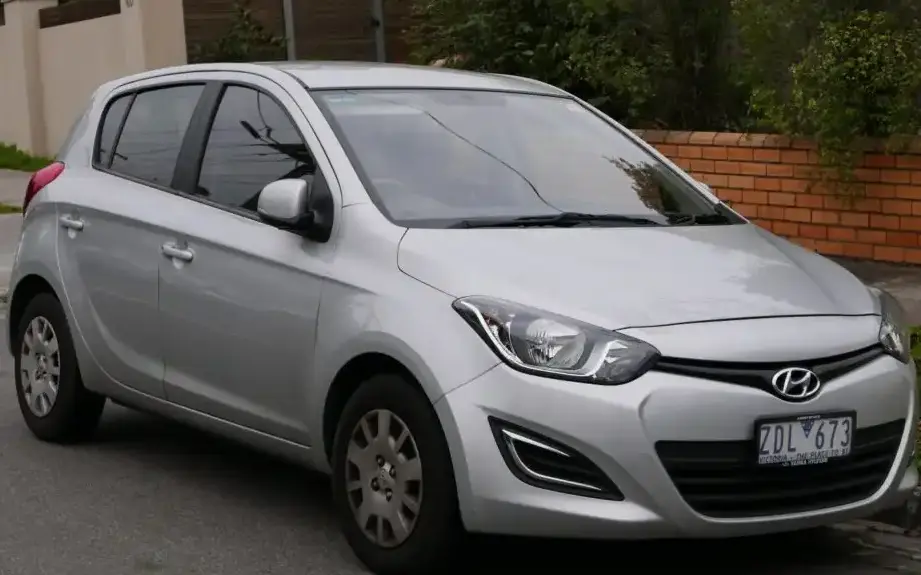
The Hyundai i20 I (PB facelift) 1.4 16V Automatic, produced from 2012 to 2014, was a significant model in Hyundai’s subcompact hatchback range. This variant, part of the first-generation i20 (PB) series that received a facelift in 2012, aimed to provide a comfortable and accessible entry point into the model range, appealing to buyers who prioritized ease of driving over outright performance. It was positioned as an upgrade from the base 1.2L engine option, offering more power and refinement while remaining more affordable than the higher-specification trims. The i20, as a whole, was designed to compete with established European rivals like the Ford Fiesta and Volkswagen Polo, offering a compelling value proposition backed by a longer warranty and increasing levels of standard equipment.
Powertrain & Engine Architecture
The 1.4L i20 variant is powered by the Hyundai G4FA 1.4-liter inline-four cylinder gasoline engine. This engine, a common component in several Hyundai and Kia models of the era, features a multi-point fuel injection system and a double overhead camshaft (DOHC) valvetrain with four valves per cylinder. The G4FA is naturally aspirated, meaning it doesn’t utilize turbocharging or supercharging, focusing on smooth and predictable power delivery. The engine generates 101 horsepower at 5,500 rpm and 137 Nm (101 lb-ft) of torque at 4,200 rpm. This engine is coupled with a four-speed automatic transmission. While not the most advanced transmission available at the time, it offered a convenient driving experience for those who preferred not to use a manual gearbox. The transmission’s gear ratios were optimized for fuel efficiency and comfortable cruising, rather than aggressive acceleration.
Driving Characteristics
The 1.4L Automatic i20 delivered a comfortable, though not particularly sporty, driving experience. Acceleration from 0-60 mph took approximately 12.3 seconds, with a top speed limited to 170 km/h (105.63 mph). The four-speed automatic transmission, while smooth, lacked the responsiveness and efficiency of more modern transmissions with a greater number of gears. The engine provided adequate power for city driving and highway cruising, but struggled when fully loaded or during quick overtaking maneuvers. Compared to the manual transmission version of the same engine, the automatic resulted in a slight performance reduction due to the transmission’s inherent power loss. Fuel economy was also somewhat lower in the automatic version. In contrast to higher-trim i20 models equipped with larger engines, this variant offered a more economical and relaxed driving experience.
Equipment & Trim Levels
The 1.4 16V Automatic trim typically included standard features such as air conditioning, power windows, central locking, and a basic audio system with a CD player. Safety features included ABS (Anti-lock Braking System) and dual front airbags. Optional extras and higher trim levels offered features like alloy wheels, a more sophisticated audio system with Bluetooth connectivity, and a sunroof. The interior upholstery was generally cloth, with a relatively simple and functional dashboard layout. The overall interior design prioritized practicality and durability over luxury.
Chassis & Braking
The i20 I (PB facelift) featured a McPherson strut independent suspension at the front and a coil spring independent suspension at the rear, providing a reasonable balance between ride comfort and handling. The front brakes were ventilated discs, while the rear brakes were solid discs. The steering system was rack and pinion with electric power assistance, offering light and easy steering feel. The car’s relatively light weight (1028 kg / 2266.35 lbs) helped to offset the limitations of the engine’s modest output.
Market Reception & Comparison
The Hyundai i20 1.4 Automatic was generally well-received by automotive critics as a practical and affordable subcompact hatchback. It was praised for its value for money, comfortable ride, and generous warranty. However, it also faced criticism for its relatively uninspiring performance and the somewhat dated four-speed automatic transmission. Compared to competitors like the Ford Fiesta and Volkswagen Polo, the i20 offered a more spacious interior and a longer warranty, but lacked the driving refinement and brand prestige of those rivals. Fuel economy was competitive within its class, and reliability was generally considered to be good.
Legacy
The Hyundai i20 I (PB facelift) 1.4 16V Automatic has proven to be a reliable and durable vehicle. The G4FA engine is known for its longevity, and the four-speed automatic transmission, while not highly sophisticated, is generally robust. In the used car market, these i20s are often sought after as affordable and practical transportation options. While not a performance-oriented vehicle, this variant represents a significant advancement for Hyundai in terms of build quality, features, and overall refinement, helping to establish the brand as a serious competitor in the European subcompact car segment.