Technical Specifications
| Brand | Hyundai |
| Model | i20 |
| Generation | i20 II Active |
| Type (Engine) | 1.0 T-GDI (120 Hp) |
| Start of production | 2016 |
| End of production | 2018 |
| Powertrain Architecture | Internal Combustion engine |
| Body type | Crossover |
| Seats | 5 |
| Doors | 5 |
| Fuel consumption (combined) | 5.0 – 5.2 l/100 km (47 – 45.2 US mpg, 56.5 – 54.3 UK mpg, 20 – 19.2 km/l) |
| CO2 emissions | 116 – 121 g/km |
| Fuel Type | Petrol (Gasoline) |
| Acceleration 0 – 100 km/h | 10.3 sec |
| Acceleration 0 – 62 mph | 10.3 sec |
| Acceleration 0 – 60 mph | 9.8 sec |
| Maximum speed | 183 km/h (113.71 mph) |
| Emission standard | Euro 6 |
| Weight-to-power ratio | 9.1 kg/Hp, 110.1 Hp/tonne |
| Weight-to-torque ratio | 6.3 kg/Nm, 157.8 Nm/tonne |
| Power | 120 Hp @ 6000 rpm |
| Power per litre | 120.2 Hp/l |
| Torque | 172 Nm @ 1500 rpm (126.86 lb.-ft. @ 1500 rpm) |
| Engine layout | Front, Transverse |
| Engine Model/Code | Kappa II / G3LC |
| Engine displacement | 998 cm3 (60.9 cu. in.) |
| Number of cylinders | 3 |
| Engine configuration | Inline |
| Cylinder Bore | 71 mm (2.8 in.) |
| Piston Stroke | 84 mm (3.31 in.) |
| Compression ratio | 10:1 |
| Number of valves per cylinder | 4 |
| Fuel injection system | Direct injection |
| Engine aspiration | Turbocharger, Intercooler |
| Valvetrain | DOHC |
| Engine oil capacity | 3.6 l (3.8 US qt | 3.17 UK qt) |
| Coolant | 6.4 l (6.76 US qt | 5.63 UK qt) |
| Kerb Weight | 1090 kg (2403.04 lbs.) |
| Max. weight | 1650 kg (3637.63 lbs.) |
| Max load | 560 kg (1234.59 lbs.) |
| Trunk (boot) space – minimum | 326 l (11.51 cu. ft.) |
| Trunk (boot) space – maximum | 1042 l (36.8 cu. ft.) |
| Fuel tank capacity | 50 l (13.21 US gal | 11 UK gal) |
| Max. roof load | 70 kg (154.32 lbs.) |
| Length | 4065 mm (160.04 in.) |
| Width | 1760 mm (69.29 in.) |
| Height | 1529 mm (60.2 in.) |
| Wheelbase | 2570 mm (101.18 in.) |
| Front track | 1511-1517 mm (59.49 – 59.72 in.) |
| Rear (Back) track | 1513-1519 mm (59.57 – 59.8 in.) |
| Front overhang | 843 mm (33.19 in.) |
| Rear overhang | 652 mm (25.67 in.) |
| Ride height (ground clearance) | 160 mm (6.3 in.) |
| Minimum turning circle | 10.2 m (33.46 ft.) |
| Drivetrain Architecture | Front wheel drive |
| Drive wheel | Front wheel drive |
| Number of gears and type of gearbox | 6 gears, manual transmission |
| Front suspension | Independent type McPherson |
| Rear suspension | Semi-independent, coil spring |
| Front brakes | Ventilated discs |
| Rear brakes | Disc |
| Assisting systems | ABS (Anti-lock braking system) |
| Steering type | Steering rack and pinion |
| Power steering | Electric Steering |
| Tires size | 185/65 R15; 195/55 R16; 205/45 R17 |
| Wheel rims size | 6.0J x 15; 6.0J x 16; 6.5J x 17 |
The Hyundai i20 II Active 1.0 T-GDI, produced from 2016 to 2018, represents a significant variant within the second generation of Hyundai’s popular subcompact hatchback. Positioned as a crossover-styled version of the i20, the Active model aimed to capitalize on the growing demand for vehicles offering a slightly more rugged aesthetic and increased ground clearance. This particular configuration, equipped with the 1.0-liter turbocharged gasoline direct injection (T-GDI) engine producing 120 horsepower, served as a mid-range offering in the i20 Active lineup, bridging the gap between the base engine options and potentially more powerful alternatives depending on the market. It was primarily sold in the European market, where the subcompact crossover segment was experiencing substantial growth.
Powertrain & Engine Architecture
The heart of the i20 Active 1.0 T-GDI is Hyundai’s Kappa II engine family, specifically the G3LC code. This is a three-cylinder, 1.0-liter turbocharged gasoline engine featuring direct fuel injection. The direct injection system, coupled with the turbocharger and intercooler, allows for a high compression ratio of 10:1 and efficient combustion, contributing to both power output and fuel economy. The engine utilizes a dual overhead camshaft (DOHC) valvetrain with four valves per cylinder, optimizing airflow for improved performance. The turbocharger is a key component, providing a significant boost in power compared to naturally aspirated engines of similar displacement. The engine’s relatively small displacement and turbocharging contribute to reduced internal friction and weight. The 6-speed manual transmission was standard, offering precise gear changes and contributing to a more engaging driving experience.
Driving Characteristics
The 120 horsepower output of the 1.0 T-GDI engine in the i20 Active provides adequate performance for everyday driving. Acceleration from 0-60 mph takes approximately 9.8 seconds, and the top speed is around 113.71 mph. While not a particularly sporty vehicle, the turbocharger provides a noticeable boost in torque at lower engine speeds, making it relatively easy to keep up with traffic and execute overtaking maneuvers. The manual transmission allows for greater driver control, but the gear ratios are tuned for fuel efficiency rather than outright performance. Compared to potential higher-output versions of the i20, this variant prioritizes fuel economy and affordability over raw speed. The Active’s slightly increased ride height, compared to the standard i20, does introduce a bit more body roll in corners, but it also improves visibility and provides a more comfortable ride on uneven road surfaces.
Equipment & Trim Levels
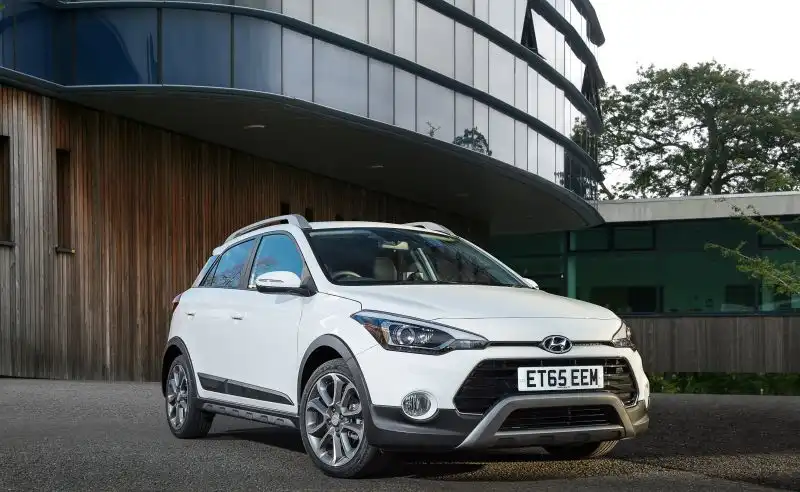
The i20 Active 1.0 T-GDI typically came with a reasonable level of standard equipment. This included air conditioning, power windows, central locking, and a basic audio system with USB connectivity. Safety features such as ABS, Electronic Stability Control (ESC), and multiple airbags were also standard. Higher trim levels offered additional features such as alloy wheels, a touchscreen infotainment system with Apple CarPlay and Android Auto compatibility, rear parking sensors, and a reversing camera. Interior upholstery was typically cloth, with options for different color schemes. The Active trim also featured unique exterior styling elements, such as rugged-looking bumpers, side moldings, and roof rails, to emphasize its crossover appearance.
Chassis & Braking
The i20 Active utilizes a McPherson strut front suspension and a semi-independent coil spring rear suspension. This setup provides a good balance between ride comfort and handling. The front brakes are ventilated discs, offering good stopping power, while the rear brakes are discs. The electric power steering provides light and precise steering feel. The Active model’s slightly increased ride height necessitates a slightly softer suspension setup compared to the standard i20, prioritizing comfort over sporty handling. The chassis is relatively lightweight, contributing to the car’s overall agility and fuel efficiency.
Market Reception & Comparison
The Hyundai i20 Active 1.0 T-GDI was generally well-received by automotive critics. It was praised for its fuel efficiency, comfortable ride, and relatively spacious interior. However, some critics noted that the engine could feel a bit strained when fully loaded or driving uphill. Compared to other trims in the i20 lineup, the 1.0 T-GDI offered a good balance between performance and economy. It was more affordable than the higher-output engine options, while still providing a noticeable improvement in performance over the base engines. In terms of reliability, the Kappa engine family has proven to be generally reliable, although regular maintenance is essential to ensure long-term durability.
Legacy
The Hyundai i20 II Active 1.0 T-GDI has established itself as a popular choice in the used car market. Its combination of fuel efficiency, practicality, and affordability makes it an attractive option for buyers looking for a small, reliable crossover. The Kappa engine, while not known for being particularly exciting, has proven to be durable and relatively easy to maintain. As with any used car, it’s important to check for signs of wear and tear and ensure that the vehicle has been properly maintained. The i20 Active 1.0 T-GDI represents a significant step forward for Hyundai in terms of design, technology, and overall quality, and it continues to be a well-regarded vehicle in its segment.