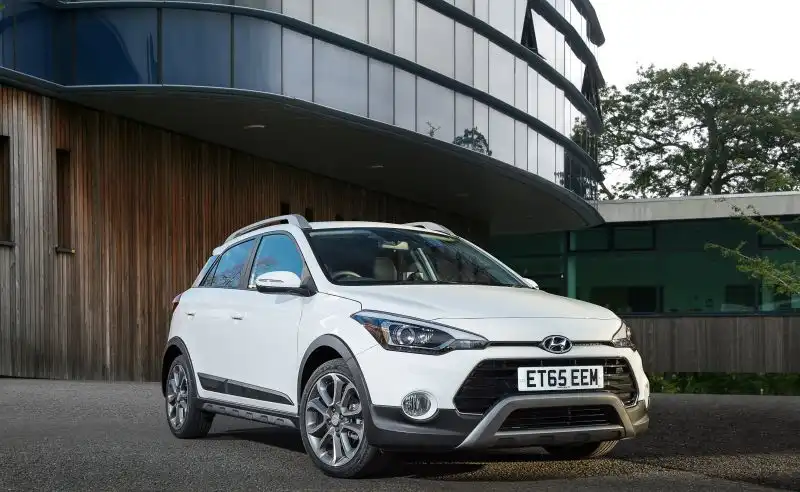
The Hyundai i20 II Active 1.4, produced from 2016 to 2018, represents a subcompact crossover variant within the second generation of the Hyundai i20 (codenamed PB). Positioned as a more rugged-looking and slightly elevated version of the standard i20, the Active model aimed to capitalize on the growing popularity of small crossovers in the European market. This specific 1.4-liter, 100 horsepower configuration served as a mid-range offering, bridging the gap between the base 1.2-liter engine and the more powerful 1.0 T-GDI turbocharged option. It was primarily sold in Europe and other markets where subcompact crossovers were gaining traction.
Technical Specifications
| Brand | Hyundai |
| Model | i20 |
| Generation | i20 II Active |
| Type (Engine) | 1.4 (100 Hp) |
| Start of production | 2016 |
| End of production | 2018 |
| Powertrain Architecture | Internal Combustion engine |
| Body type | Crossover |
| Seats | 5 |
| Doors | 5 |
| Fuel consumption (combined) | 5.6 – 5.8 l/100 km (42 – 40.6 US mpg) |
| CO2 emissions | 129 – 135 g/km |
| Fuel Type | Petrol (Gasoline) |
| Acceleration 0 – 100 km/h | 11.9 sec |
| Acceleration 0 – 62 mph | 11.9 sec |
| Acceleration 0 – 60 mph | 11.3 sec |
| Maximum speed | 178 km/h (110.6 mph) |
| Emission standard | Euro 6 |
| Weight-to-power ratio | 10.5 kg/Hp |
| Weight-to-torque ratio | 7.8 kg/Nm |
| Power | 100 Hp @ 6000 rpm |
| Torque | 134 Nm @ 3500 rpm (98.83 lb.-ft. @ 3500 rpm) |
| Engine layout | Front, Transverse |
| Engine Model/Code | Kappa / G4LC |
| Engine displacement | 1368 cm3 (83.48 cu. in.) |
| Number of cylinders | 4 |
| Engine configuration | Inline |
| Cylinder Bore | 72 mm (2.83 in.) |
| Piston Stroke | 84 mm (3.31 in.) |
| Compression ratio | 10.5:1 |
| Number of valves per cylinder | 4 |
| Fuel injection system | Multi-port manifold injection |
| Engine aspiration | Naturally aspirated engine |
| Valvetrain | DOHC |
| Engine oil capacity | 3.5 l (3.7 US qt | 3.08 UK qt) |
| Coolant | 4.3 l (4.54 US qt | 3.78 UK qt) |
| Kerb Weight | 1050 kg (2314.85 lbs.) |
| Max. weight | 1620 kg (3571.49 lbs.) |
| Max load | 570 kg (1256.63 lbs.) |
| Trunk (boot) space – minimum | 326 l (11.51 cu. ft.) |
| Trunk (boot) space – maximum | 1042 l (36.8 cu. ft.) |
| Fuel tank capacity | 50 l (13.21 US gal | 11 UK gal) |
| Max. roof load | 70 kg (154.32 lbs.) |
| Length | 4065 mm (160.04 in.) |
| Width | 1760 mm (69.29 in.) |
| Height | 1529 mm (60.2 in.) |
| Wheelbase | 2570 mm (101.18 in.) |
| Front track | 1511-1517 mm (59.49 – 59.72 in.) |
| Rear (Back) track | 1513-1519 mm (59.57 – 59.8 in.) |
| Front overhang | 843 mm (33.19 in.) |
| Rear overhang | 652 mm (25.67 in.) |
| Ride height (ground clearance) | 160 mm (6.3 in.) |
| Minimum turning circle | 10.2 m (33.46 ft.) |
| Drivetrain Architecture | Front wheel drive |
| Drive wheel | Front wheel drive |
| Number of gears and type of gearbox | 6 gears, manual transmission |
| Front suspension | Independent type McPherson |
| Rear suspension | Semi-independent, coil spring |
| Front brakes | Ventilated discs |
| Rear brakes | Disc |
| Assisting systems | ABS (Anti-lock braking system) |
| Steering type | Steering rack and pinion |
| Power steering | Electric Steering |
| Tires size | 185/65 R15; 195/55 R16; 205/45 R17 |
| Wheel rims size | 6.0J x 15; 6.0J x 16; 6.5J x 17 |
INTRODUCTION
The Hyundai i20 II Active 1.4, launched in 2016, was a key component of Hyundai’s strategy to expand its presence in the European B-segment crossover market. Building upon the success of the standard i20, the Active variant featured increased ride height, plastic body cladding, and a more robust appearance. The 1.4-liter engine, producing 100 horsepower, was a popular choice for buyers seeking a balance between fuel efficiency and adequate performance. This trim level typically sat in the middle of the Active range, offering more than the base models but falling short of the more expensive turbocharged options.
Powertrain & Engine Architecture
The heart of the i20 II Active 1.4 is Hyundai’s Kappa 1.4-liter inline-four cylinder engine, designated G4LC. This engine is a naturally aspirated unit featuring multi-point fuel injection and a double overhead camshaft (DOHC) valvetrain. The engine’s design prioritizes fuel efficiency and smooth operation over outright performance. The 1.4L Kappa engine utilizes a timing chain, contributing to reduced maintenance compared to timing belts. The engine’s 100 horsepower output is achieved at 6,000 rpm, while peak torque of 134 Nm (98.83 lb-ft) arrives at 3,500 rpm. The engine is paired with a six-speed manual transmission, delivering power to the front wheels. The transmission’s gear ratios are tuned for a balance of acceleration and fuel economy, with a relatively tall final drive to aid in highway cruising.
Driving Characteristics
The i20 II Active 1.4 offers a comfortable and predictable driving experience. Acceleration from 0 to 60 mph takes around 11.3 seconds, which is adequate for everyday driving but doesn’t provide particularly brisk performance. The engine feels responsive enough in most situations, but can feel strained when climbing hills or during overtaking maneuvers. The six-speed manual transmission is light and precise, allowing for smooth gear changes. Compared to the more powerful 1.0 T-GDI version, the 1.4-liter engine lacks the same level of punch, but it offers a more linear power delivery and potentially better fuel economy. The Active’s slightly raised suspension provides a more comfortable ride over rough surfaces, but it also introduces a bit more body roll in corners.
Equipment & Trim Levels
The i20 II Active 1.4 typically came equipped with a decent level of standard features. These included air conditioning, power windows, central locking, a basic audio system with USB connectivity, and ABS brakes. Higher trim levels added features such as alloy wheels, a touchscreen infotainment system with Apple CarPlay and Android Auto compatibility, a reversing camera, and parking sensors. Interior upholstery was typically cloth, with a dark color scheme. Optional extras included a panoramic sunroof, heated seats, and automatic climate control.
Chassis & Braking
The i20 II Active utilizes a front McPherson strut suspension and a semi-independent coil spring rear suspension. This setup provides a good balance of ride comfort and handling. The Active variant features a slightly increased ride height compared to the standard i20, enhancing its off-road appearance and ability to cope with uneven surfaces. Braking duties are handled by ventilated discs at the front and solid discs at the rear. ABS (Anti-lock Braking System) is standard, providing enhanced stopping power and stability in emergency braking situations. Steering is via a rack and pinion system with electric power assistance, offering light and precise control.
Market Reception & Comparison
The Hyundai i20 II Active 1.4 was generally well-received by automotive critics. It was praised for its comfortable ride, spacious interior, and good value for money. However, some reviewers noted that the 1.4-liter engine could feel underpowered, especially when fully loaded. Compared to other subcompact crossovers in its class, such as the Ford Fiesta Active and the Vauxhall/Opel Crossland X, the i20 Active offered a competitive level of equipment and a longer warranty. Fuel economy was a strong point, with the 1.4-liter engine achieving around 40-48 mpg in real-world driving. Reliability was also generally good, with few reported issues.
Legacy
The Hyundai i20 II Active 1.4 has proven to be a reliable and durable vehicle. The Kappa 1.4-liter engine is known for its longevity, and the six-speed manual transmission is generally trouble-free. On the used car market, these models represent a good value proposition for buyers seeking an affordable and practical subcompact crossover. While not the most exciting vehicle to drive, the i20 II Active 1.4 offers a comfortable, economical, and dependable transportation solution. Its relatively simple mechanical design also makes it easier and less expensive to maintain compared to more complex modern vehicles.