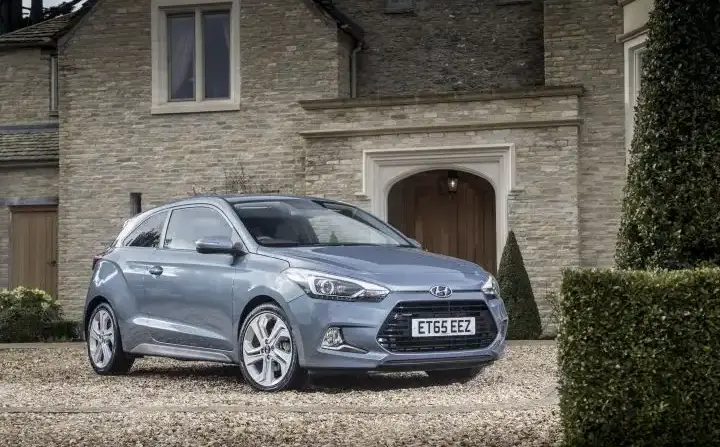
The Hyundai i20 II Coupe 1.2 (84 hp) was a subcompact, three-door hatchback produced by the South Korean manufacturer Hyundai between 2015 and 2018. Positioned as an entry-level offering within the broader i20 II generation (codenamed PB), this variant aimed to provide affordable and economical transportation, particularly appealing to younger drivers or those seeking a city car. It represented Hyundai’s continued effort to establish a stronger foothold in the European small car market, offering a more stylish alternative to traditional five-door hatchbacks. The i20 II Coupe, including the 1.2L engine, was primarily sold in Europe and other markets where demand for smaller, more fuel-efficient vehicles was high.
Technical Specifications
| Brand | Hyundai |
| Model | i20 |
| Generation | i20 II Coupe |
| Type (Engine) | 1.2 (84 Hp) |
| Start of production | 2015 |
| End of production | 2018 |
| Powertrain Architecture | Internal Combustion engine |
| Body type | Coupe |
| Seats | 5 |
| Doors | 3 |
| Fuel Type | Petrol (Gasoline) |
| Acceleration 0 – 100 km/h | 12.8 sec |
| Acceleration 0 – 62 mph | 12.8 sec |
| Acceleration 0 – 60 mph | 12.2 sec |
| Maximum speed | 170 km/h (105.63 mph) |
| Emission standard | Euro 6 |
| Power | 84 Hp @ 6000 rpm |
| Power per litre | 67.3 Hp/l |
| Torque | 122 Nm @ 4000 rpm (89.98 lb.-ft. @ 4000 rpm) |
| Engine layout | Front, Transverse |
| Engine Model/Code | G4LA |
| Engine displacement | 1248 cm3 (76.16 cu. in.) |
| Number of cylinders | 4 |
| Engine configuration | Inline |
| Cylinder Bore | 71 mm (2.8 in.) |
| Piston Stroke | 78.8 mm (3.1 in.) |
| Compression ratio | 10.5:1 |
| Number of valves per cylinder | 4 |
| Fuel injection system | Multi-port manifold injection |
| Engine aspiration | Naturally aspirated engine |
| Valvetrain | DOHC |
| Engine oil capacity | 3.5 l (3.7 US qt | 3.08 UK qt) |
| Coolant | 4.3 l (4.54 US qt | 3.78 UK qt) |
| Trunk (boot) space – minimum | 336 l (11.87 cu. ft.) |
| Trunk (boot) space – maximum | 1011 l (35.7 cu. ft.) |
| Fuel tank capacity | 50 l (13.21 US gal | 11 UK gal) |
| Length | 4045 mm (159.25 in.) |
| Width | 1730 mm (68.11 in.) |
| Height | 1449 mm (57.05 in.) |
| Wheelbase | 2570 mm (101.18 in.) |
| Front track | 1514-1520 mm (59.61 – 59.84 in.) |
| Rear (Back) track | 1513-1519 mm (59.57 – 59.8 in.) |
| Front overhang | 815 mm (32.09 in.) |
| Rear overhang | 660 mm (25.98 in.) |
| Ride height (ground clearance) | 140 mm (5.51 in.) |
| Minimum turning circle | 10.2 m (33.46 ft.) |
| Drivetrain Architecture | The Internal combustion engine (ICE) drives the front wheels of the vehicle. |
| Drive wheel | Front wheel drive |
| Number of gears and type of gearbox | 5 gears, manual transmission |
| Front suspension | Independent type McPherson |
| Rear suspension | Semi-independent, coil spring |
| Front brakes | Ventilated discs |
| Rear brakes | Disc |
| Assisting systems | ABS (Anti-lock braking system) |
| Steering type | Steering rack and pinion |
| Power steering | Electric Steering |
| Tires size | 185/65 R15; 195/55 R16; 205/45 R17 |
| Wheel rims size | 6.0J x 15; 6.0J x 16; 6.5J x 17 |
Powertrain & Engine Architecture
The i20 II Coupe 1.2 utilized Hyundai’s G4LA engine, a 1.248-liter inline-four cylinder gasoline engine. This engine was part of Hyundai’s Kappa engine family, known for its relatively lightweight construction and focus on fuel efficiency. The G4LA featured a double overhead camshaft (DOHC) valvetrain with four valves per cylinder, and employed multi-point fuel injection. The engine produced 84 horsepower at 6000 rpm and 122 Nm (89.98 lb-ft) of torque at 4000 rpm. This engine was paired with a five-speed manual transmission as standard. The engine’s design prioritized fuel economy and smooth operation over outright performance. It was a common choice in Europe for its compliance with emissions regulations and low running costs.
Driving Characteristics
The 1.2-liter engine, coupled with the five-speed manual transmission, provided adequate, though not exhilarating, performance. Acceleration from 0 to 60 mph took approximately 12.2 seconds, and the top speed was around 105.63 mph. The gear ratios were tuned for fuel efficiency, meaning the engine needed to be revved to access its power band. Compared to other i20 II Coupe variants, such as the 1.4-liter engine, the 1.2L felt noticeably less powerful, particularly when fully loaded or tackling inclines. However, its lighter weight and responsive steering made it enjoyable to drive in urban environments. The suspension provided a comfortable ride, absorbing bumps and imperfections in the road reasonably well.
Equipment & Trim Levels
The i20 II Coupe 1.2 typically came with a base level of equipment, reflecting its position as the entry point to the i20 Coupe range. Standard features generally included air conditioning, power steering, electric front windows, a basic audio system with USB connectivity, and ABS brakes. Higher trim levels, often denoted by ‘SE’ or ‘Sport’ designations, added features such as alloy wheels, a more advanced audio system, rear electric windows, and fog lights. Interior upholstery was typically cloth, with a functional and durable design. Optional extras included a panoramic sunroof, parking sensors, and a navigation system.
Chassis & Braking
The i20 II Coupe utilized a front-wheel-drive layout with an independent McPherson strut suspension at the front and a semi-independent coil spring suspension at the rear. The front brakes were ventilated discs, providing adequate stopping power, while the rear brakes were solid discs. The steering was an electric power-assisted rack and pinion system, offering light and precise control. The chassis was designed to balance ride comfort with handling stability. Stabilizer bars were included to reduce body roll during cornering, though the overall handling characteristics were geared towards everyday usability rather than sporty performance.
Market Reception & Comparison
The Hyundai i20 II Coupe 1.2 was generally well-received by automotive critics as an affordable and practical city car. It was praised for its fuel efficiency, comfortable ride, and relatively spacious interior for its size. However, the 1.2-liter engine was often criticized for its lack of power, particularly when compared to competitors offering larger engines. Compared to the 1.4-liter i20 Coupe, the 1.2L offered significantly lower running costs but sacrificed performance. Against rivals like the Ford Fiesta and Volkswagen Polo, the i20 Coupe 1.2 offered a competitive price point and a generous warranty, but often lacked the brand prestige and driving refinement of its European counterparts.
Legacy
The Hyundai i20 II Coupe 1.2 has proven to be a relatively reliable vehicle in the used car market. The G4LA engine is known for its durability, and routine maintenance is generally inexpensive. While not a performance standout, the 1.2L engine’s simplicity contributes to its long-term reliability. Today, these vehicles are often sought after as affordable and economical transportation, particularly by first-time car buyers or those seeking a dependable city runabout. Parts availability remains good, and the i20 II Coupe continues to represent a value-for-money option in the used car segment.