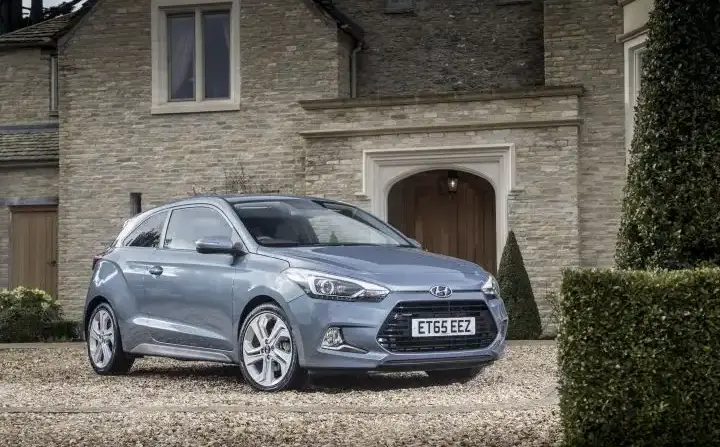
The Hyundai i20 II Coupe 1.4 (100 hp) Automatic, produced between 2015 and 2018, represented an entry-level offering within the second generation (IB/GB) i20 range. Positioned as a stylish and affordable compact coupe, it aimed to attract buyers seeking a practical yet visually distinct hatchback. This variant utilized Hyundai’s Kappa 1.4-liter gasoline engine paired with a four-speed automatic transmission, catering to drivers prioritizing ease of use over outright performance. The i20 II Coupe, with its three-door configuration, distinguished itself from the five-door hatchback model, targeting a slightly younger demographic. It was primarily sold in European and Asian markets, where smaller, fuel-efficient vehicles are highly valued.
Technical Specifications
| Brand | Hyundai |
| Model | i20 |
| Generation | i20 II Coupe |
| Type (Engine) | 1.4 (100 Hp) Automatic |
| Start of production | 2015 |
| End of production | 2018 |
| Powertrain Architecture | Internal Combustion engine |
| Body type | Coupe |
| Seats | 5 |
| Doors | 3 |
| Fuel Type | Petrol (Gasoline) |
| Acceleration 0 – 100 km/h | 13.2 sec |
| Acceleration 0 – 62 mph | 13.2 sec |
| Acceleration 0 – 60 mph | 12.5 sec |
| Maximum speed | 170 km/h (105.63 mph) |
| Emission standard | Euro 6 |
| Power | 100 Hp @ 6000 rpm |
| Power per litre | 73.1 Hp/l |
| Torque | 134 Nm @ 3500 rpm (98.83 lb.-ft. @ 3500 rpm) |
| Engine layout | Front, Transverse |
| Engine Model/Code | Kappa / G4LC |
| Engine displacement | 1368 cm3 (83.48 cu. in.) |
| Number of cylinders | 4 |
| Engine configuration | Inline |
| Cylinder Bore | 72 mm (2.83 in.) |
| Piston Stroke | 84 mm (3.31 in.) |
| Compression ratio | 10.5:1 |
| Number of valves per cylinder | 4 |
| Fuel injection system | Multi-port manifold injection |
| Engine aspiration | Naturally aspirated engine |
| Valvetrain | DOHC |
| Engine oil capacity | 3.5 l (3.7 US qt | 3.08 UK qt) |
| Coolant | 4.3 l (4.54 US qt | 3.78 UK qt) |
| Trunk (boot) space – minimum | 336 l (11.87 cu. ft.) |
| Trunk (boot) space – maximum | 1011 l (35.7 cu. ft.) |
| Fuel tank capacity | 50 l (13.21 US gal | 11 UK gal) |
| Length | 4045 mm (159.25 in.) |
| Width | 1730 mm (68.11 in.) |
| Height | 1449 mm (57.05 in.) |
| Wheelbase | 2570 mm (101.18 in.) |
| Front track | 1514-1520 mm (59.61 – 59.84 in.) |
| Rear (Back) track | 1513-1519 mm (59.57 – 59.8 in.) |
| Front overhang | 815 mm (32.09 in.) |
| Rear overhang | 660 mm (25.98 in.) |
| Ride height (ground clearance) | 140 mm (5.51 in.) |
| Minimum turning circle | 10.2 m (33.46 ft.) |
| Drivetrain Architecture | The Internal combustion engine (ICE) drives the front wheels of the vehicle. |
| Drive wheel | Front wheel drive |
| Number of gears and type of gearbox | 4 gears, automatic transmission |
| Front suspension | Independent type McPherson |
| Rear suspension | Semi-independent, coil spring |
| Front brakes | Ventilated discs |
| Rear brakes | Disc |
| Assisting systems | ABS (Anti-lock braking system) |
| Steering type | Steering rack and pinion |
| Power steering | Electric Steering |
| Tires size | 185/65 R15; 195/55 R16; 205/45 R17 |
| Wheel rims size | 6.0J x 15; 6.0J x 16; 6.5J x 17 |
Powertrain & Engine Architecture
The heart of the i20 II Coupe 1.4 Automatic is Hyundai’s Kappa G4LC engine. This 1.4-liter, inline-four cylinder engine utilizes a naturally aspirated configuration and a multi-point fuel injection system. The Kappa engine family was designed for efficiency and refinement, featuring a double overhead camshaft (DOHC) valvetrain with four valves per cylinder. This configuration contributes to reasonable power output and improved breathing compared to older engine designs. The engine’s 100 horsepower peak is achieved at 6000 rpm, while its 134 Nm (98.83 lb-ft) of torque is delivered at 3500 rpm. Paired with this engine is a conventional four-speed automatic transmission. While offering convenience, this transmission lacks the efficiency and responsiveness of more modern six or seven-speed automatics or continuously variable transmissions (CVTs).
Driving Characteristics
The 1.4-liter engine and four-speed automatic combination in the i20 II Coupe delivers adequate, but not particularly exciting, performance. Acceleration from 0 to 60 mph takes approximately 12.5 seconds, and the top speed is around 105.63 mph. The automatic transmission’s gear ratios are tuned for fuel economy rather than spirited driving. Compared to the manual transmission version of the same engine, the automatic suffers a slight performance penalty due to transmission losses. Higher-output versions of the i20, such as those equipped with a 1.6-liter engine, offered significantly more responsive acceleration. The automatic transmission provides smooth shifts under normal driving conditions, but can feel hesitant during quick acceleration or when attempting to overtake. The overall driving experience is best described as comfortable and predictable, making it well-suited for urban commuting and relaxed highway cruising.
Equipment & Trim Levels
The i20 II Coupe 1.4 Automatic typically came equipped with a reasonable level of standard features. These generally included air conditioning, power windows, central locking, and a basic audio system with USB connectivity. Safety features such as ABS (Anti-lock Braking System) and airbags were also standard. Higher trim levels offered optional extras such as alloy wheels, a more advanced audio system with Bluetooth connectivity, a sunroof, and parking sensors. Interior upholstery was typically cloth, with a relatively simple dashboard layout. The overall interior design prioritized functionality and durability over luxury.
Chassis & Braking
The i20 II Coupe utilizes a front-wheel-drive layout with an independent McPherson strut suspension at the front and a semi-independent coil spring suspension at the rear. This suspension setup provides a comfortable ride quality, absorbing bumps and imperfections in the road surface effectively. The front brakes are ventilated discs, offering good stopping power, while the rear brakes are solid discs. The steering is rack and pinion with electric power assistance, providing light and precise steering feel. The relatively lightweight nature of the vehicle contributes to its nimble handling characteristics.
Market Reception & Comparison
The Hyundai i20 II Coupe 1.4 Automatic received generally positive reviews for its affordability, practicality, and fuel efficiency. Critics noted that the four-speed automatic transmission felt dated compared to newer transmissions available in competing vehicles. Compared to other trims in the i20 lineup, the 1.4 Automatic offered a balance between price and features. The 1.6-liter engine provided more performance, but at a higher cost. The diesel variants (typically 1.1 CRDi or 1.4 CRDi) offered superior fuel economy, but with a different driving experience. The i20 II Coupe competed with other small coupes and hatchbacks, such as the Volkswagen Polo, Ford Fiesta, and Opel Corsa.
Legacy
The Kappa 1.4-liter engine and four-speed automatic transmission pairing in the i20 II Coupe has proven to be reasonably reliable in the long term. While not known for exceptional performance, the powertrain is generally durable and relatively inexpensive to maintain. In the used car market, these models represent an affordable entry point into Hyundai ownership. Common issues are typically related to wear and tear on suspension components and routine maintenance items. The i20 II Coupe’s enduring appeal lies in its combination of practicality, affordability, and Hyundai’s improving reputation for build quality and reliability.