Technical Specifications
| Brand | Hyundai |
| Model | i20 |
| Generation | i20 II Coupe |
| Type (Engine) | 1.4 CRDi (90 Hp) |
| Start of production | 2015 |
| End of production | 2018 |
| Powertrain Architecture | Internal Combustion engine |
| Body type | Coupe |
| Seats | 5 |
| Doors | 3 |
| Fuel Type | Diesel |
| Acceleration 0 – 100 km/h | 12.1 sec |
| Acceleration 0 – 62 mph | 12.1 sec |
| Acceleration 0 – 60 mph | 11.5 sec |
| Maximum speed | 175 km/h (108.74 mph) |
| Emission standard | Euro 6 |
| Power | 90 Hp @ 4000 rpm |
| Power per litre | 64.5 Hp/l |
| Torque | 240 Nm @ 1500-2500 rpm (177.01 lb.-ft. @ 1500-2500 rpm) |
| Engine layout | Front, Transverse |
| Engine Model/Code | D4FC |
| Engine displacement | 1396 cm3 (85.19 cu. in.) |
| Number of cylinders | 4 |
| Engine configuration | Inline |
| Cylinder Bore | 75 mm (2.95 in.) |
| Piston Stroke | 79 mm (3.11 in.) |
| Compression ratio | 16:1 |
| Number of valves per cylinder | 4 |
| Fuel injection system | Diesel Commonrail |
| Engine aspiration | Turbocharger, Intercooler |
| Engine oil capacity | 5.3 l (5.6 US qt | 4.66 UK qt) |
| Coolant | 6.4 l (6.76 US qt | 5.63 UK qt) |
| Trunk (boot) space – minimum | 336 l (11.87 cu. ft.) |
| Trunk (boot) space – maximum | 1011 l (35.7 cu. ft.) |
| Fuel tank capacity | 50 l (13.21 US gal | 11 UK gal) |
| Length | 4045 mm (159.25 in.) |
| Width | 1730 mm (68.11 in.) |
| Height | 1449 mm (57.05 in.) |
| Wheelbase | 2570 mm (101.18 in.) |
| Front track | 1514-1520 mm (59.61 – 59.84 in.) |
| Rear (Back) track | 1513-1519 mm (59.57 – 59.8 in.) |
| Front overhang | 815 mm (32.09 in.) |
| Rear overhang | 660 mm (25.98 in.) |
| Ride height (ground clearance) | 140 mm (5.51 in.) |
| Minimum turning circle | 10.2 m (33.46 ft.) |
| Drivetrain Architecture | The Internal combustion engine (ICE) drives the front wheels of the vehicle. |
| Drive wheel | Front wheel drive |
| Number of gears and type of gearbox | 6 gears, manual transmission |
| Front suspension | Independent type McPherson |
| Rear suspension | Semi-independent, coil spring |
| Front brakes | Ventilated discs |
| Rear brakes | Disc |
| Assisting systems | ABS (Anti-lock braking system) |
| Steering type | Steering rack and pinion |
| Power steering | Electric Steering |
| Tires size | 185/65 R15; 195/55 R16; 205/45 R17 |
| Wheel rims size | 6.0J x 15; 6.0J x 16; 6.5J x 17 |
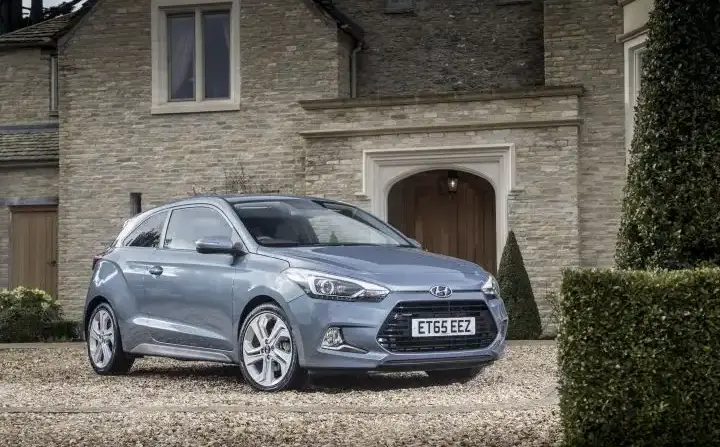
The Hyundai i20 II Coupe 1.4 CRDi (90 hp) was introduced as a more stylistically focused variant of the popular i20 II. Built on the PB platform, shared with the Kia Rio, the Coupe offered a three-door body style intended to appeal to younger buyers. The 1.4 CRDi engine, producing 90 horsepower, was a key component of Hyundai’s strategy to offer a fuel-efficient and affordable option in the competitive subcompact segment. This particular engine and body style combination was available from 2015 through 2018, representing a mid-cycle refresh within the i20 II’s production run.
Powertrain & Engine Architecture
The heart of this i20 Coupe is the Hyundai D4FC 1.4-liter common rail direct injection (CRDi) diesel engine. This engine is a four-cylinder, inline configuration, displacing 1396 cc. It utilizes a turbocharger with an intercooler to boost power and efficiency. The D4FC engine is known for its relatively simple design and robust construction. Fuel is delivered via a Bosch common rail system, operating at high pressure for optimized combustion. The engine features four valves per cylinder (DOHC) and a compression ratio of 16:1. The 90 hp output is achieved at 4000 rpm, while peak torque of 240 Nm (177 lb-ft) is available between 1500-2500 rpm, providing good low-end grunt for everyday driving. The engine is paired with a six-speed manual transmission, chosen for its fuel efficiency and driver engagement. While an automatic transmission was available on other i20 II variants, it was not offered with the 1.4 CRDi 90 hp engine.
Driving Characteristics
The 1.4 CRDi 90 hp engine in the i20 Coupe delivers adequate, though not exhilarating, performance. Acceleration from 0-60 mph takes approximately 11.5 seconds, and top speed is around 108.74 mph. The engine’s strength lies in its torque delivery, making it feel responsive in urban driving and capable on inclines. The six-speed manual transmission is well-matched to the engine, allowing drivers to keep the engine in its optimal torque band. Compared to higher-output i20 variants, such as those with more powerful gasoline engines, the 1.4 CRDi feels less eager to rev. However, it compensates with significantly better fuel economy. The gear ratios are tuned for efficiency, prioritizing fuel savings over outright acceleration. The steering is light and precise, making it easy to maneuver in tight spaces, but lacks the feedback desired by more enthusiastic drivers.
Equipment & Trim Levels
The i20 II Coupe 1.4 CRDi (90 hp) typically came equipped with a reasonable level of standard features. Base models included air conditioning, power steering, electric front windows, a basic audio system with USB connectivity, and ABS brakes. Higher trim levels, such as SE or Sport, added features like alloy wheels, fog lights, a more advanced audio system, Bluetooth connectivity, and cruise control. Interior upholstery was typically cloth, with a dark color scheme. Optional extras included a panoramic sunroof, parking sensors, and a navigation system. The dashboard layout was functional and straightforward, with a focus on ease of use. The three-door configuration meant slightly less rear passenger access compared to the five-door i20.
Chassis & Braking
The i20 II Coupe utilizes a McPherson strut front suspension and a semi-independent coil spring rear suspension. This setup provides a comfortable ride quality, absorbing bumps and imperfections in the road effectively. The front brakes are ventilated discs, offering good stopping power, while the rear brakes are solid discs. ABS (Anti-lock Braking System) is standard, enhancing safety during emergency braking situations. The steering is rack and pinion with electric power assistance, providing light and precise control. Stabilizer bars are fitted to both the front and rear axles to reduce body roll during cornering. Tire sizes varied depending on the trim level, ranging from 185/65 R15 to 205/45 R17.
Market Reception & Comparison
The Hyundai i20 II Coupe 1.4 CRDi (90 hp) was generally well-received by automotive critics as a practical and economical choice. It was praised for its fuel efficiency, comfortable ride, and reasonable price point. However, some reviewers noted that the engine lacked outright power and that the interior materials were somewhat basic. Compared to other trims in the i20 lineup, the 1.4 CRDi offered the best fuel economy but the slowest acceleration. It competed with other subcompact hatchbacks such as the Ford Fiesta, Volkswagen Polo, and Renault Clio. The i20 Coupe often undercut its rivals in price, making it an attractive option for budget-conscious buyers.
Legacy
The Hyundai i20 II Coupe 1.4 CRDi (90 hp) has proven to be a relatively reliable vehicle in the used car market. The D4FC engine is known for its durability, and routine maintenance is generally affordable. Common issues are relatively minor, often related to wear and tear on components such as the clutch and suspension. The availability of spare parts is good, and the car’s simple design makes it relatively easy to repair. Today, these i20 Coupes represent a good value proposition for buyers seeking an economical and practical city car. While not a performance icon, it remains a testament to Hyundai’s growing reputation for building reliable and affordable vehicles.